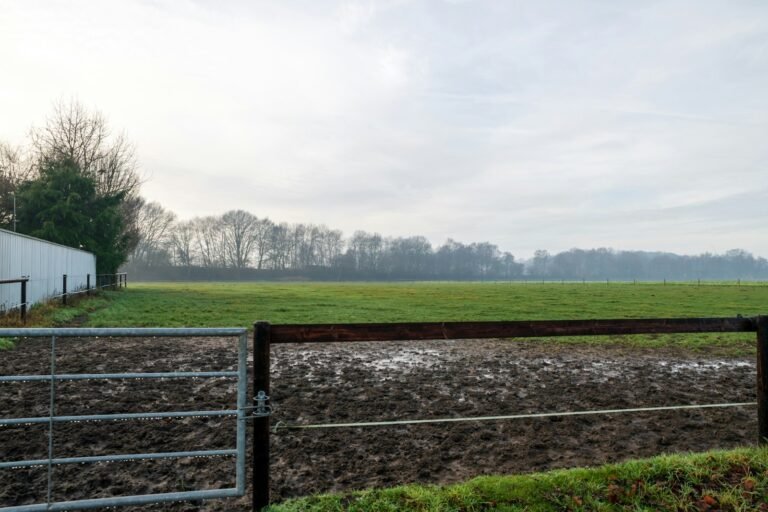
Potholes, ruts and a green strip down the middle are symptoms. Nearly every failing farm track has the same underlying problem: water sitting on or running down it. Good farm track repair deals with drainage first, then reshapes and re-firms the surface, ideally reusing the stone already in the track. This guide sets out a method that suits Devon, Cornwall and Somerset farms, and the kit to hire for each step.

In this guide
Why farm tracks fail
A track is a layer of stone holding up vehicles over softer ground. When water gets into that layer, the stone and subsoil mix, the surface softens, and every wheel pushes it further out of shape. Typical causes on South West farms:
- No crossfall or crown, so rain sits in the wheel ruts.
- Blocked or missing side ditches, so water runs down the track instead of beside it.
- No cross drains on slopes, so a steep track becomes a stream in a storm.
- Heavy machinery on a track built for a pickup.
- Soft subsoil: the Culm clays of mid and north Devon lose strength badly when wet, while granite and shillet areas tend to hold up better.
Step 1: survey and plan the drainage
Walk the track in heavy rain if you can; it is the quickest way to see where water comes from and where it goes. Mark the low spots, the places water crosses, and where it could be let out into a ditch or field safely. Then plan:
- Side ditches cleaned or recut on the uphill side.
- Cross drains (grips, rubber or timber water bars, or piped culverts) angled across the track on slopes to shed water at intervals.
- Outfalls that release water where it will not erode a bank or carry silt straight into a stream.
If outfalls go near a watercourse, check with the Environment Agency first. On Dartmoor or Exmoor, or anywhere designated as a SSSI, speak to the national park authority or Natural England before starting work.
Step 2: ditching and reshaping with an excavator
An excavator does most of the heavy work: recutting ditches, digging culvert crossings, pulling the edges of the track back in, and reshaping the surface to a crossfall or crown of a few per cent so water runs off. For a typical farm track, the Sunward SWE 60UF has the reach and bucket capacity for ditching without being too wide for gateways. For long, heavy runs or larger culverts, the SWE 90UF is our biggest. Both are on the construction equipment page.
To move an excavator between fields or farms, the Bailey 10-ton low loader trailer has a 6m by 2.5m deck and pairs with the John Deere 6155R tractor. Ask us to confirm the right combination for the machine you choose.
Step 3: crush the stone in place
Many old tracks have plenty of stone in them, just in the wrong shape: large lumps, rutted edges and loose rock. A tractor-mounted stone crusher turns it into a graded, compactable surface without importing material.
The Valentini 2.3 Leon stone crusher is PTO-driven with a 2.3m working width, so it covers a typical farm track in a pass or two. The Nardi FAST 3m ripper can help loosen a compacted or overgrown surface so buried stone comes up to the crusher; ask us whether it suits your track and ground. Both run behind a suitable tractor, and the John Deere 6155R (155HP, 4WD) is available from our agriculture fleet. Tell us the length, width and stone type and we will match the set-up.
Where the track lacks enough stone, you will need to bring some in. Quarry stone is the simple route. If you plan to use demolition rubble or crushed concrete, waste rules may apply; the Environment Agency’s U1 waste exemption guidance sets out what can be used, in what quantities and whether you need to register. Our Dragon 400 and 450 tracked jaw crushers handle concrete, brick and aggregate if you have a stockpile to recycle, but check the current guidance on what the exemption allows before you start.
Imported stone needs moving from the delivery point to the track. A Venieri 1.63D telescopic pivot loader (1,850kg tip load) loads trailers from a stockpile in the yard, while a tracked dumper spreads material along narrow sections where a tractor and trailer cannot turn. Spread in even layers rather than tipping heaps and dragging them, which separates the fines from the larger stone.
Step 4: compact and finish
Crushed stone only becomes a track once it is compacted with the right moisture. Shape it to the crossfall, then compact. For narrow tracks, yard edges and gateways, the Weber MT CR 7 reversible plate is designed for large area compaction. For long runs, a ride-on roller is quicker; it is not in our listed fleet, so ask us and we will tell you what is available. Traffic will finish the job over the following weeks, but keep heavy loads off until the surface has settled.
Leave a slightly raised edge on the downhill side only where you want to direct water to a cross drain. A berm along the whole length traps water on the track, which is the problem you are fixing.
Farm track repair kit by problem
| Problem | Fix | Kit to hire |
|---|---|---|
| Water running down the track | Cross drains, recut ditches | Sunward SWE 60UF or SWE 90UF |
| Potholes and loose rock | Rip, crush and reshape | Valentini 2.3 Leon, Nardi FAST ripper, John Deere 6155R |
| Not enough stone | Import or recycle material | Dragon 400 or 450 crusher, dumpers |
| Soft gateways | Dig out, stone up, compact | Excavator, Weber MT CR 7 plate |
| Moving machines between sites | Low loader | Bailey 10-ton low loader |
When to do farm track repair work
Late spring to early autumn usually gives the driest ground in the South West. Crushing and compaction work best when the stone is damp but the subsoil is firm. Avoid starting just before silage or harvest when the track will take its heaviest traffic, and book machines early for summer, which is the busiest time for farm groundworks.
Do you need permission for farm track repair?
Repairing and resurfacing an existing track on its current line is generally treated as maintenance. Building a new track, or significantly altering an existing one, is different. On agricultural units of 5 hectares or more, the formation or alteration of a private way can be permitted development, but you must first apply to the local planning authority for a determination as to whether prior approval is needed for its siting and means of construction.
Work cannot start until the authority confirms, gives approval, or 28 days pass without a decision. The rules are in Part 6 of the General Permitted Development Order; check with your planning authority if you are unsure which side of the line your project falls.
Other consents can apply regardless of planning. Work in or next to a watercourse, including new culverts, can need consent from the lead local flood authority or the Environment Agency. Tracks within or next to a SSSI, scheduled monument or national park need extra care, and importing waste materials brings in the exemption rules covered below. None of this is legal advice, so check the current guidance before you start.
Track design basics
Whether you are repairing or rebuilding, the same few features keep a track dry and firm. Use them as a checklist when you walk the line.
| Feature | What it does | Practical notes |
|---|---|---|
| Crossfall or camber | Sheds rain off the surface | A few per cent is usually enough; one-way crossfall towards the ditch side suits hillside tracks |
| Side ditch | Carries water beside the track, not down it | On the uphill side of hillside tracks; keep it lower than the base of the stone |
| Cross drains | Take water off the track at intervals | Angled across the track; place them closer together on steeper sections |
| Culverts | Carry ditch water under the track | Size generously, and protect inlets and outlets from erosion |
| Width | Lets traffic stay on the stone | Allow for your widest machine plus a margin; add passing places on long tracks |
| Firm edges | Stop wheels pushing stone outwards | Pull edges back in when reshaping; avoid a continuous berm that traps water |
Estimating stone and machine time
Before booking farm track repair kit, work out roughly how much material you are dealing with. As an illustration, topping up a 400m track that is 3.5m wide with 150mm of compacted stone is 400 × 3.5 × 0.15 = 210m³. At around 2 tonnes per cubic metre compacted, that is in the region of 400 tonnes, or dozens of lorry loads. If the same track has enough stone in it to rip and crush in place, you might import only a fraction of that.
That difference is why a test dig matters. Dig a few holes across the track with the excavator or a spade, and see how deep the stone goes and what it is like. Good stone mixed with mud can often be ripped, crushed and reshaped. A track that is mostly soil with a skin of gravel needs new material, and probably a geotextile underneath on soft ground.
Machine time depends on length, drainage work and how stony the ground is, but a rough planning order is: excavator for ditches and culverts first, crusher and tractor next, compaction last. Booking them in that sequence, rather than all at once, avoids machines standing idle.
A worked example: the track to a livestock building
An illustrative job on a beef farm in mid Devon: a 350m track from the road to a cattle shed has deep ruts, a soft patch at the bottom where a spring crosses, and water running its length every winter. The ground is Culm clay. These details are typical, not a real customer project.
- Week 1, days 1 to 3: Sunward SWE 60UF recuts the uphill ditch, installs two cross drains on the steepest section and a culvert at the spring. Soft material at the bottom is dug out and replaced with stone over a geotextile.
- Week 1, days 4 and 5: Nardi FAST ripper behind the John Deere 6155R loosens the compacted top of the track along its length.
- Week 2, days 1 and 2: Valentini 2.3 Leon crushes the loosened stone in two passes. The excavator pulls the edges back in and shapes a crossfall towards the ditch.
- Week 2, day 3: compaction while the stone is damp, with the Weber MT CR 7 plate in the gateway and yard edge.
- Afterwards: light traffic only for a couple of weeks while the surface settles, then check cross drains after the first heavy rain.
Two weeks of machines replaces what would otherwise be a large import of stone, and fixes the cause rather than filling potholes again next spring.
Maintaining a repaired track
A rebuilt track still needs attention to stay good. A little each year is far cheaper than another full repair.
- Clear cross drains and culvert inlets every autumn, and after big storms.
- Cut back vegetation along ditch edges so water can flow.
- Fill potholes early with matching stone, rather than letting them grow.
- Grade the surface when ruts start to form, keeping the crossfall.
- Keep the heaviest traffic, such as loaded silage trailers, to drier spells where you can.
What affects the cost of farm track repair
We quote each job individually and do not publish hire prices. The main factors are the size of excavator, whether you need a tractor as well as the crusher and ripper, the number of days, delivery distance from our depot near Okehampton, and how much stone you import. Smaller kit such as dumpers can be moved between sites on a plant trailer from our trailer range.
Estates and contractors with tracks to repair across several sites may find Flex Hire simpler: one flat monthly fee, with the option to swap machines as the job moves from ditching to crushing. Insurance is not included automatically, so arrange cover before the hire starts. We can usually plan delivery so a tractor and its implements arrive together; tell us your farm postcode, lane width and where the track starts.
Safety checklist for track work
- Check for buried services, water pipes to troughs and land drains before ditching or ripping, and look up for overhead lines, which often cross farm tracks.
- Keep people well away from a working stone crusher. Stones can be thrown from the rotor housing, so check guards and flaps before starting and never stand behind or beside it while it runs.
- Only attach or detach PTO implements with the tractor engine off and the key removed, and make sure PTO shaft guards are in place.
- Keep excavators back from the edge of deep ditches, which can collapse when wet.
- Close the track or use a banksman where machines work near livestock, walkers on a right of way, or deliveries coming and going.
- Clean mud off the public road at the track entrance before the end of each day.
When a geotextile helps
On soft clay or peaty ground, a geotextile separation layer under new stone stops it being pushed down into the subsoil and mixing with mud, which is how many tracks fail. On firm shillet or granite it is often unnecessary. If you are digging out a soft section anyway, it is worth considering.
Choosing a dry window
On clay farms in mid and north Devon, the gap between ground too wet to work and ground baked hard can be short. Watch the forecast, and have the drainage stage done first so that if rain arrives mid-job the track at least sheds water while you wait. Crushing works best with stone that is damp but not saturated, and compaction needs a little moisture to bind the fines.
Frequently asked questions
Can I crush the stone already in my farm track?
Often, yes. A PTO stone crusher such as the Valentini 2.3 Leon breaks up existing stone into a usable surface, provided there is enough stone in the track to work with.
What tractor do I need for a stone crusher?
It needs enough horsepower and the right PTO set-up for the crusher. Our John Deere 6155R is available, or tell us your tractor and we will check compatibility.
How long does a farm track repair take?
That depends on length, drainage work and stone. Tell us the details and we will suggest a hire period; weekly hire suits most jobs.
Can I use crushed concrete on a farm track?
Possibly, but it may count as waste. Check the Environment Agency’s exemption rules first.
Do I need planning permission to repair a farm track?
Repairing an existing track on its current line is generally maintenance. Forming a new track or altering one on a farm of 5 hectares or more usually means applying to the planning authority first to see whether prior approval is needed.
How wide should a farm track be?
Wide enough for your widest regular vehicle to stay on the stone, with a margin either side. Long single tracks benefit from passing places and wider sections at bends and gateways.
Will a ripper damage land drains?
It can if drains are shallow. Find out where existing drains and services run before ripping, and set the working depth to stay above them.
Get your track sorted
Send us the track length and width, what the surface is like now, your postcode and dates, and we will recommend the right farm track repair package and a current quote. WhatsApp or call 07841 036064, or use our contact page.