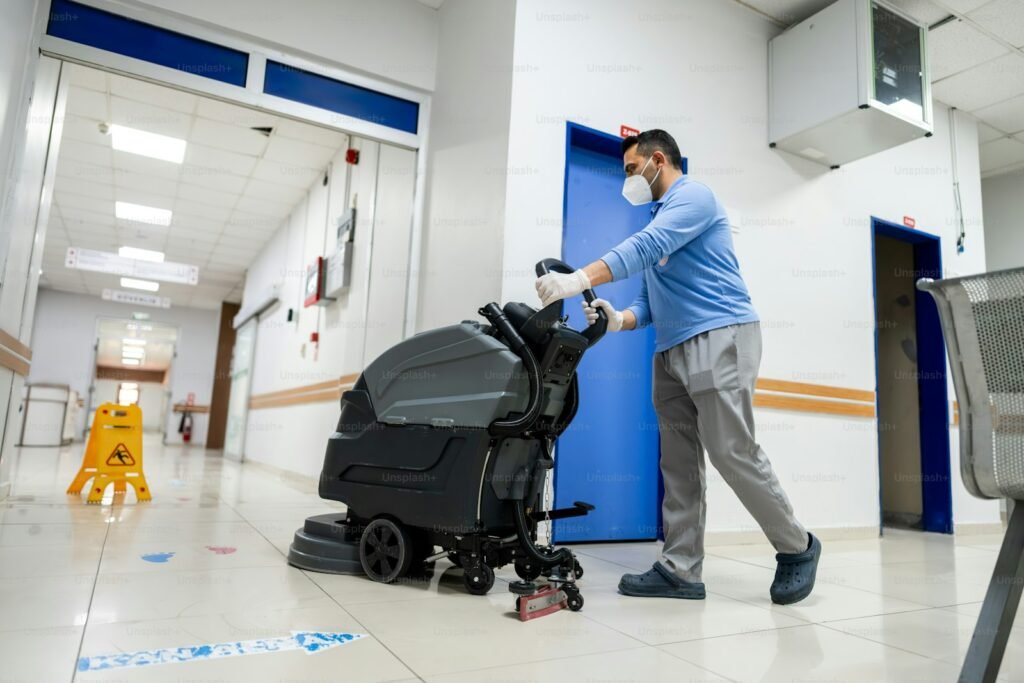
Floor scrubber hire is the fastest way to deep clean a large hard floor properly, because a scrubber washes, scrubs and dries in a single pass instead of leaving a wet floor behind a mop. We hire three Eureka machines from our Okehampton depot: the E50 ride-on scrubber for large open areas, the compact E36 walk-behind scrubber for medium spaces, and the Picobello 151 Ecovac push sweeper for dry sweeping aisles and tight spots. Pair them with a Big Brute industrial vacuum for dust and spills.

In this guide
Ride-on, walk-behind or sweeper?
Choose by the size and layout of the floor, then by the type of dirt. A ride-on covers open ground quickly but needs room to turn. A walk-behind gets into aisles and around fixtures. A sweeper lifts loose debris but does not wash.
| Machine | Type | Suits | Not for |
|---|---|---|---|
| Eureka E50 | Ride-on scrubber dryer with on-board water tank | Large warehouse floors, factory units, big retail sheds, car park decks under cover | Cramped rooms and narrow aisles |
| Eureka E36 | Compact walk-behind scrubber dryer | Shops, workshops, showrooms, school halls, medium warehouse areas | Very large open floors where you need speed |
| Eureka Picobello 151 Ecovac | Manual push sweeper, quiet, zero emissions | Dry sweeping aisles, loading areas, tight spaces before scrubbing | Wet cleaning or greasy floors |
| Big Brute industrial vacuum | Wet and dry vacuum | Fine dust, debris and spill recovery in workshops and warehouses | Scrubbing a whole floor |
All four are listed in our warehouse and cleaning range.
A rough area guide for floor scrubber hire
There is no exact cut-off, as layout matters as much as size. A 600 square metre floor full of racking can take longer than a 2,000 square metre empty unit. As a rule of thumb:
- Small areas, up to a few hundred square metres, or floors broken up by shelving, counters and fixtures: the E36 walk-behind.
- Large open floors running into thousands of square metres, such as distribution units and factory floors: the E50 ride-on, possibly with the E36 for edges and aisles.
- Any floor with loose grit, packaging or swarf: sweep first with the Picobello or vacuum with the Big Brute, then scrub.
Send us the approximate floor area, a description of the layout and photos if you can, and we will recommend the right mix of machines.
Which floors can you scrub?
Scrubber dryers are designed for hard, sealed floors. Typical suitable surfaces:
- Power-floated and sealed concrete in warehouses and workshops
- Epoxy and resin coated floors in factories, food units and garages
- Vinyl, safety flooring and sealed tiles in shops, schools and kitchens
- Smooth stone and ceramic tiles in showrooms and reception areas
Take care with unsealed timber, laminate and anything that should not get wet, and never use a scrubber on carpet. On new or specialist coatings, check with the installer which brushes, pads and chemicals are acceptable. If you are cleaning a freshly laid concrete or resin floor, make sure it has cured fully first.
Brushes, pads and getting the contact right
The part of the scrubber touching the floor matters as much as the machine. Scrubber dryers run either brushes or pads held on a pad driver, and the right choice depends on the floor:
- Brushes suit textured, anti-slip and grouted floors, because the bristles reach into the texture and grout lines. They are also common on rough or older concrete.
- Pads suit smooth floors such as sealed concrete, vinyl and polished stone. Pads come in different levels of aggressiveness. Lighter pads are used for routine cleaning and polishing, more aggressive ones for heavy soiling. Colour codes differ between manufacturers, so check what you have been supplied.
- Too aggressive a pad or brush can dull a polished floor or strip a coating. Too gentle, and you will be making extra passes for no improvement.
Tell us the floor type when you book your floor scrubber hire and we will confirm what comes fitted and what alternatives are available. If you are cleaning a specialist coating, ask the installer what they recommend before you start.
How to get a good result: step by step
- Clear the floor. Move pallets, bins and loose items, and pick up string, shrink wrap and banding that can wrap around brushes.
- Dry sweep or vacuum. Removing grit first stops the squeegee streaking and protects the brushes.
- Fill with clean water and the right detergent. Use a low-foam floor detergent at the manufacturer’s dilution. Too much chemical leaves a sticky film and can cause foaming in the recovery tank.
- Work in straight overlapping lanes, starting at the far end and working towards the exit, so you do not walk over clean floor.
- Do two passes on heavy soiling. First pass with the squeegee up to let the solution dwell, second pass to scrub and recover.
- Empty and rinse the recovery tank regularly and at the end of every session, and clean the squeegee blades and filters.
- Charge the batteries once you finish so the machine is ready for the next shift.
Batteries, charging and run time
The E50 and E36 are battery powered, so plan charging as carefully as the cleaning. Run time depends on the brush or pad pressure, how much water and detergent you are using and how much of the time the machine is moving. Heavy scrubbing on dirty concrete uses more power than a light maintenance clean on vinyl.
- Start every session with a fully charged battery.
- Charge in a ventilated area away from walkways, and keep the charger lead out of traffic routes.
- Charge after each session rather than waiting for the battery to run down.
- On big floors, clean the most important areas first in case the battery runs low before you finish.
If you need to clean a very large area in one go, tell us the size and timescale. We can talk through whether one machine will cope or whether a second machine, or a split over two sessions, makes more sense.
Dirty water and slip risk
The water in the recovery tank is contaminated with dirt, oil and detergent. Empty it into a foul drain, such as a toilet or a designated cleaners’ sink, not a yard gully or rainwater drain, which usually discharge straight to a stream. GOV.UK guidance on pollution prevention for businesses explains the difference between foul and surface water drains.
HSE’s guidance on preventing slips during cleaning makes the point that signs and cones only warn of a hazard: they do not stop people walking onto a wet floor. Use barriers, close off areas or clean in sections so there is always a dry route. Check the safety data sheet for any detergent you use and wear the gloves and eye protection it specifies.
Scrubber dryers leave floors almost dry, but edges, ramps and areas you have passed over with the squeegee raised will be wet. Put out wet floor signs, clean busy areas outside working hours where you can, and keep pedestrians and forklifts clear of the lane you are working in.
Cleaning after building work: a worked example
Post-construction cleans are one of the most common reasons for floor scrubber hire, and the hardest on the machine. Here is an illustrative plan for a newly fitted-out trade unit of about 800 square metres with a sealed concrete floor, ahead of handover to a tenant.
- Remove the big stuff. Offcuts, packaging, fixings and cable ties all come out first. A single screw caught under a squeegee blade can tear it.
- Scrape off splashes. Plaster, paint, mastic and adhesive spots need scraping with a floor scraper. A scrubber will not remove hardened lumps and they can damage pads.
- Vacuum the fine dust. Construction dust turns to a grey paste when wet. Pick up as much as possible first with the Big Brute industrial vacuum, paying attention to edges and corners.
- First scrub. With the E36 or E50, make a first pass with solution down and a slow speed to loosen what is left. Empty the recovery tank often, as it fills fast on a dusty floor.
- Second scrub and dry. Pass again with fresh solution and the squeegee down to recover everything.
- Finish the edges by hand with a mop or squeegee where the machine cannot reach, then let the floor dry before the tenant moves in.
Check that any new floor coatings have fully cured before scrubbing. If in doubt, ask the flooring contractor.
Floor scrubber hire for regular cleaning
A one-off deep clean makes a big difference, but floors stay that way only with regular maintenance. If you are thinking about scrubbing on a schedule, consider:
- Frequency: busy food, retail and production floors may need scrubbing daily or several times a week, while a quiet warehouse might need it weekly or monthly.
- Timing: clean when traffic is lowest, such as early morning or between shifts, so wet areas are not walked on.
- People: train a small number of staff properly rather than everyone a little, and give them time to do it.
- Routine care: empty and rinse tanks, clean squeegee blades and filters, and charge the machine after every use.
For an ongoing need, long-term rental provides a machine on a monthly rate with servicing included, so you are not paying to own and maintain a scrubber yourself.
Ramps, slopes and edges
Gentle slopes are usually manageable, but every machine has a gradient limit and a wet ramp is a slip risk, so tell us about ramps on the route or in the cleaning area when you book. Edges, corners and the strip under racking are where dirt collects in a routine programme. Plan a periodic hand clean or a pass with the walk-behind along those lines, otherwise a band of grime builds up that the ride-on never reaches. A simple sign-off sheet showing which areas were cleaned and when also helps keep a regular programme on track.
Common mistakes that spoil the finish
Most complaints about streaky or sticky floors after floor scrubber hire come down to a handful of avoidable habits:
- Skipping the sweep. Grit trapped under the squeegee blade leaves wet lines across the floor.
- Overdosing detergent. More chemical does not mean cleaner. It leaves residue that attracts dirt again within days.
- Driving too fast. The brushes need time in contact with the floor, and the squeegee needs time to pick up water.
- Letting the recovery tank fill. When it is full, the machine stops picking up water and you start spreading dirty solution around.
- Turning on the spot with the squeegee down, which can leave a puddle and wear the blades.
Plan delivery for when the space is quiet. For shops and showrooms that often means early morning or after closing, and for warehouses a gap between shifts.
Floor scrubber hire by type of premises
Every building brings its own dirt and its own constraints. A few notes from the kinds of sites we supply:
Workshops and vehicle garages
Oil, diesel and tyre rubber are the main problems. Soak up any fresh spills with absorbent first, use a degreasing detergent suitable for scrubber dryers, and allow time for it to work before the recovery pass. Recovery water from oily floors needs to go to a foul drain or an oil separator system, never a surface water gully.
Shops, showrooms and receptions
Appearance matters most here, so a smooth, streak-free finish is the aim. The walk-behind E36 manoeuvres around displays and counters, and cleaning before opening or after closing keeps wet floors away from customers.
Food and drink units
Grease and sugary residues build up quickly. Follow your food safety cleaning schedule for chemicals and frequency, and keep scrubber equipment for production areas separate from raw material or waste areas where your procedures require it.
Schools, halls and community buildings
Summer holidays are the usual window for a deep clean. Check the floor finish first, as sports hall floors and polished timber often need specialist methods and should not be flooded with water.
Farm shops and agricultural buildings
Farm shops, packing sheds and workshops on farms often have sealed concrete that suits a scrubber well. Rough, unsealed or broken yard concrete does not, and is better tackled with a pressure washer. Sweep up straw, grit and feed first, as all of it will block the squeegee and filters.
Delivery, handover and collection
When you book, tell us the site postcode, where the machine needs to be unloaded and anything about access: steps, kerbs, lifts and door widths. Ride-on scrubbers are much larger than walk-behind machines, so measure the route. Someone needs to sign for the machine on arrival, and we will run through filling, operation, emptying and charging. At the end of the hire, empty and rinse both tanks, clean the squeegee and leave the machine charged and ready for us to collect.
What affects the cost
We quote each hire individually. The main factors are the machine (a ride-on costs more to hire and transport than a walk-behind), the length of hire, the delivery distance from our depot near Okehampton and any timing requirements such as early-morning delivery. Weekly hire often works out better value than several separate days if you are cleaning a large or very dirty site. Insurance for hired equipment is not included, so check your cover or ask our partner insurance4plant.co.uk. WhatsApp us for a current quote.
One-off clean or regular cleaning?
Many hires are one-offs: a deep clean before a new tenant moves in, after building work, before an audit or ahead of an open day. For units that need regular scrubbing, our long-term rental gives you a machine on a monthly rate with on-site servicing included. Floor cleaning kit is also part of Tier 1 of our Flex Hire account, so you can switch between a scrubber, pallet truck and other everyday equipment on one monthly fee.
Frequently asked questions
Do I need training to use a ride-on scrubber?
Operators should be shown how to use it safely and understand the controls. We will run through the basics at handover. Anyone using work equipment needs adequate training for the task.
What chemicals should I use in a hired scrubber?
A low-foam detergent intended for scrubber dryers, at the recommended dilution. Ask us before using anything acidic, solvent-based or caustic.
Can a floor scrubber clean an outdoor yard?
These machines are designed for indoor hard floors. For rough external yards, our Brendon pressure washer is usually the better tool.
Will the scrubber remove tyre marks?
Light marks often lift with the right pad and detergent. Heavy rubber build-up may need repeated passes or specialist products.
How long will it take to scrub my floor?
It depends on the area, how dirty it is, how much is in the way and whether you need two passes. Clearing and sweeping often take as long as the scrubbing itself. Send us the floor area and photos and we will help you plan a realistic timetable.
Do you supply detergent with floor scrubber hire?
Ask us when you book. Whatever you use, it should be a low-foam product intended for scrubber dryers, used at the manufacturer’s dilution rate.
Can I hire a scrubber and a sweeper together?
Yes, subject to availability. Sweeping first with the Picobello 151 and then scrubbing with the E36 or E50 is often the quickest way to get a dirty floor back to a good standard, as the scrubber is left dealing only with what is stuck to the floor.
Hire a floor scrubber
WhatsApp or call 07841 036064 with your floor area, floor type, postcode and dates, and we will recommend the right machine. Written quotes and accounts are available through our contact form.