
Plant hire Exeter jobs range from a single mini digger in a back garden to a 9-tonne excavator, dumpers and a crusher on a commercial plot. We supply the full construction fleet from our depot near Okehampton, about 25 miles west along the A30, with same-day delivery often possible. This guide is for contractors, groundworkers and self-builders who want to match the right machines to the job, the ground and the site in and around the city.
In this guide
It covers what we hire, which machine suits which task, what Exeter‘s soils do to a dig, how to deal with access and parking in the city, and how to choose a hire period that keeps costs under control.
Plant hire Exeter: what the fleet covers
Most plant hire Exeter enquiries involve more than one machine. A digger needs something to take the spoil away, the sub-base needs compacting, and materials need lifting or moving. We hire all of that from one depot, so you can book the whole package with one message.
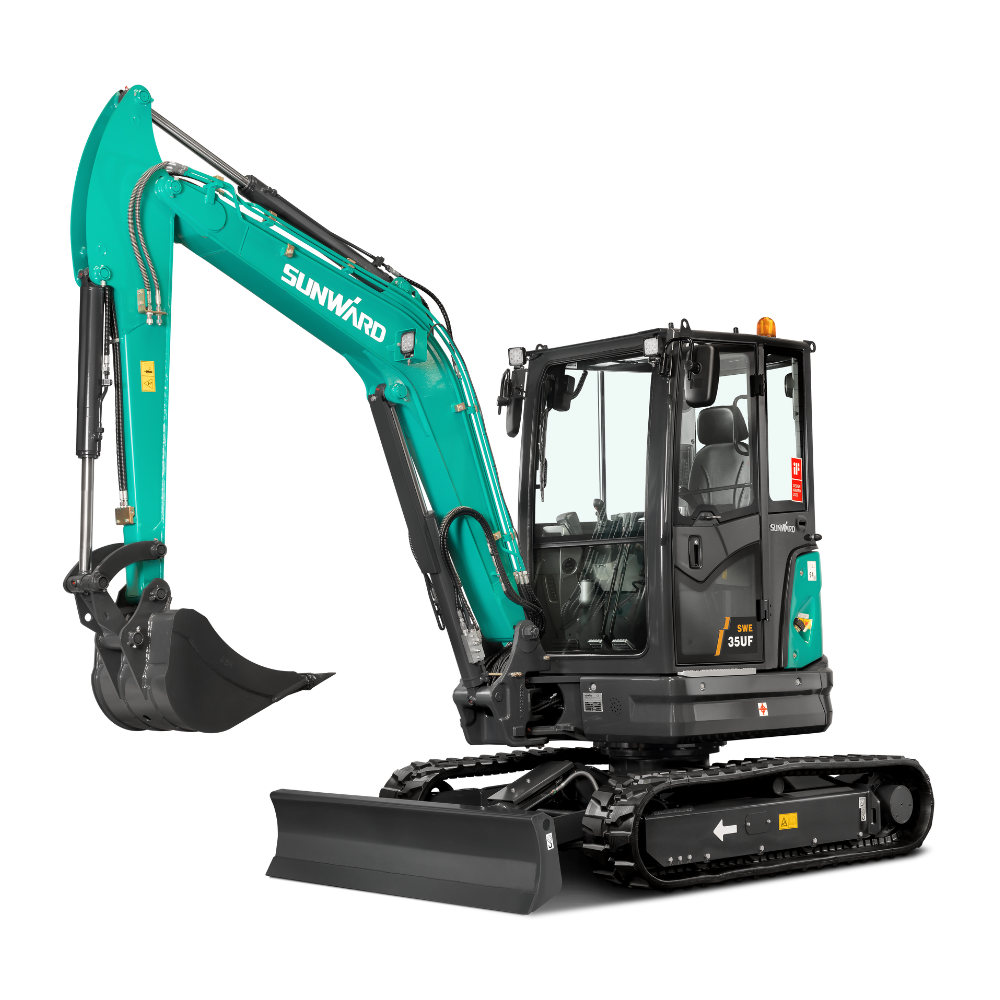
- Excavators: Sunward SWE 08B (0.8t), SWE 18UF (1.8t zero tail), SWE 20F (2.0t), SWE 25UF (2.5t zero tail), SWE 35UF (3.5t zero tail), SWE 60UF (6t zero tail) and SWE 90UF (9t).
- Loaders and handlers: Sunward SWL 2830 tracked skid-steer and the Merlo P40.14 telehandler (14m reach, 4t lift, stabilised).
- Dumpers and carriers: HG 1000 electric wheeled dumper (1,000kg), Hyundai 500kg tracked dumper, Mechbadger tracked dumper and the Tracspider 1,000kg electric tracked carrier.
- Compaction: Weber MT rammers, forward and reversible plates, the MC 85 trench roller, the VPR 450 paving roller and the SM 82-3 pavement saw.
- Crushing: Dragon 400 and 450 tracked jaw crushers and the CR400 concrete crusher.
- Mixing and cleaning: Baron forced action mixer, Altrad Belle electric cement mixer and the Brendon 35KPE power washer.
- Trailers and storage: plant and flatbed trailers, plus Hiway Storage units for keeping tools and materials secure on site.
You can see the full construction range on our construction equipment hire page. If you need something that isn’t on the list, such as pumps or scaffolding, ask us and we’ll tell you what’s available or point you in the right direction.
Matching machines to typical Exeter jobs
The table below is a starting point for the work we see most often across the city and its edges. Every site is different, so treat it as a guide and send us details for a firm recommendation.
| Job | Excavator | Moving material | Finishing |
|---|---|---|---|
| Rear extension footings on a terrace | SWE 08B or SWE 18UF | Hyundai 500kg tracked dumper | SRV 620-II rammer, CR 2 plate |
| Extension on a detached or semi with side access | SWE 25UF or SWE 35UF | Mechbadger tracked dumper | CR 3-III reversible plate |
| Drainage run or soakaway | SWE 20F or SWE 25UF | Tracked dumper | SRV 300-II SF rammer, MC 85 trench roller |
| Driveway or yard sub-base | SWE 18UF to SWE 35UF | HG 1000 or tracked dumper | CF 3-II Hd plate, VPR 450 for block paving |
| Self-build groundworks and services | SWE 60UF | Tracked dumper plus telehandler for materials | CR 7 reversible plate |
| Small commercial site clearance | SWE 90UF | Telehandler, skid-steer | Dragon crusher for hardcore |
| Landscaping and garden rebuilds | SWE 08B or SWE 18UF | Tracspider carrier or tracked dumper | CF 1-III Hd or CF 2-II Hd plate |
The biggest single factor in any plant hire Exeter booking is access. A 3.5t machine digs faster than a 1.8t, but only if it can get to the work. Measure gate widths, side passages and overhead clearances before you choose.
Exeter ground: red soils, clay and river silts
Much of Exeter sits on red Permian rocks, the breccias and sandstones that give the city its red soil and many of its older walls their colour. Breccia is a mix of angular stone fragments in a sandy, sometimes clayey matrix. It can dig well in one spot and be hard and blocky a few metres away.
To the north and west, towards Crediton and the edge of Dartmoor, the geology changes to the shales and sandstones locally called Culm, which weather to sticky clay. Near the Exe and its tributaries you can meet soft alluvial silts and gravels, with groundwater close to the surface after rain.
What that means for your plant choice
- Breccia and harder bands: a heavier machine has more breakout force. If a 1.8t is struggling, the 2.5t or 3.5t may be worth the access planning.
- Clay: it sticks to buckets and tracks, holds water and goes greasy in wet weather. Tracked dumpers cope far better than wheeled ones, and you should plan to keep haul routes boarded or stoned.
- Soft silts and high water: trench sides can slump quickly. Plan support or battering back, and keep plant and spoil heaps away from the edge.
- Old fill: many city plots have rubble, old foundations and brick from earlier buildings. A crusher can turn that into usable hardcore rather than skip loads.
HSE’s guidance on excavations covers trench collapse, edge protection and keeping materials back from the sides. It is worth reading before any dig over shallow depth.
Excavators: choosing between 0.8t and 9t
Our Sunward excavators span the full range a city contractor is likely to need. The step between sizes matters more than people expect, both for digging rate and for what the machine can reach and lift.
Micro and mini: SWE 08B, SWE 18UF, SWE 20F
The SWE 08B is the one for back gardens reached through a side passage or a house. It’s slow on bulk dig but gets where nothing else can. The SWE 18UF has zero tail swing, so the counterweight stays within the track width as it slews, which is ideal next to walls, fences and parked cars. The SWE 20F is a conventional 2t that suits drainage and utility trenches.
Our machine guides go into more detail on the Sunward SWE 18UF if you’re weighing up the 1.8t class.
Midi: SWE 25UF and SWE 35UF
These are the workhorses for extensions with reasonable access, longer drainage runs and driveway dig-outs. Both are zero tail swing. The 3.5t gives a noticeably faster dig and more depth for foundations and soakaways, but it needs a larger plant trailer or lorry delivery and firmer ground to work from.
Larger: SWE 60UF and SWE 90UF
The 6t zero tail suits self-build plots, service trenches and site strip on open ground. The 9t is a full-size machine for bulk dig, larger foundations and demolition clearance. These need proper delivery access, so tell us about the route into the plot, any weight limits and where the lorry can stand.
All excavator hire is self-drive unless agreed otherwise. Whoever operates the machine needs suitable training and competence for that size and type.
Dumpers, carriers and moving spoil
A digger that has nowhere to put its spoil soon stops. Planning how material leaves the dig, and where it goes, is one of the biggest factors in how many hire days a job takes.
- Hyundai 500kg tracked dumper: narrow and compact, for gardens and back-of-house work where access is tight.
- Mechbadger tracked dumper: for rough terrain and longer runs where you need tracks for grip.
- HG 1000 electric wheeled dumper: 1,000kg payload for firmer surfaces, yards and paved areas, with no exhaust fumes and low noise.
- Tracspider 1,000kg bed carrier: an electric tracked carrier with low ground pressure for soft lawns, slopes and sensitive surfaces. See also the Tracspider Elektro Joe tipping transporter.
Spoil bulks up when it comes out of the ground, often by a quarter or more. A trench that looks modest on paper can fill a surprising number of dumper loads and a skip far quicker than planned. If the spoil is leaving site, arrange skips or grab lorries before the digger arrives, not on the first morning.
Follow HSE’s dumper safety guidance: keep pedestrians separate from dumper routes, don’t overfill the skip and use stops at excavation edges when tipping.
Compaction and finishing
Most Exeter groundworks end with compaction: backfilled trenches, sub-bases for drives and patios, and reinstatement after services go in. The right tool depends on the space and the depth of fill.
| Machine | Best for |
|---|---|
| Weber SRV 620-II and SRV 300-II SF rammers | Trench backfill and narrow areas, cohesive soils |
| CF 1-III Hd, CF 2-II Hd forward plates | Paths, patios, light sub-base and block bedding |
| CF 3-II Hd forward plate | Heavier sub-base compaction on drives |
| CR 2, CR 3-III, CR 7 reversible plates | Thicker lifts, backfill, road sub-base and larger areas |
| MC 85 trench roller | Deeper, confined trench compaction |
| VPR 450 paving roller | Consolidating block paving |
| SM 82-3 pavement saw | Clean cuts in tarmac and concrete for service access |
Compaction plates and rammers vibrate, so plan rotation of operators on long jobs. If you’re cutting concrete or paving, use water suppression to control dust.
Lifting and handling materials
Self-build and extension sites in places like Cranbrook, Monkerton or the edges of Alphington often need materials lifted onto scaffolds or moved around a plot. The Merlo P40.14 telehandler has a 14m reach and 4t lift capacity, with stabilisers for lifting at height.
Telehandler work is lifting work. You need a trained operator, a plan for each lift and ground firm enough for the stabilisers. Check the current HSE guidance on lifting equipment before you start.
For lighter loads on soft ground, the Sunward SWL 2830 tracked skid-steer handles pallets, muck and grading. On landscaping jobs, a Dragon LT1000 dumpy bag lifter makes moving bulk bags of sand and aggregate much easier.
Crushing and recycling on site
Demolition of an old garage, outbuilding or slab produces brick and concrete that is costly to take away. Our Dragon 400 and 450 tracked jaw crushers and the CR400 concrete crusher can turn it into hardcore for use under new slabs, drives or haul roads.
Using waste on site can need a registered waste exemption, depending on what you’re doing and how much. Check the Environment Agency’s rules on GOV.UK before you crush and reuse, and keep a record of where the material came from.
Crushing generates noise and dust. In residential Exeter streets, talk to neighbours, damp down and keep working hours sensible.
Working in the city: access, parking and the highway
Exeter has a mix of Victorian terraces, narrow lanes, busy arterial roads and newer estates with tight turning heads. Each brings its own delivery challenge.
- Parking for the delivery vehicle: tell us whether there’s off-road space, a drive or only on-street parking. Some city streets have controlled parking and loading restrictions.
- Skips and materials on the road: putting a skip or materials on the public highway usually needs permission from the highway authority. For Exeter that is Devon County Council, so check their current process and lead times.
- Width and height: measure side gates, passages and any arches. Note overhead cables and low branches along the route.
- Surfaces: protect paving and lawns with boards if the machine is tracking across them.
- Neighbours: a quick word about delivery time and noise saves complaints later.
Before you break ground, check for buried services. LinesearchbeforeUdig is a free service for checking many utility networks. It doesn’t cover every network, so use plans, a cable avoidance tool and hand-dug trial holes as well.
Near the Exe and the estuary
Work close to the River Exe, the canal or the estuary needs extra planning. The ground is often softer, groundwater is higher and the estuary is a protected wildlife area.
Some work on or near a main river, a flood defence or a sea defence needs a flood risk activity permit from the Environment Agency. The GOV.UK flood risk activities guidance explains when you need one and what’s exempt.
On site, keep fuel and spoil well back from water, have spill kits to hand and avoid tracking machines on saturated banks. Low ground pressure kit, like the Tracspider carrier, can help where ground damage is a concern.
Delivery from Okehampton and hire periods
Exeter is about 25 miles from our depot near Okehampton via the A30, with easy links onto the M5 for the eastern edges of the city. Same-day delivery is often possible if you book early in the day, and Day 1 delivery is available.
When you message us, send the machine (or the job), the site postcode, your dates and access details. Photos of the access help a great deal.
Picking a hire period
- Daily: for short jobs like a single trench or a plate for an afternoon. Minimum is usually one day.
- Weekly: our most popular option, suits most extensions and driveway jobs.
- Monthly or long-term rental: for self-builds and longer contracts, with on-site servicing included.
- Flex Hire: one flat monthly fee with swaps any time. Tier 1 compact kit and everyday tools is £795 +VAT & delivery per month, Tier 2 adds crushers and excavators at £895 a month. Tier 3 adds large excavators and forklifts at £995 a month. And Tier 4 covers everything including 9t excavators and tractors at £1,495.
Flex Hire works well for Exeter contractors who move between jobs. You might need a 1.8t on a garden one week and a 6t on a plot the next, without separate hire agreements. It includes servicing, collection and redelivery, with a 10% rebate and no long-term contract.
If you’re moving kit between your own sites, our plant and flatbed trailers are available too. Check your licence entitlement and towing weights before you tow.
Worked examples for plant hire Exeter jobs
These are illustrative scenarios to show how a package comes together. They are not customer stories.
A rear extension on a terrace in Heavitree
Access is through a 900mm side passage. A SWE 08B or SWE 18UF, depending on measured width, digs the footings. A Hyundai 500kg tracked dumper runs spoil to a skip at the front. A rammer compacts trench bases where needed. A weekly hire usually covers the dig with time to spare for building control inspection.
A new driveway in a newer estate on the eastern side
There’s open frontage, so a SWE 25UF digs out to formation level and loads the HG 1000 electric dumper. A CF 3-II Hd plate compacts the Type 1 in layers, then the VPR 450 consolidates block paving. Check the planning rules first: a non-permeable surface over 5 square metres in a front garden normally needs permission unless water drains to a permeable area.
A self-build plot on the city fringe
A SWE 60UF strips topsoil and digs foundations and service trenches. A Mechbadger tracked dumper moves spoil. The Merlo telehandler lifts blocks and trusses later in the build. A Hiway Storage unit keeps tools secure. A plot like this is a good candidate for Flex Hire, swapping machines as the build progresses.
Common mistakes on Exeter jobs
- Choosing the machine before measuring access, then finding it won’t fit through the gate.
- Not arranging spoil removal, so the digger sits idle while skips are chased.
- Underestimating clay in wet weather and having no boards or stone for haul routes.
- Skipping service checks before digging in streets full of old and new utilities.
- Forgetting highway permission for a skip or materials on the road.
- Booking a day when the job needs a week, then extending at short notice.
- Assuming insurance is included. It isn’t automatically, so arrange cover first. Many customers use insurance4plant.co.uk.
Frequently asked questions
Do you deliver plant to all parts of Exeter?
Yes. We deliver across Exeter and the surrounding area from our depot near Okehampton, with same-day delivery often possible. Tell us about access and parking so we send the right vehicle.
Can I hire several machines on one booking?
Yes. Many Exeter jobs need a digger, a dumper and a compactor together. For larger fleets, use our contact form and we’ll put together a tailored proposal with an account manager.
Do I need a licence to operate an excavator?
There’s no single legal licence for operating a mini digger on private land, but the law requires operators to be trained and competent. Many sites expect a recognised card such as CPCS or NPORS. Check what your site or client requires.
What size excavator do I need for house foundations?
It depends on access, depth and ground. Small extensions are often dug with a 1.8t to 2.5t machine. Larger footings and self-build plots suit a 3.5t to 6t. Send us the drawings and access details and we’ll advise.
Is plant hire Exeter delivery included in the price?
Delivery is quoted with the hire and depends on the machine and site. WhatsApp us with your postcode for a current quote.
What happens if a machine breaks down?
Call or WhatsApp us. We’ll assess the problem and arrange repair or a replacement as quickly as we can.
Can I hire for just a weekend?
Short hires are possible. Minimum hire is usually one day. Ask us about weekend arrangements for your dates.
Book plant hire Exeter
Send the job, site postcode, dates and access details on WhatsApp or call 07841 036064, Monday to Friday, 7:30am to 5:30pm. We aim to reply within the hour during business hours. For written quotes or accounts, email info@conagri.co.uk or use our contact page.