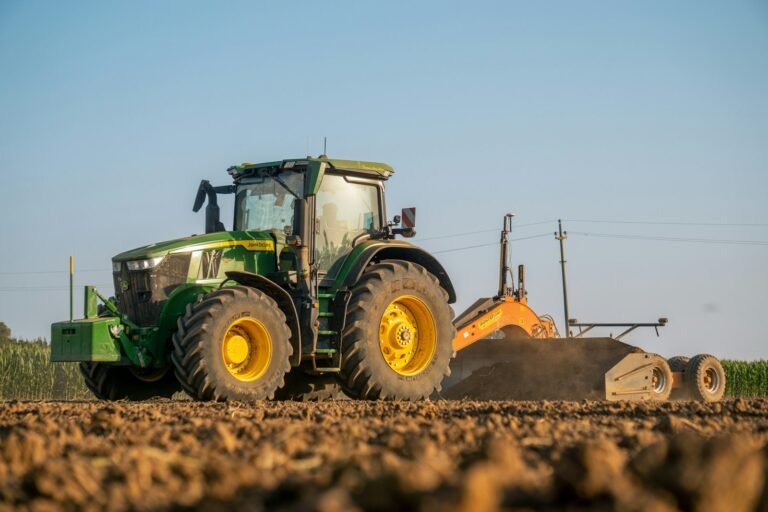
Topper hire is the quickest way to take rough paddocks, rush-infested fields and overgrown margins back under control without buying a machine you will use a few times a year. We hire three cutting options from our Okehampton depot: the heavy-duty SaMASZ Mammut 2.8m flail topper, the Del Moriano 1.8m PTO topper and the Conagri MEGA 1.45m flail mower. Each is matched to a tractor of the right size, which we can also supply, across Devon, Cornwall, Somerset and Dorset.

In this guide
Three toppers, three types of job
| Machine | Cut width | Best for | Tractor |
|---|---|---|---|
| SaMASZ Mammut flail topper | 2.8m | Rough vegetation, rushes, rank grass, larger fields | A full-size tractor such as our John Deere 6155R |
| Del Moriano PTO topper | 1.8m | Grassland and verge topping, smaller fields and paddocks | Mid-size tractor; ask us for the power requirement |
| Conagri MEGA flail mower | 1.45m | Rough and amenity grass, paddocks, orchards, estate margins | Compact tractors such as our Captain 26HP |
The Mammut and Del Moriano are on our agriculture page, and the MEGA flail sits with the compact tractor range on our sports and landscaping page.
Flail topper or lighter topper: what is the difference?
A flail topper has many small hammers or blades on a horizontal rotor spinning across the width of the machine. It chops material finely, copes well with thick, coarse growth and leaves a mulched finish that breaks down quickly. The hood and rear roller help contain debris, which is useful near roads, footpaths and buildings.
The Mammut is the heavy-duty end of our range. It suits ground that has been left for a season or more, where tussocks, rushes and woody weeds have taken hold. The Del Moriano 1.8m is lighter and handier for regular topping of grazed pasture and verges inside your own land, where you want to get round quickly and turn in tight corners. The MEGA 1.45m flail brings the same flail principle down to compact tractor scale for paddocks and estates.
Topper hire for the jobs that matter in the South West
Rushes on wet ground
Soft rush thrives on the wet, heavy soils common across Devon, Bodmin Moor’s fringes and the Culm grasslands of north-west Devon and north-east Cornwall. Regular cutting weakens rushes over time, particularly when combined with better drainage and grazing management. A heavy flail like the Mammut handles dense clumps that would choke a lighter machine. Many farmers top rushes from mid to late summer, once the ground will carry a tractor.
Thistles, docks and nettles
Topping before weeds set seed stops the problem getting worse next year. For thistles, that usually means cutting around flowering time, before seed heads ripen. Docks and nettles respond to repeated cutting, though topping alone rarely clears them.
Ragwort needs extra care
Topping ragwort does not control it on its own, and cut or wilted ragwort stays poisonous to horses and cattle and can become more palatable. If ragwort is present, pull or remove it rather than leaving cut plants in the field.
Evening up grazed pasture
After grazing, cattle and horses leave a patchwork of tall, rejected grass and closely grazed areas. Topping at a sensible height evens the sward, encourages fresh growth and makes the field more useful for the next round of grazing.
Cutting height: why it matters
The height you top at shapes the field for weeks afterwards. Cut too low and you scalp the sward, expose bare soil for weeds to colonise and slow regrowth, especially in a dry spell. Cut too high and you leave stemmy, rejected grass that animals still will not eat.
- Topping grazed pasture: aim to remove the seed heads and rejected clumps while leaving enough leaf for the grass to recover quickly. Many graziers top just above the height the animals have grazed to.
- Weed control: set the topper low enough to take off flower and seed heads of thistles and docks, but not so low that the flails hit the ground.
- Rushes: cutting close to the base does more to weaken the plant, but rough, tussocky ground makes that hard without scalping the grass around it. Expect to make two passes in places.
- Uneven ground: raise the height a little on molehills, ant hills and ridges so the flails are not digging in. Soil in the rotor dulls flails quickly.
Set the height using the rear roller or skids as the manufacturer describes, check it on a test strip, then adjust before doing the whole field.
Horse paddocks
Horses graze unevenly, creating short “lawns” and long “roughs” where they dung. Regular topping of the roughs keeps the paddock more even and stops weeds seeding there. Many owners pick up droppings before topping, as a flail spreads them across the paddock. Keep horses out until the cuttings have been cleared or have dried and broken down, and never leave cut ragwort in the field.
When to top: timing and wildlife
Ground conditions decide most topping dates in Devon and Cornwall. Wait until the field will take a tractor without rutting, which on clay can be well into late spring.
Think about wildlife before cutting long grass in spring and early summer. Ground-nesting birds use rough grass and field margins, and the Wildlife and Countryside Act protects active nests. Walking the field first, cutting from the centre outwards so animals can escape, and leaving uncut margins where possible all help.
Toppers are for grass and ground vegetation, not hedges. If your plans include hedge trimming, note that covered hedgerows on or next to agricultural land in England cannot be cut or trimmed from 1 March to 31 August under the hedgerow management rules. Check the current guidance before you start.
Injurious weeds and your responsibilities
The Weeds Act 1959 names five injurious weeds: common ragwort, spear thistle, creeping (field) thistle, curled dock and broad-leaved dock. GOV.UK guidance on stopping ragwort and other harmful weeds spreading explains that it is not an offence to have them on your land, but you should stop them spreading onto neighbouring agricultural land, and Natural England can require you to clear them.
Topping plays a part in that by cutting plants back before seeds disperse, but timing is everything. Cutting after thistles and ragwort have set seed can spread the problem rather than solve it. With ragwort in particular, follow the code of practice for control and disposal, and do not leave cut ragwort where livestock can reach it. Small quantities can rot down in a lidded container, while larger amounts need proper disposal through a permitted route. Check the current guidance before you start.
Worked example: bringing a neglected field back
This illustrative job shows how topper hire fits into reclaiming a ten-acre field on heavy ground in north-west Devon that has not been grazed or cut for two years. It is full of rushes, docks, tussocks and some bramble creeping in from the hedge.
- Walk the field in early summer. Mark old fence lines, fallen wire, troughs, stone piles and wet holes. Check the hedge bottoms for nesting birds before working near them.
- First cut with the SaMASZ Mammut behind the John Deere 6155R once the ground will carry the tractor. Go slowly through the dense rushes and tussocks, raising the height on rough patches.
- Let it recover for a few weeks so you can see what is regrowing and where the wettest areas are.
- Second cut in late summer to weaken rushes further and take docks and thistles back before more seed sets.
- Plan the longer term. Topping alone rarely clears rushes on wet ground. Better drainage, grazing management and, where appropriate, reseeding are part of the answer. Our Nardi ripper can help where compaction is holding water.
A tractor and topper package for a week covers each cut with time to work around the weather.
The smaller-scale version
On a three-acre paddock that has been left for a season, the same approach works with the Captain 26HP and the MEGA 1.45m flail mower. The lighter outfit is kinder to soft ground and easier through narrow gateways, though it will need more passes and a slower pace on dense growth.
Set-up and safe topping checklist
- Walk the field. Look for stones, fence wire, old posts, troughs, drain covers and soft patches, and mark or remove them.
- Check the PTO shaft is the correct length with guards in place, and the topper is level on the linkage.
- Set the cutting height to suit the job. Scalping the ground wears blades and exposes soil.
- Keep people, dogs and livestock out of the field while cutting. Flails can throw stones a long way.
- Take steep ground carefully, working up and down where the tractor’s stability guidance allows.
- Stop the PTO, lower the topper and remove the key before clearing any blockage.
Hire is self-drive, so the operator needs to be competent with the tractor and implement.
Daily checks and care during the hire
A topper works hard and gets hit by stones, wire and stumps. A short check each morning keeps it cutting cleanly and catches damage before it causes a breakdown:
- Flails or hammers: look for any that are missing, cracked or badly worn. A missing flail throws the rotor out of balance and causes vibration that damages bearings. Stop and report it rather than carrying on.
- Rear roller: check it turns freely and is not packed with soil or wrapped with grass, as a seized roller drags and scalps.
- Rotor: clear wrapped grass, twine and wire with the PTO stopped, the engine off and the key removed.
- Grease points: grease the rotor bearings, roller bearings and PTO shaft as the manual describes.
- Gearbox and belts: check the gearbox for leaks and, where fitted, belts for tension and wear.
- Guards and hood: make sure the front and rear guards, flaps and hood are intact. They are what stop stones being thrown.
- PTO shaft: guards intact, chains attached and the shaft sliding freely.
If anything looks wrong, call or WhatsApp us. We will assess it and arrange repair or replacement. Damage caused by hitting obstacles that a walk of the field would have found can be chargeable under our hire terms, which is another good reason to walk it first.
Verges, tracks and roadside work
Toppers are also used to keep farm tracks, field margins and private drives under control. A few extra considerations apply near roads and paths:
- Thrown debris: keep well back from roads, footpaths and parked vehicles, and check the guards are in good order. On sensitive edges, the MEGA 1.45m or Del Moriano 1.8m are easier to place accurately.
- Public rights of way: stop if walkers or riders approach and let them pass before starting again. Flails can throw stones well beyond the width of the machine.
- Livestock: move animals out of adjoining areas if the work is close to a fence line, as noise and thrown debris can unsettle them.
- Public road verges: these are generally the highway authority’s responsibility. Do not work on a public verge without the right permissions and traffic management.
- Banks and ditches: verges in Devon and Cornwall often hide steep banks and ditch edges under long grass. Walk the line first and stay well away from unseen drops.
Getting a clean finish
A topper that leaves windrows, uncut strips or scalped patches usually comes down to technique rather than the machine:
- Match forward speed to the growth. Dense rushes and long, wet grass need a slower pace so the rotor is not overloaded. Light topping of grazed pasture can go faster.
- Run the PTO at the recommended speed throughout. Letting revs drop leaves a ragged cut.
- Overlap each pass slightly so you do not leave a strip of standing grass between runs.
- Cut in dry conditions where you can. Wet grass clumps, and wet ground marks easily.
- Clear wrapped material from the rotor safely and promptly, with the PTO stopped and key out.
Plan your pattern before you start. One or two passes round the headland give you room to turn, then work the middle from the centre outwards in straight runs, which also gives wildlife a route out of the field.
Implement only, or tractor and topper?
If you have your own tractor, we can hire the topper on its own, provided the linkage, PTO and power suit it. Send us your tractor’s make, model and horsepower first. If not, we can supply a matched package: the 6155R with the Mammut or Del Moriano, or the Captain 26HP with the MEGA flail. Contractors who need a tractor and a rotating set of implements through the season can look at our Flex Hire account.
What affects the cost of topper hire
We quote each job individually. The main factors are which topper you need, whether you also need a tractor, how long the hire runs and the delivery distance from our depot near Okehampton. A topper on its own for your own tractor costs less to deliver than a tractor and topper package, while a week’s hire gives you flexibility to work around showers. Insurance for hired equipment is not included, so check your farm policy covers hired-in machinery or ask our partner insurance4plant.co.uk. Send us your field size and what you are cutting for a current quote.
Delivery and handover
We deliver to your farm or yard and collect at the end of the hire. Tell us the best gateway and any weight or width limits on the way in. If you are using your own tractor, have it ready at the delivery point so we can check the topper fits the linkage and PTO before we leave, and run through height adjustment and daily checks.
At the end of the hire, clean off the worst of the grass and soil, leave the topper lowered on firm ground and let us know it is ready to collect.
Frequently asked questions
What size topper do I need for a 5-acre paddock?
For a few acres, the 1.8m Del Moriano or the 1.45m MEGA flail is usually enough. The 2.8m Mammut is better suited to larger or rougher fields.
Can a flail topper cut brambles and scrub?
A heavy-duty flail handles light scrub and bramble regrowth. Mature woody growth may need different tools, so ask us first.
How quickly can I get topper hire booked?
Same-day delivery is often possible across most of Devon and Cornwall, subject to availability. Summer is busy, so book ahead where you can.
Can I top a field when the ground is wet?
It is better to wait. A tractor on soft ground ruts and compacts the soil, and wet grass clumps and leaves a poor finish. On heavy Devon clay, a few dry days make a big difference.
Should I use a topper or a mower for hay?
Use a mower. A flail topper chops and scatters the grass, which is right for pasture management but not for making hay or silage. Our SaMASZ Samba 281 disc mower gives a 2.8m clean cut for conserving grass.
Will topping get rid of rushes for good?
Rarely on its own. Repeated cutting weakens rushes over a few seasons, but on wet ground they come back unless drainage and grazing are improved too.
Do you hire hedge cutters as well?
Our range covers toppers and mowers for grass and ground vegetation. If you need a hedge cutter, ask us and we will tell you what is available or point you in the right direction. Remember the hedgerow cutting restrictions from 1 March to 31 August.
Book a topper
WhatsApp or call 07841 036064 with your field size, what you are cutting, your postcode and whether you need a tractor too. For written quotes, use our contact form.