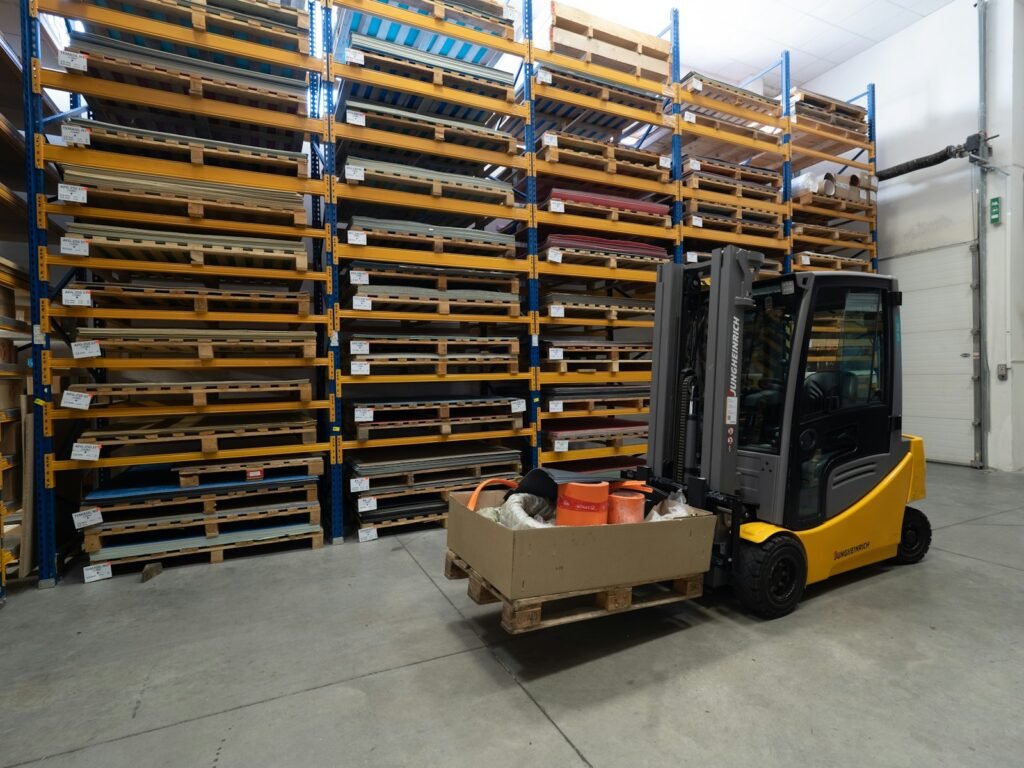
Electric forklift hire gives you lifting capacity without diesel fumes, which is why it is the default choice for warehouses, food distribution, manufacturing units and any indoor space. We hire two electric counterbalance trucks from our Okehampton depot: the EP EFL 253, rated at 2,500kg, and the CESAB B420, rated at 2,000kg with integrated side-shift. Both can be hired by the day, week or month, or on long-term and Flex Hire arrangements across Devon, Cornwall, Somerset and Dorset.

In this guide
Our two electric forklifts compared
| EP EFL 253 | CESAB B420 | |
|---|---|---|
| Type | Electric counterbalance | Electric counterbalance |
| Rated capacity | 2,500kg | 2,000kg |
| Notable features | Built as a replacement for diesel or gas (IC) trucks | Heavy-duty, integrated side-shift |
| Typical use | Heavier pallets, mixed indoor work, replacing an IC truck | Busy warehouse and logistics work, accurate placement in racking |
Both sit in our warehouse and cleaning range alongside electric pallet trucks, stackers and a scissor lift. Ask us for the lift height, mast type and fork length of the truck you are booking so you can check them against your racking and pallets.
Why businesses hire rather than buy
Across the South West, a lot of trade is seasonal. Food and drink producers, garden centres, agricultural merchants and holiday-season suppliers often see demand swing hard between quiet months and busy ones. Hiring lets you add a truck for the peak and hand it back afterwards. Other common reasons we hear:
- Your own truck is off the road for repair and the warehouse cannot stop.
- You are moving into a new unit and need to shift racking and stock over a fortnight.
- You want to try an electric truck before committing to replace a diesel or gas one.
- A new contract needs extra lifting capacity before you know if it will last.
Delivery from Okehampton is straightforward along the A30 to Exeter and Cornwall, and on to the M5 corridor for Somerset.
Moving unit or installing racking
Relocations and racking installations are short, intense jobs. Stock needs to come out, racking needs to be dismantled or built, and stock goes back in, often over a weekend. One truck at the old unit and one at the new can halve the shuttle time. Tell us your timetable and the heaviest items involved, including racking frames and beams, and we will plan delivery and collection around it so the trucks are there when the work starts and gone when it finishes.
Electric, diesel or gas: which truck suits your site?
Electric forklift hire is the obvious choice indoors, but it helps to understand the trade-offs, especially if you are used to running a diesel or LPG truck.
| Electric counterbalance | Diesel or LPG counterbalance | |
|---|---|---|
| Exhaust emissions at point of use | None | Yes, needs good ventilation indoors (diesel especially) |
| Noise | Low, suits early starts and shared buildings | Higher |
| Refuelling | Charging, usually overnight or between shifts | Quick refill or bottle change |
| Surfaces | Smooth, hard floors and good yards | Similar, with some models better on rougher yards |
| Food, pharma and clean areas | Well suited | Often restricted |
| Running costs | Electricity rather than fuel, fewer moving parts | Fuel costs and more engine servicing |
We hire electric trucks only in this range. If your work is mainly outdoors on rough ground, the answer is usually a telehandler or loader rather than any counterbalance forklift.
Choosing between 2 tonnes and 2.5 tonnes
The rated capacity on a forklift’s data plate applies at a stated load centre, the distance from the fork face to the centre of the load’s weight. A long, deep or offset load moves that centre forward and reduces what the truck can safely lift. Lifting to the top of the mast can also reduce capacity, depending on the truck.
So the question is not just “how heavy is my heaviest pallet?” but also “how big is it, and how high does it go?” As a rough guide:
- Standard palletised goods, drinks, packaged food and retail stock often sit comfortably within the CESAB B420’s 2,000kg rating.
- Bagged aggregates, feed, steel, stone and dense machinery parts can push towards or past 2 tonnes, which is where the EP EFL 253’s extra capacity helps.
- If you are unsure, weigh a sample load or check the delivery paperwork. Never guess near the limit.
Electric forklift hire for indoor work: what to check
Floors and ramps
Electric counterbalance trucks are designed for smooth, hard surfaces such as warehouse concrete and tarmac yards. They are not rough-terrain machines. If you need to lift on gravel, mud or a farm track, a telehandler or pivot loader from our construction and agricultural ranges is the better tool. Check any ramps or dock plates against the truck’s gradient limits before you rely on them.
Charging
Plan a charging point before the truck arrives. You need a suitable socket in a safe spot away from traffic routes, flammable materials and the public. Ask us which battery type your truck has. Lead-acid batteries give off gas during charging and should be charged in a well-ventilated area, while lithium batteries have their own charging instructions. Follow the manufacturer’s guidance, and get into the habit of charging at the end of each shift.
Space and pedestrians
Counterbalance trucks need room to turn. Measure your narrowest aisle and compare it with the truck’s turning circle. Mark pedestrian routes, use mirrors at blind corners and keep people out of the area where loads are being lifted.
Mast height, free lift and fork length
Three other measurements matter as much as capacity. The closed mast height decides whether the truck fits through doors, under mezzanines and into containers. The maximum lift height needs to clear your top beam with room to place the pallet. Free lift, how far the forks rise before the mast extends upwards, matters when stacking inside containers or under low ceilings.
Fork length should suit your pallets: too short and the load is unstable, too long and the tips can push into the pallet behind. Ask us for these figures for the truck you are booking before your electric forklift hire starts.
Charging and battery care through the hire
A well-managed battery gives a full shift of work. A badly managed one leaves you with a truck that slows down mid-afternoon. A few rules cover most situations:
- Charge in the right place. Choose a dedicated spot with good ventilation, away from walkways, vehicle routes, ignition sources and flammable stock. HSE’s COSHH guidance on battery charging highlights ventilation because lead-acid batteries give off hydrogen while charging.
- Follow the charging pattern for your battery type. Ask us at handover whether your truck has a lead-acid or lithium battery. Lead-acid batteries generally prefer a full charge rather than frequent short top-ups, while lithium batteries are more tolerant of opportunity charging. The manufacturer’s instructions take priority.
- Do not run the battery completely flat. Put the truck on charge when the indicator shows it is getting low, not when it stops.
- Keep the connector and cables in good order. Do not drive away with the charger still connected, and report damaged plugs or cables immediately.
- Leave battery maintenance to us unless we have agreed otherwise. If a lead-acid battery needs topping up with water, protective goggles and gloves are essential and the work should only be done by someone trained to do it.
Safe load handling on a counterbalance truck
Training covers this in depth, but these are the habits that prevent most incidents with hired trucks:
- Check the load first. Damaged pallets, unstable stacks and loose wrapping cause dropped loads. Do not lift what you would not trust.
- Travel with forks low and the mast tilted back, raising only at the stack.
- On slopes and ramps, drive with the load facing uphill, and never turn on a gradient.
- Look in the direction of travel. If a load blocks your forward view, drive in reverse.
- Keep within the capacity at the height you are working, using the data plate, not memory.
- Never carry passengers or lift people on the forks.
- Park safely: forks lowered to the floor, controls neutral, handbrake on and key removed.
Keeping people and trucks apart
Electric trucks are quiet, which is good for staff but means pedestrians hear them coming later than a diesel. Where you can, separate walkways from truck routes with barriers or floor markings, set a sensible site speed, and fit or use warning lights and horns at blind corners and doorways. Brief agency staff and visitors on day one, because they are the people least likely to expect a truck. HSE’s workplace transport guidance sets out the principles if you are reorganising a busy floor for a peak.
Training: who can drive a hired forklift
All our hires are self-drive, so you are responsible for making sure operators are trained and competent. HSE guidance on lift truck training describes three stages:
- Basic training in the skills and knowledge to operate a lift truck safely, usually off the job.
- Specific job training on the controls of the particular truck and how it will be used at your workplace.
- Familiarisation training on the job, under close supervision.
The detail is set out in HSE’s approved code of practice, L117. A certificate from a recognised training provider is the usual way to show an operator’s competence. An experienced diesel driver moving to an electric truck should still be familiarised with its controls, which can feel quite different, particularly the regenerative braking and smooth acceleration. If in doubt, check the current HSE guidance or speak to a training provider.
Daily checks every operator should do
- Battery charge level and connector condition
- Forks, mast, chains and carriage for damage or cracks
- Tyres for damage and embedded debris
- Horn, lights, brakes, steering and seat belt
- Hydraulic leaks under the truck and around the mast
- Data plate readable and any attachment fitted correctly
If anything is wrong, take the truck out of use and call or WhatsApp us. We will assess the problem and arrange a repair or replacement as quickly as we can.
Thorough examination and paperwork
A forklift is lifting equipment under the Lifting Operations and Lifting Equipment Regulations (LOLER). HSE says that unless an examination scheme sets other intervals, lifting equipment should be thoroughly examined at least every 12 months, and every 6 months for lifting accessories and equipment used to lift people. Our trucks are maintained and examined as part of our fleet management, and you can ask us for the current report for your records or your client’s.
Your responsibilities during the hire are the daily pre-use checks, reporting faults promptly and keeping the truck within its limits. If your site uses attachments such as fork extensions or clamps, tell us first, because they change the truck’s capacity and may need their own examination. See the HSE guidance on thorough examination of lifting equipment for the detail, and check the current guidance if your situation is unusual.
Planning electric forklift hire for a seasonal peak
Peaks in the South West are predictable: the run-up to Christmas, the summer tourist season for suppliers to Cornwall and the coast, harvest for agricultural merchants and feed suppliers. A simple timeline keeps electric forklift hire for a peak stress-free:
- Four to six weeks before: work out how many extra trucks you need, measure aisles and check racking heights and pallet weights. Confirm who will drive and whether they need training or refresher training.
- Two to three weeks before: book the truck and agree the delivery date. Identify the charging point and make sure the socket is suitable.
- The week before: brief staff on pedestrian routes, any new one-way systems and where the truck will be parked and charged.
- Delivery day: have the nominated operator available for the handover, sign the delivery note and do the first pre-use check together.
- End of the peak: let us know when you want it off hire, leave it charged and clean, and we will arrange collection.
If the peak runs longer than expected, message us before the hire end date and we will extend where we can.
Delivery or collection
Forklifts are heavy and need suitable transport and loading equipment, so most customers have us deliver. If you have a suitable vehicle and want to collect, talk to us first and we will confirm what is involved.
Short-term, long-term or Flex Hire
Short hires cover breakdowns of your own truck, stock takes, seasonal peaks and one-off deliveries. If you need a forklift for months, our long-term rental gives you a monthly rate with on-site servicing included, which takes maintenance off your hands without buying a truck outright.
Electric forklifts are also included from Tier 3 of our Flex Hire account, at £995 +VAT and delivery per month. Tier 3 covers everything in Tiers 1 and 2 as well, so a site that needs a forklift some weeks and a scissor lift or excavator others can swap between them on one flat fee, with servicing included and a 10% rebate.
Common mistakes with a hired forklift
- Booking on weight alone. A 1,800kg load that is long or deep may be beyond a truck’s capacity at its actual load centre. Give us dimensions as well as weights.
- Forgetting the lift height. Top-beam height plus clearance to place the pallet is what counts, and capacity can drop near the top of the mast.
- No plan for charging. A truck delivered at 8am with no suitable socket nearby is a lost day.
- Container and trailer work without checks. Driving onto a trailer or into a container needs a suitable dock plate, wheel chocks or a vehicle restraint, and an overall height that clears the container roof. Check before the truck arrives.
- Assuming any licence covers any truck. An operator trained on reach trucks or telehandlers still needs training and familiarisation for a counterbalance truck.
- Leaving faults until collection. Report damage or faults as soon as they happen. It is quicker to fix and avoids disputes at the end of the hire.
Frequently asked questions
Can I use an electric forklift outside?
On smooth, hard, level surfaces in suitable weather, generally yes. They are not designed for rough or soft ground, so ask us about a telehandler or pivot loader for that work.
Does electric forklift hire include delivery?
Delivery and collection are quoted separately on standard hires. On Flex Hire, delivery, collection and swaps are part of the arrangement. WhatsApp us for a current quote.
Is insurance included?
No. You need cover for hired-in equipment. Check your existing policy, or ask our partner insurance4plant.co.uk about plant hire cover.
Can you supply more than one forklift?
Yes, subject to availability. For multiple machines, use our contact form and we will put together a tailored proposal.
How long does a charge last on a hired electric forklift?
It depends on the battery, the loads, how far the truck travels and how much lifting it does. Most single-shift sites charge overnight and run all day. If you work two shifts, tell us so we can talk through charging between them.
Can we use the forklift to lift a person to reach high stock?
No. Never lift people on the forks or on a pallet. For work at height, use a properly designed access platform such as our Sunward electric scissor lift.
Our yard has a slope down to the loading area. Is that a problem?
Not necessarily, but send us the details. Counterbalance trucks have gradient limits, and loaded trucks need extra care on slopes. A photo and a rough idea of the gradient let us confirm whether the truck suits your yard or whether you need a different approach.
Arrange your forklift hire
Tell us your heaviest load, lift height, site postcode and dates. WhatsApp or call 07841 036064, Monday to Friday 7:30am to 5:30pm, or send fleet enquiries through our contact page.