
Electric pallet truck hire is the quickest way to take the strain out of moving pallets when deliveries pile up, a hand pump truck is wearing staff out, or a seasonal peak doubles your throughput. We hire two battery-powered EP machines from our Okehampton depot: the EP F4 electric pump truck, which moves pallets up to 2,000kg along the ground, and the EP ESL 122 stand-on stacker, which lifts 1,200kg into racking up to 5m. Both are delivered across Devon, Cornwall, Somerset and Dorset.
In this guide
Pump truck or stacker: which do you need?
The simple test is height. If pallets only travel along the floor, from a lorry to a bay or from goods-in to a picking area, you need a pallet truck. If they have to go up into racking or onto a raised platform, you need a stacker or a forklift.
| EP F4 electric pump truck | EP ESL 122 electric stacker | |
|---|---|---|
| Job | Horizontal pallet transport | Lifting pallets into racking |
| Capacity | Up to 2,000kg | 1,200kg |
| Lift height | Just enough to clear the floor | Racking up to 5m |
| Operator position | Walks with the truck | Stand-on |
| Best for | Dock work, deliveries, moving stock between areas | Compact warehouses, stockrooms, low and medium racking |
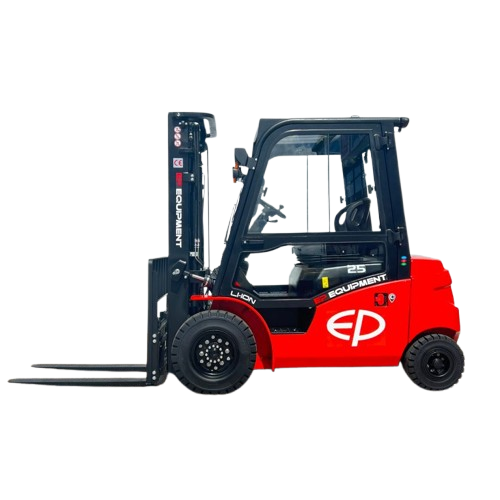
Both sit in our warehouse and cleaning range. For loads heavier than 1,200kg at height, look at our electric counterbalance forklifts, rated at 2,000kg and 2,500kg.
The EP F4: powered moving at ground level
A manual pump truck is fine for the odd light pallet on a smooth floor. It becomes hard work with heavy loads, long distances, slight slopes or a full trailer to unload. The F4’s electric drive does the pulling and pushing, so the operator steers and controls speed rather than heaving.
Typical jobs include unloading curtain-siders at a dock, moving pallets of feed, bagged goods or drinks across a unit, and shuttling stock between goods-in and dispatch. It is compact, so it suits back rooms, shop stockrooms and cold stores where a forklift would struggle for space.
The EP ESL 122: compact stacking to 5m
The ESL 122 is a stand-on electric stacker that lifts up to 1,200kg into racking up to 5m. It is a good fit for smaller warehouses and stockrooms that have racking but not the aisle width or workload to justify a counterbalance forklift. Its capacity at height can be lower than at ground level, so check the capacity plate on the mast against your heaviest pallet and top beam level.
Is a powered truck worth it over a hand pump truck?
If you already own a manual pump truck, it is fair to ask whether paying for electric pallet truck hire makes sense. It usually does when one or more of these applies:
- Pallets regularly weigh more than a person can comfortably start moving by hand.
- The route includes a slope, a dock plate or a rough patch of floor.
- Staff are moving pallets for most of a shift rather than occasionally.
- You are unloading full trailers, where every minute at the dock counts.
Pushing and pulling heavy loads is a common cause of back and shoulder strain, and a powered truck removes most of the pushing and pulling. It also tends to be faster on long runs, which matters when drivers are waiting to be unloaded.
Pushing, pulling and the case for powered handling
Moving pallets by hand is one of the most common sources of strain in warehouses and shops. The effort needed to get a heavy pallet moving, and to stop it again, is much higher than the effort to keep it rolling, and it rises sharply on rough floors, slopes and when the truck’s wheels are worn or clogged with debris.
HSE’s RAPP tool for pushing and pulling helps employers assess these tasks. It looks at the load, the distance, the floor surface, slopes, obstacles, posture and how often the task is done. If your assessment of manual pallet moves comes out high risk, electric pallet truck hire is one of the most direct ways to bring it down, because the motor does the starting, stopping and hauling.
Signs it is time to go powered
- Staff are leaning their whole body weight into a pallet to get it moving.
- Pallets have to go up or down a ramp, dock plate or threshold strip.
- Two people are regularly needed to move one pallet.
- Distances are long, such as from a rear dock to the front of a large shop.
- Back, shoulder or wrist complaints are cropping up among the people doing the job.
Older buildings and mixed floors
Many stores in South West market towns and converted farm buildings have uneven concrete, steps between sections and narrow doorways. Walk the route the pallets will take before you book, noting cracks, drainage channels, thresholds and any slope. Send us photos of the worst spots and the narrowest point, and we will tell you honestly whether a powered truck will cope or whether the route needs some work first.
Electric pallet truck hire for peaks and deliveries
Most of our handling hires are linked to a busy period. Common examples:
- Seasonal peaks: the run-up to Christmas, the summer visitor season for suppliers to Cornwall and the coast, and harvest-time demand for agricultural merchants.
- Stock takes and relocations: emptying and refilling racking, or moving into a new unit.
- One-off deliveries: a container or several trailers of stock arriving at a site with no handling kit.
- Events and exhibitions: moving staging, catering supplies and generators on hard standing.
- Cover: your own truck is out of action and the work cannot wait.
Check these before the truck arrives
- Pallet sizes and fork fit. UK standard pallets are 1,200mm by 1,000mm and Euro pallets 1,200mm by 800mm. Ask us for the fork length and width of the truck you are hiring and check they suit your pallets and which way you enter them.
- Floors and gradients. Pallet trucks have small wheels and need smooth, hard floors. Check dock plates, ramps and thresholds against the truck’s gradient limit.
- Racking heights and beam loads. For the stacker, measure your top beam and confirm the beam’s safe working load as well as the truck’s capacity.
- Charging point. Choose a safe charging spot away from walkways and flammable stock, and charge at the end of each shift.
- Delivery access. Tell us if there is a dock, a tail-lift requirement, or a tight yard.
Unloading a delivery, step by step
Here is an illustrative method for unloading a curtain-sider or box trailer at a dock with the EP F4. Adjust it to your own site rules and the haulier’s procedures.
- Secure the vehicle. Make sure the lorry is parked, the brakes are on and the vehicle is prevented from moving away during loading, using your site’s system of wheel chocks, vehicle restraints or key control.
- Set the dock plate or leveller and check it is seated properly and within its rated load.
- Check the load before you touch it. Look for damaged pallets, leaning stacks and loads that have shifted in transit. Deal with these before moving anything.
- Enter the pallet squarely, with the forks fully inserted, raise just enough to clear the floor and pull back slowly.
- Cross the dock plate straight and steadily, not at an angle, with the load stable.
- Put pallets down in a marked area clear of walkways and fire exits, not in the path of the next pallet.
- Finish by clearing the trailer floor of wrap and broken boards so nothing jams the truck’s wheels.
If the truck is going onto a vehicle bed without a dock, check the floor strength and the vehicle operator’s procedure first.
Stacking into racking with the ESL 122
Putting pallets into racking takes more care than ground-level work, because the load is higher and the stacker’s stability depends on the load staying within its rated capacity at that height.
- Check the capacity plate on the mast for the height you are lifting to, and confirm the pallet weight.
- Approach the bay squarely with the load low, then stop before raising.
- Raise slowly to just above the beam, watching for overhead obstructions such as lights, sprinklers and beams above.
- Move forward gently until the pallet is over the beams, lower it onto the beams and check it is sitting evenly front and back.
- Lower the forks slightly, withdraw, and lower fully before moving off.
Never stand under a raised load, and keep other people out of the aisle while lifting. Report any damage to racking uprights or beams straight away: a damaged upright can fail under load, and racking inspection is the responsibility of whoever owns or manages the racking.
Training and safe use
Powered pallet trucks and stackers are often treated as simple kit, but they are heavy and can trap feet and crush against walls. Under the Provision and Use of Work Equipment Regulations, employers must make sure everyone using work equipment is adequately trained in how to operate it, the risks involved and the precautions to take. HSE’s page on training and competence for work equipment sets this out. Stand-on stackers may need more structured training than a walk-behind pump truck, so check with a training provider which course suits your operators.
Good habits to brief your team on:
- Wear safety footwear and keep feet clear of the chassis.
- Travel with forks lowered and the load stable, and never carry people on the forks.
- Take dock plates and ramps slowly, load facing uphill where the manufacturer advises.
- Keep pedestrians out of the stacker’s working area while lifting.
- Report damage straight away rather than working around it.
Pre-use checks, examination and battery care
A short check at the start of each shift catches most problems before they become breakdowns. For both machines:
- Battery charge level and charger lead condition
- Wheels and rollers free of wrap, string and debris
- Forks straight, with no cracks or bends
- Tiller or controls, horn, emergency stop and brake working
- No hydraulic leaks under the truck or around the mast
- For the stacker: mast, chains and lift and lower functions working smoothly, and the capacity plate readable
The ESL 122 lifts loads into racking, so it counts as lifting equipment under LOLER and must be thoroughly examined at intervals. HSE says that unless an examination scheme sets otherwise, that is at least every 12 months for most lifting equipment. We look after examination as part of maintaining our fleet, and you can ask us for the current report.
Charge both machines in a ventilated spot away from walkways and flammable stock, ideally at the end of every shift rather than when they start to slow. Follow the charging instructions for the battery type, which we will explain at handover.
Mistakes that cause breakdowns and damage
- Running over shrink wrap and strapping. It winds round the load rollers and drive wheel and can stop the truck dead. Keep the floor clear.
- Using the forks as a lever to prise apart stuck pallets or nudge stacks into place. It bends forks and damages the lift mechanism.
- Overloading the stacker at height. Ground-level capacity is not the capacity at the top beam.
- Leaving the truck on charge in a walkway where the lead becomes a trip hazard or gets driven over.
- Taking a pallet truck onto rough yards or gravel. The small wheels are designed for smooth floors and are easily damaged outside.
Short, long-term and Flex Hire
A day or a week covers most one-off deliveries and stock takes. If you need handling kit for a whole season or longer, our long-term rental offers monthly rates with on-site servicing included. Pallet trucks are also included in Tier 1 of our Flex Hire account, from £795 +VAT and delivery per month, alongside floor cleaning kit and other everyday equipment.
Sizing electric pallet truck hire for a busy period
Working out how many machines you need is mostly about bottlenecks. Ask where pallets queue: at the dock while trailers wait, in goods-in while stock is checked, or at the racking while one stacker does all the put-away. Adding a truck where the queue forms helps; adding one elsewhere often does not.
An illustrative example
A drinks wholesaler supplying pubs and holiday parks in Cornwall expects deliveries to roughly double from late spring. At the moment one manual pump truck handles the dock and staff put stock away by hand into low racking.
For the season, one EP F4 at the dock speeds up unloading and takes the strain off staff, while an ESL 122 stacker lets them use the upper racking levels instead of floor stacking in the aisles. The manual truck stays as a spare for short moves. Both machines go on hire a week before the busy period starts, so staff are familiar with them before the pressure is on.
If you need handling kit for several months, or you want to switch between a pallet truck, a floor scrubber and other everyday equipment as needs change, Tier 1 of our Flex Hire account covers pallet trucks and floor cleaning on one monthly fee, with delivery, collection and servicing handled by us.
Delivery and collection
Tell us about your delivery point when you book: whether there is a dock, level access or only steps, and whether the yard is tight. Someone needs to sign for the machines and we will run through the controls and charging at handover. At the end of the hire, leave them charged, clean and somewhere easy to reach, and let us know they are ready to go back.
Extending the hire
If the peak runs on, message us before the hire end date and we will confirm availability. If you find you are extending every month, long-term rental or Flex Hire is likely to work out simpler.
Frequently asked questions
Can the EP F4 lift pallets onto a shelf?
No. A pump truck only lifts enough to clear the floor. For racking you need the ESL 122 stacker or a forklift.
Can I use an electric pallet truck on a lorry trailer?
Many operators use pallet trucks to move loads along a trailer bed, provided the trailer floor, dock plate and load weight are all within limits. Check with the vehicle operator and the truck’s manual first.
How quickly can you deliver?
Same-day delivery is often possible across most of Devon and Cornwall, subject to availability. For planned peaks, book a few days ahead.
Can I hire both a pump truck and a stacker together?
Yes, subject to availability. Many sites use the F4 at the dock and the stacker in the racking.
Do operators need a licence to use an electric pallet truck?
There is no driving licence for pallet trucks, but the law requires adequate training for anyone using work equipment. Many employers use a recognised pedestrian pallet truck or stacker course, and keep a record of training for each operator.
Will the pallet truck handle my pallets?
Most UK and Euro pallets are fine, provided the fork length and width suit the pallet and you enter from a side the forks fit. Odd pallet types, such as half pallets or plastic pallets with closed bases, are worth checking with us before electric pallet truck hire starts.
When should I choose a forklift instead of a stacker?
Go for a counterbalance forklift if loads at height exceed the stacker’s capacity, if you need to load or unload lorries from the side at ground level, or if the work involves long runs across a yard. Our EP EFL 253 and CESAB B420 cover 2,500kg and 2,000kg respectively.
Book a pallet truck or stacker
WhatsApp or call 07841 036064 with your postcode, dates, pallet weights and racking height. For multiple machines or an account, use our contact form.