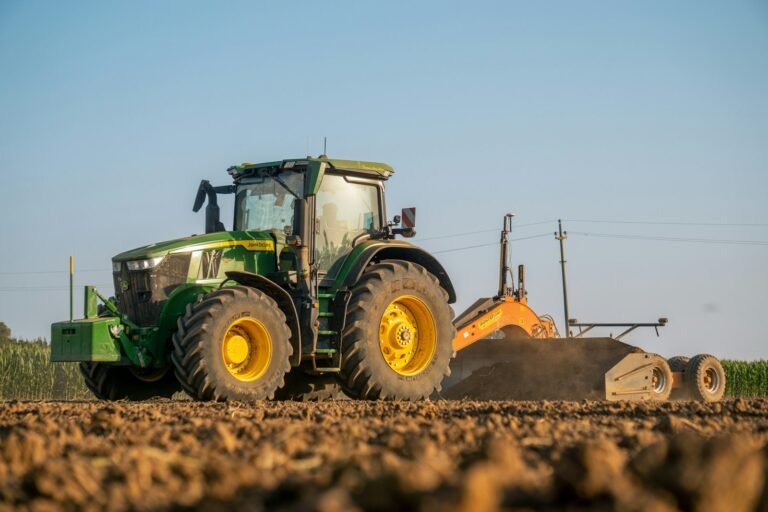
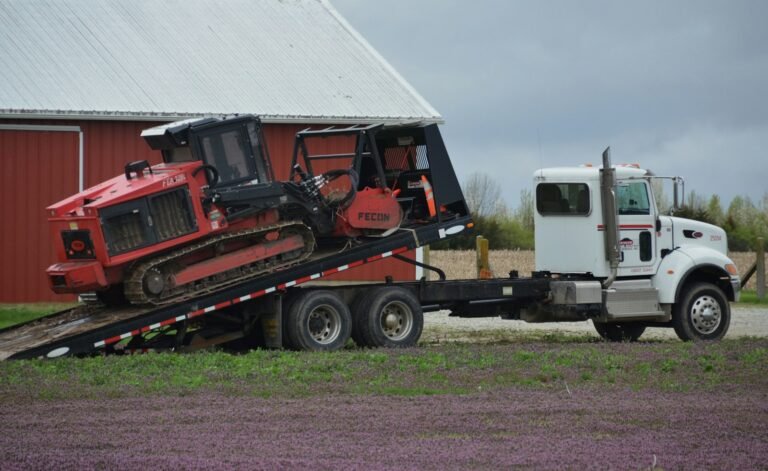
When a job outgrows a car-towed plant trailer, a tractor and low loader is how most farms in the South West move their machinery. Our low loader trailer hire centres on the Bailey 10-ton low loader, with a 6m × 2.5m deck and a 10-tonne payload, available from our Okehampton depot for farmers, contractors and estates across Devon, Cornwall, Somerset and Dorset. Below we cover what it carries, what you need to tow it, and how to load and secure machinery properly.

In this guide
What the Bailey low loader carries
A low loader keeps the deck close to the ground, so machinery climbs on at a gentler angle and rides with a lower centre of gravity. That matters with tall, top-heavy machines on cambered rural roads.
A 6m × 2.5m deck with a 10-tonne payload covers most of the machinery a mixed farm or groundworks contractor moves day to day:
- Mini and midi excavators, including our Sunward machines up to the 6-tonne SWE 60UF, subject to checking weight and width.
- Pivot loaders such as the Venieri 1.63D, and compact tractors.
- Tracked dumpers and skid-steer loaders.
- Implements too awkward for a pick-up, such as rippers, toppers and crushers.
- Pallets of fencing materials, posts and stone, properly restrained.
The 9-tonne SWE 90UF sits close to the payload limit once attachments are added, so give us the exact configuration and we will confirm before you load.
Typical bookings include moving a hired excavator from the yard to an outlying field for a drainage job, shifting a loader between two farm holdings for silage or muck work, or taking a broken-down machine to a dealer. If the move is a one-off, daily hire is often enough; contractors with several moves in a week usually take weekly hire.
Pairing it with a tractor
A 10-tonne low loader needs a tractor with the weight, braking and hitch to control it. If you do not have one, our John Deere 6155R (155HP, 4WD, full cab) is available from our agricultural machinery range and is a comfortable match. If you are using your own tractor, check its permitted towing weights and that its trailer brake connections suit the Bailey. Send us the details and we will help you check.
Licences and road rules to check before low loader trailer hire
Tractor and trailer rules differ from car and van rules. According to the GOV.UK guide to tractors and regulatory requirements, as general information:
| Point | What the guidance says |
|---|---|
| Licence | Category F covers agricultural tractors on the road; category B (car) holders have F automatically |
| Young drivers | At 16, drivers are limited to tractors and trailers up to 2.45m wide, so a 2.5m low loader is not for 16-year-olds |
| Speed | Most tractors are limited to 40km/h (about 25mph); some higher-specification tractors can do more |
| Width | Wider vehicles and loads face lower speed limits; width includes the trailer and anything on it |
| Weight | Agricultural tractor and trailer combinations up to 31 tonnes, with limits on the trailer itself |
| Non-agricultural use | Using a tractor for haulage outside agriculture can need a goods vehicle licence such as C1E or CE |
These rules depend on what the tractor is being used for and can change. Check the current guidance for your situation, and if you are a contractor moving plant for construction work, take particular care over which licence and rules apply.
Loading machinery step by step
- Choose firm, level ground, ideally a concrete yard rather than a gateway or a sloping field.
- Couple up and apply the brakes on both tractor and trailer before anything goes up the ramps.
- Check ramps are seated and pinned, and clear of mud and diesel.
- Drive on slowly and straight, with a banksman to the side, never in front or behind.
- Position the load so the weight sits just ahead of the trailer axles, putting a sensible load on the hitch.
- Lower everything: buckets, blades, loader arms and booms onto the deck.
- Isolate the machine: engine off, key out, park brake on.
Securing the load
An unsecured excavator on a Devon lane is a serious hazard. DVSA’s guidance on securing loads on vehicles and trailers sets out the principles; the practical version is:
- Use rated chains and tensioners, or straps where suitable, at four points minimum.
- Attach to the machine’s marked lashing or tie-down points, never to hydraulic hoses or thin brackets.
- Cross the restraints to stop forward, backward and sideways movement.
- Secure loose buckets and attachments separately; never leave them sitting on the deck unrestrained.
- Stow ramps securely and check the trailer lights are clean and working.
- Stop after the first mile or two and re-tension everything.
Driving rural roads with a loaded low loader
Most of the miles in the South West are on narrow lanes with tight bends, steep gradients and high hedges. A loaded tractor and low loader needs room. Plan the route to avoid weak bridges, low branches and steep descents, and check the overall height of a tall machine against any low structures on the way. Pull in where it is safe to let traffic pass, and do not rely on sat-nav routes intended for cars.
Mud on the road is another responsibility. If you are coming out of a field, clean down the tyres and the trailer where you can, and put out warning signs if mud has been deposited.
Measuring up: weight, width and height
Before you book low loader trailer hire for a particular move, check the load against three limits. Weight is the obvious one, but width and height catch out more people on rural roads.
| Check | What to measure | Why it matters |
|---|---|---|
| Weight | Machine operating weight plus attachments, fuel and anything else on the deck | The Bailey’s payload is 10 tonnes; the tractor’s own limits also apply |
| Width | Widest point of the machine: tracks, tyres, mirrors, buckets carried crossways | The deck is 2.5m wide; keep the load within it |
| Length | Machine length with arm or loader folded for transport | The 6m deck must take the machine with the weight positioned correctly |
| Height | Deck height plus machine height, including cab, beacon and folded boom | Low bridges, branches and overhead lines on farm routes |
The GOV.UK guide to tractors notes that width includes the tractor and anything it tows, and that very wide combinations have extra requirements: over 3.0m the police must be notified of journeys, and over 3.5m attendants are needed. A load that fits on the 2.5m deck keeps you well clear of that, which is one more reason not to let tracks or buckets hang over the sides.
Coupling up and daily checks
Coupling a heavy trailer is one of the moments when people get hurt on farms, usually by being between the tractor and the drawbar while someone else is reversing. Do it methodically, and use the HSE’s Safe Stop procedure (handbrake on, controls in neutral, engine off, key out) before anyone approaches the hitch.
- Check the tractor’s hitch matches the trailer drawbar and is rated for the load.
- Reverse slowly onto the drawbar with nobody standing between the tractor and trailer.
- Apply Safe Stop, then fit and secure the hitch pin or check the automatic hitch has locked.
- Connect the trailer brakes as the trailer is set up for, and test them at low speed before loading.
- Connect the lighting and check indicators, brake lights and tail lights work.
- Raise and stow the trailer’s stand or prop before moving.
- Walk round: tyres, wheel nuts, ramps pinned, deck clear of mud and diesel.
We go through the trailer’s brake and lighting connections at handover. If your tractor is set up differently, tell us when you book so we can check compatibility before the day.
Uncoupling safely
Reverse the process when you are done. Park the empty trailer on firm, level ground, lower the stand or prop so it carries the drawbar weight, and apply the trailer’s parking brake before disconnecting anything. Chock the wheels if there is any slope. Apply Safe Stop on the tractor, disconnect the lights and brake lines and stow them so they are not dragged through mud, then remove the hitch pin. Drive the tractor forward slowly, watching the drawbar settle onto its stand.
Operator licensing, fuel and tachographs
How you use the tractor and low loader decides which rules apply. The GOV.UK guide to tractors and regulatory requirements sets out, in general terms:
- Operator licensing. Vehicles over 3.5 tonnes used to move goods generally need a goods vehicle operator’s licence unless an exemption applies. Exemptions listed include moving farm implements, carrying farm produce within 15 miles of the farm, and travel between land you occupy.
- Tachographs. Road haulage of goods by tractors over 3.5 tonnes needs a tachograph unless exempt. Exemptions include tractors not capable of exceeding 40km/h, and agricultural or forestry use within 100km of base.
- Testing. Faster tractors used to haul goods more than 15 miles from base may need a goods vehicle test certificate.
- Licence category. Category F applies to tractors used primarily for agriculture or forestry; other uses can need a goods vehicle licence such as C1E or CE.
Moving your own machinery around your own farm is very different from using a tractor and low loader to move plant for a construction client. If your use is anything other than straightforward farm work, check the current guidance or take advice before you set off.
On fuel: our hire terms require white diesel (DERV) in all diesel equipment we hire out, and red diesel is not permitted. Equipment comes full and should go back full.
Worked examples
These scenarios are illustrative, to show how low loader trailer hire typically fits into farm and estate work.
A digger to an outlying field
A farmer has hired a Sunward SWE 60UF for a month to clear ditches and lay a field drain on land a few miles from the main yard. Rather than track the machine along the lanes, which is slow and damages the tracks and the road, they take the Bailey low loader for a day at each end of the job. The machine is loaded in the concrete yard, chained at four points, and unloaded on the hardstanding by the field gate.
A loader between two holdings
An estate runs two blocks of land about ten miles apart and needs its pivot loader at the second for a week of muck spreading and yard work. A weekly hire of the low loader covers both journeys, with time in between for other moves, such as taking a topper and a ripper to the same holding.
A breakdown to the dealer
A tractor-mounted implement has failed and needs to go to the dealer for repair. The low loader carries it safely on the deck, properly restrained, rather than risking a long road journey on the tractor’s linkage.
Common mistakes with low loaders
- Loading on a slope or in a muddy gateway, so the machine slides on the ramps.
- Weight too far back, which takes load off the tractor’s rear axle and makes the combination unstable.
- Forgetting attachments in the weight sum, especially on machines close to the payload.
- Chaining to the wrong points, such as hoses, guards or light brackets.
- Not rechecking restraints after the first mile or two.
- Underestimating height under trees, barn doors and overhead lines.
- Using a tractor that is too light to brake and control a loaded 10-tonne trailer on a downhill lane.
Timing a machinery move in the South West
When you move matters almost as much as how. A few local patterns are worth planning around.
- Summer traffic. From the Easter holidays to September, the A30, A39 and A38 and the lanes to the coast carry heavy holiday traffic, including caravans and hire cars driven by people unfamiliar with narrow roads. Early mornings and midweek are usually easier.
- Silage and harvest. Contractors’ tractors and trailers are on the lanes in numbers at busy times of year, and demand for trailers rises. Book ahead if your move falls in a peak window.
- Winter mud and short days. Field entrances turn soft, and loading in failing light is a risk. Plan to load and unload in daylight on hardstanding.
- Market days and events. Town centres and the roads into livestock markets and agricultural shows can be congested; route round them.
When you message us, include the machine, its weight and width if you know them, the tractor you will use, the loading and unloading points, and your dates. If anything about the move worries you, such as a weak bridge or a steep farm track, say so and we will help you think it through. A short call before the day usually saves a lot of trouble on it.
What affects the cost of low loader trailer hire
We do not publish hire rates. The main factors behind a quote are:
- Trailer only, or tractor and trailer. Hiring the John Deere 6155R with the Bailey is two items on the hire.
- Hire length. A single move may need a day. Contractors and estates doing several moves in a week usually take weekly hire.
- Delivery and collection, quoted separately and based on distance from our depot near Okehampton, or collect it yourself with a suitable tractor.
- The machine you are moving. If you are also hiring an excavator from our construction range, the moves can be planned together.
- Insurance, which is not automatically included. Check your farm policy covers hired-in trailers and the loads on them.
Deposits, payment and off-hire procedures are on our hire FAQ page.
Frequently asked questions
Can I tow the Bailey low loader with a 4×4?
No. A 10-tonne low loader is far beyond any car or pick-up’s towing limit. It needs a suitable tractor. For car-towed loads, see our 9ft to 18ft plant trailers.
Will a 6-tonne excavator fit on the low loader?
By weight, a 6-tonne machine is well within the 10-tonne payload, and the 6m deck gives room to position it. Send us the exact model and attachments so we can confirm width and balance.
Can you hire the tractor and low loader together?
Yes. The John Deere 6155R and Bailey low loader are both in our agricultural fleet. Hire is self-drive, so the driver must hold the right entitlement.
How long can I hire the low loader for?
Daily, weekly, monthly or longer. Many farms take it for a week around a specific job, such as a machinery move or a block of contract work.
Can a 17-year-old tow the low loader with a tractor?
The GOV.UK guide says drivers aged 17 to 20 can drive all tractors with the relevant entitlement, while 16-year-olds are limited to tractors and trailers up to 2.45m wide. Check the current guidance and the driver’s licence before they tow.
Can I carry bales, pallets or feed on the low loader?
Yes, within the payload and properly restrained. Bales need strapping so they cannot slide or fall, and pallets need securing individually. Keep the load within the deck width.
Do I need an operator’s licence to use the low loader?
For moving your own machinery and implements as part of farm work, exemptions often apply. For haulage outside agriculture, an operator’s licence may be needed. Read the GOV.UK guidance for your situation.
Book low loader trailer hire
WhatsApp or call 07841 036064 (Mon–Fri, 7:30am–5:30pm) with what you are moving, the tractor you will use, collection and delivery points and dates. For written quotes, fleet enquiries or account set-up, use our contact page or email info@conagri.co.uk.
See all our trailers on the trailers page.