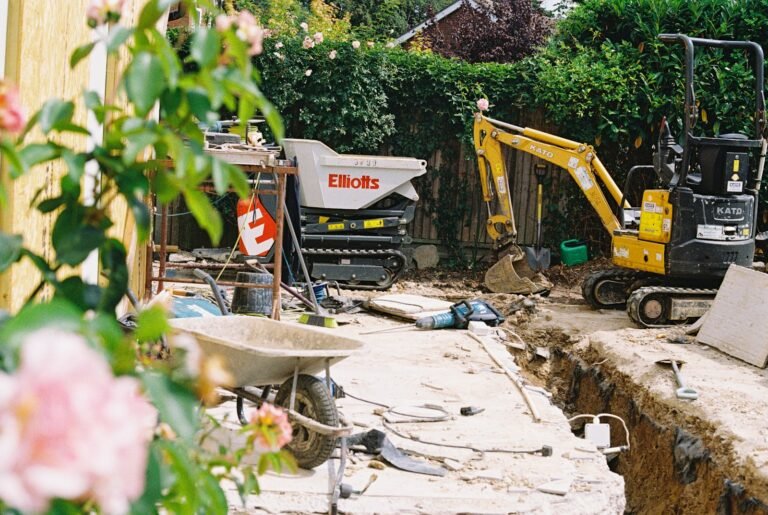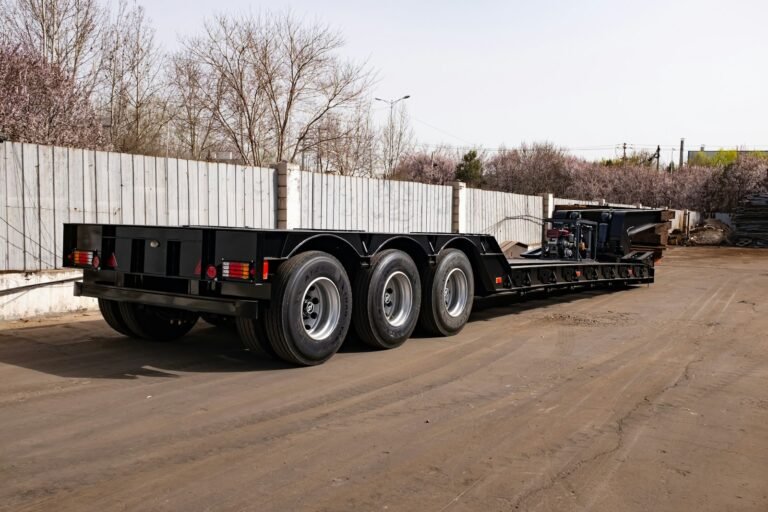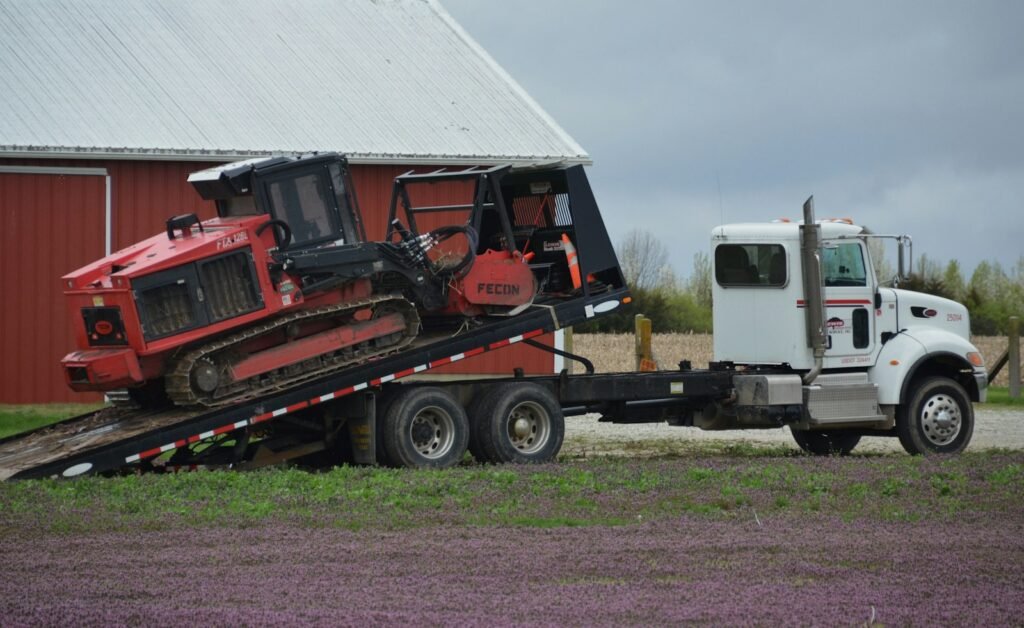
Moving your own mini digger between jobs, collecting a dumper from our depot or shifting a vehicle across the county? We offer plant trailer hire Devon-wide from our depot near Okehampton, with four trailers to choose from: a compact Brian James 9ft, a mid-size Indespension 10ft, and two Ifor Williams 18ft trailers, one flat bed and one tilt bed. This guide explains which size suits which machine, how to check the weights add up, and what your licence allows.

In this guide
Plant trailer hire Devon: the four trailers compared
| Trailer | Bed size | Key detail | Typical loads |
|---|---|---|---|
| Brian James 9ft plant trailer | 9ft × 4ft 4in | 2,700kg GVW, compact | Micro and small mini diggers, small dumpers, compactors |
| Indespension 10ft plant trailer | 10ft × 5ft 6in | Loading ramps included | Mini diggers, tracked dumpers, carriers, mixed small plant |
| Ifor Williams 18ft flat bed | 18ft × 7ft 5in | Ramp access, widest deck | Vehicles, oversized or multiple items, materials |
| Ifor Williams 18ft tilt bed | 18ft × 6ft 8in | Hydraulic tilt, drive-on loading | Wheeled plant, vehicles, machines that dislike steep ramps |
GVW (gross vehicle weight) is the most the trailer and its load can weigh together. The payload you can actually carry is the GVW minus the trailer’s own unladen weight, which is shown on the trailer’s plate. We will tell you the figures for the specific trailer when you book.
Matching the trailer to the machine
The commonest mistake is choosing a trailer by deck length alone. Check three things for every load.
- Weight. Machine operating weight (plus any buckets or attachments carried) plus the trailer’s unladen weight must stay within the trailer GVW.
- Width. Tracks must sit fully on the deck, not overhang the sides.
- Length and balance. The machine has to sit far enough forward to put a modest, positive load on the hitch, without exceeding your tow vehicle’s nose weight limit.
As a rough guide, the 9ft Brian James suits our smallest machines such as the Sunward SWE 08B micro digger and small tracked dumpers. The 10ft Indespension gives a wider bed and ramps for slightly larger compact kit. Machines towards the top of the mini range need a careful weight check, and anything from around 3.5 tonnes upward is beyond what a car-towed trailer can legally carry. For those, ask about our delivery service instead. You can browse machine sizes on our construction equipment page and see the Sunward SWE 08B in detail.
Your tow vehicle and licence
Two limits apply, and you have to stay within both. First, your vehicle’s maximum towing weight, found in the handbook and usually on the VIN plate. Many pick-ups and larger 4x4s are rated to 3,500kg braked, but plenty of cars and smaller SUVs are rated far lower.
Second, your driving licence. GOV.UK guidance says drivers who passed their car test from 1 January 1997 can now tow a trailer up to 3,500kg MAM, after the rules changed in 2021. Earlier licence holders usually have wider entitlements. Rules change, so read the current GOV.UK towing guidance and check your own entitlement before you tow. This is general information, not legal advice.
Loading and securing
- Load on firm, level ground with the trailer coupled to the tow vehicle and its handbrake on.
- Use the ramps or tilt bed slowly, in a low gear or low travel speed, with someone guiding from the side, never from in front.
- Lower the dozer blade and bucket onto the deck and turn the machine off.
- Secure the machine at four points with rated chains or straps to the trailer’s lashing points.
- Stow and secure ramps and loose items such as buckets.
- Check lights, tyres, the breakaway cable and the coupling before setting off.
- Recheck the lashings after the first few miles.
Towing on Devon roads
The A30 and A38 are straightforward, but the last few miles to most Devon and Cornish jobs are narrow lanes with high hedges, steep hills and few passing places. With a loaded 18ft trailer behind you, plan the route before you set off. Avoid sat-nav short cuts down single-track lanes, allow far longer stopping distances on descents, and think about where you will turn round at the far end. A farm gateway is not always as wide as it looks.
Wet weather adds another problem: mud. Pulling a loaded trailer off a soft field entrance is a frequent cause of trouble, so park on hardstanding where you can and walk the machine in.
What to send us for a plant trailer hire Devon quote
We do not take online bookings, because the right trailer depends on details a form would miss. A quick WhatsApp with the following lets us check the combination before you arrive:
- The machine or load you are moving, with its weight if you know it.
- Your tow vehicle’s make, model and maximum towing weight.
- Where you are going, and whether the site has hardstanding for loading.
- Your dates, and whether you want daily, weekly or longer hire.
If the numbers do not work for towing, we will say so and suggest an alternative, such as our own delivery or a smaller machine.
Collect or have it delivered
You can collect trailers from our Okehampton depot during business hours with a suitable tow vehicle. Combining a trailer with a machine hire is common; for example, a groundworker hiring a mini digger by the month may take a trailer too, so the machine can move between nearby jobs. All our trailers are listed on the trailers and mobile storage page.
A worked weight check
Numbers are where most towing problems start, so here is how to run the check yourself. The figures below are illustrative; always use the real numbers from the trailer’s plate, the machine’s specification and your vehicle’s VIN plate or handbook.
- Find the trailer GVW. The Brian James 9ft is 2,700kg GVW.
- Find its unladen weight on the trailer plate. Suppose, for this example, it showed 600kg. The most you could then load is 2,700kg minus 600kg, which is 2,100kg.
- Add up the load. Take the machine’s operating weight from its spec sheet, then add any spare buckets, fuel cans, chains and tools you will carry on the deck.
- Check your vehicle’s braked towing limit. The loaded trailer must not weigh more than this, however strong the vehicle feels.
- Check the gross train weight on the VIN plate. The loaded vehicle plus loaded trailer must stay within it. GOV.UK’s towing weight and width limits page explains that if the plate shows no train weight, the vehicle should not be used for towing.
- Check your licence covers the trailer’s maximum authorised mass.
A small digger on the 9ft trailer behind a pick-up usually passes these checks comfortably. The same load behind a mid-size car often fails on step four or five. If the numbers are tight, we would rather tell you before you set off than have you find out on the A30.
Matching trailers to machines in our fleet
As a starting point for plant trailer hire Devon customers ask us about most, these pairings are typical. Every one still needs the weight check above, using the exact machine and attachments.
| Machine | Trailer to consider | What to watch |
|---|---|---|
| Sunward SWE 08B micro digger | Brian James 9ft | Add the weight of spare buckets carried on the deck |
| Hyundai 500kg tracked dumper | Brian James 9ft or Indespension 10ft | Track width against the deck width |
| Tracspider 1000kg tracked carrier | Indespension 10ft | Use the ramps slowly with the body lowered |
| Small wheeled kit, compact tractors, vehicles | Ifor Williams 18ft tilt bed | Total weight against your vehicle’s limit, not just the trailer’s |
| Mixed loads, pallets, several small machines | Ifor Williams 18ft flat bed | Secure each item separately |
Legal checks at a glance
This summary is general information drawn from GOV.UK guidance and the Highway Code. Rules can change, so check the current guidance before you tow.
| Check | What the guidance says |
|---|---|
| Licence (car test passed from 1 January 1997) | Can tow a trailer up to 3,500kg MAM |
| Licence (car test passed before 1 January 1997) | Usually a vehicle and trailer combination up to 8,250kg MAM |
| Trailer width | Maximum 2.55m for any towing vehicle |
| Trailer length | Maximum 7m (excluding the A-frame) if the towing vehicle’s MAM is 3,500kg or less |
| Speed limits when towing | 50mph on single carriageways, 60mph on dual carriageways and motorways |
| Motorway lanes | Vehicles towing trailers must not use the right-hand lane of a motorway with three or more lanes, unless lanes are closed |
| Unbraked trailers | Must not weigh more than 750kg loaded |
| Breakaway cable or secondary coupling | Should be used, so the trailer brakes or stops if it comes off |
| Tyres | At least 1.6mm tread, no cuts or bulges, inflated for the load |
The 50 and 60mph limits are maximums, not targets. With a loaded plant trailer on Devon’s hills and bends, you will often be well below them. The full GOV.UK speed limits table covers other vehicle types.
Walk-round check before every trip
Two minutes with the trailer before you pull away catches most of the problems that cause breakdowns and roadside stops. GOV.UK publishes a fuller trailer safety checks list.
- Coupling locked fully onto the tow ball, with the indicator showing it is engaged.
- Breakaway cable attached to a proper point on the tow bar, with enough slack for corners but not dragging.
- Jockey wheel fully raised and clamped, or removed and stowed.
- Electrical plug connected and every light working: indicators, brake lights, tail lights and number plate light.
- Number plate on the trailer showing your tow vehicle’s registration.
- Tyres inflated and undamaged, wheel nuts present and tight.
- Ramps or tilt bed locked in the travel position.
- Load chained, buckets and loose items secured, nothing left on the deck that could blow off.
- Trailer handbrake released before moving off.
Unloading at the other end
Unloading is where people relax too early. Park on the firmest, flattest ground available, leave the trailer coupled with the vehicle’s handbrake on, and chock the trailer wheels if there is any slope. Release the chains one at a time, keeping clear of the machine in case it has shifted against a chain in transit.
Lower the ramps or tilt the bed, then reverse the machine off slowly and straight, with a guide standing to one side. On wet ground, a sheet of ply or a couple of boards at the bottom of the ramps stops tracks digging in as they leave the trailer. Stow the ramps and chains straight away so nothing is left lying in long grass.
Reversing and manoeuvring
Most Devon and Cornish sites involve reversing a trailer at some point, often into a yard or gateway off a narrow lane. A few habits make it far less stressful.
- Hand at the bottom of the wheel. Move your hand the way you want the back of the trailer to go.
- Make small corrections early. Once the trailer starts to fold, stop, pull forward to straighten and try again.
- Short trailers react faster. The 9ft and 10ft trailers swing quickly when reversing; the 18ft trailers are slower to respond but need more room.
- Use a guide standing where you can see them in your mirror, and agree hand signals first.
- Get out and look before reversing into a gateway, checking for posts, soft verges and ditches hidden in long grass.
- Consider towing mirrors. If the trailer or load is wider than your vehicle and blocks your view, extended mirrors make reversing and lane changes much safer.
Moorland and coastal routes
Crossing Dartmoor, Exmoor or Bodmin Moor with a trailer brings its own hazards: cattle grids, free-roaming ponies, sheep and cattle, lower speed limits in places, and exposed stretches where crosswinds catch a high-sided load. On the coast, steep valleys down to harbours and beaches often end in tight turning areas. Look at the route on a map before you go, and if in doubt take the longer, wider road.
Common mistakes with plant trailers
- Loading too far back. Too little weight on the hitch can make a trailer snake at speed. Too much overloads the tow bar. Aim for the balance the trailer and vehicle manufacturers recommend.
- Forgetting the extras. Buckets, a breaker, fuel and chains can add a surprising amount to the load.
- Tracks overhanging the deck, which makes chaining difficult and the load unstable.
- Driving with the jockey wheel down or the trailer handbrake on.
- Not rechecking chains after the first few miles, when loads settle.
- Taking a sat-nav short cut down a single-track lane with nowhere to turn.
- Assuming your insurance covers it. Check both your vehicle policy for towing and your cover for the hired trailer and machine.
What affects plant trailer hire Devon prices
We quote each hire rather than publishing a rate card. The main factors are:
- Which trailer. The 18ft tilt bed and flat bed are larger, heavier trailers than the 9ft and 10ft plant trailers.
- Hire length. Daily, weekly and monthly hire are available. If you are moving a machine between several jobs, a weekly hire often makes more sense than two separate days.
- Collection or delivery. Collecting from our depot near Okehampton with your own vehicle avoids transport charges.
- Combining with a machine hire. A trailer booked alongside a digger or dumper is planned as one job.
- Insurance, which is not automatically included.
- Condition on return. Trailers should come back clean, with ramps, chains and any loose parts present. Mud-caked decks and missing items are charged, so a quick wash before return saves money.
Deposits, payment and off-hire are covered on our hire FAQ page. For most customers looking for plant trailer hire Devon-wide, the deciding factor is simply whether their own vehicle can tow the load legally; if it cannot, our delivery service is usually the answer.
Frequently asked questions
Which trailer do I need for a 1.8 tonne digger?
It depends on the exact operating weight, attachments and the trailer’s unladen weight. Send us the machine details and we will confirm whether a trailer works or recommend delivery.
Can I tow a plant trailer with a car?
Possibly, if the car’s towing limit and your licence both cover the loaded trailer weight. Many cars are not rated for plant loads, so check the handbook first.
Do your trailers come with ramps?
The Indespension 10ft includes loading ramps, the Ifor Williams flat bed has ramp access and the tilt bed tilts for drive-on loading. Ask us about the Brian James when you book.
Is insurance included with trailer hire?
No. Insurance is not automatically included, and you should check your vehicle policy covers towing. We refer customers to insurance4plant for plant hire cover.
Do I need to pass a towing test to tow a plant trailer?
Under current GOV.UK guidance, drivers who passed their car test from 1 January 1997 can tow trailers up to 3,500kg MAM without a separate trailer test. Check your own entitlement and the current guidance before towing.
What speed can I tow at?
The legal maximum for a car towing a trailer is 50mph on single carriageways and 60mph on dual carriageways and motorways, unless a lower limit applies. With a loaded plant trailer, drive to the conditions.
Can I carry building materials on the 18ft flat bed?
Yes, as long as the total stays within the trailer’s GVW and your vehicle’s limits, and the load is properly secured. Pallets need strapping down, and loose materials need containing or sheeting.
Book your plant trailer
WhatsApp or call 07841 036064 (Mon–Fri, 7:30am–5:30pm) with the trailer you want, what you are moving, your tow vehicle, dates and whether you will collect. For written quotes, fleet enquiries or account set-up, use our contact page or email info@conagri.co.uk.