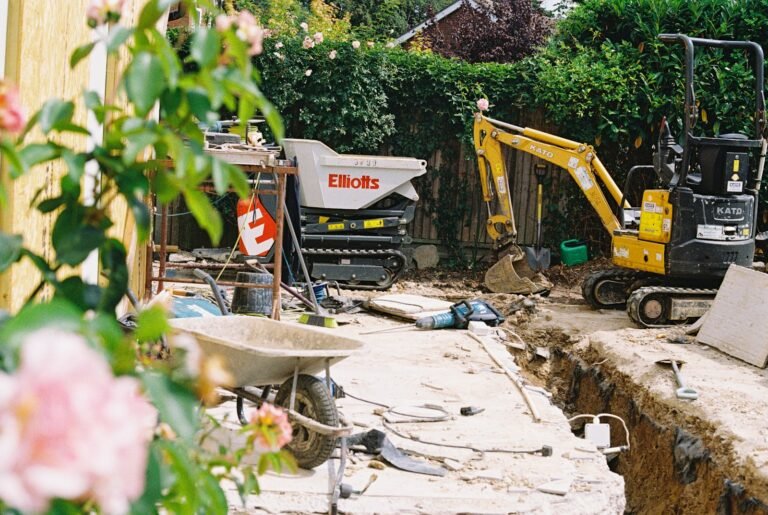
The Sunward SWE 08B is the smallest excavator in our fleet: a 0.8 tonne mini digger built for jobs where access is tight and the dig is modest. It goes where bigger machines cannot, through side gates, along garden paths and into outbuildings, and it is available with a zero tail swing option for working hard up against walls and fences. This guide explains what the machine is good at, how to get it to site, how it compares with the rest of our Sunward range, and how to hire one from our depot near Okehampton.

In this guide
What the Sunward SWE 08B is
The SWE 08B sits in the 0.8 tonne class, the lightest category of tracked excavator most hire customers will come across. It has a boom and dipper arm like any excavator, a blade at the front for backfilling and stability, and rubber tracks that spread its weight over the ground.
The zero tail swing option means the back of the machine stays within the line of its tracks as the upper body turns. In practice, that lets you dig alongside a house wall or a boundary fence without the counterweight swinging into it. When you enquire, tell us if your site needs zero tail swing and we will confirm the configuration we send.
We do not quote dig depth, reach, transport width or engine details from memory, because a few centimetres can decide whether a machine fits through your gate. Ask us for the spec sheet for the exact machine and check it against your site before you book.
Who usually hires it
- Homeowners and self-builders with a garden project too big for a spade but too small to justify a larger digger.
- Landscapers digging out for patios, paths, ponds and raised beds in finished gardens.
- Electricians and plumbers running cable or water supply trenches to garden offices, outbuildings and EV chargers.
- Small builders preparing footings for garden walls, porches and small structures, or breaking out inside barns and outbuildings.
What the Sunward SWE 08B is good for
The machine earns its keep on jobs where access, not volume, is the main problem. These are the tasks it suits best.
Residential and garden work
Levelling a garden for a patio, digging out a base for a shed or garden room, removing old paving and lifting shrubs are typical first jobs. A small bucket gives you precise control, which matters when you are working near lawns, borders and drainage you want to keep.
Landscaping
Ponds, swales, tree pits, raised bed foundations and shallow re-grading of lawns all suit a 0.8 tonne machine. The front blade is useful for spreading topsoil and pushing back loose material once the digging is done.
Trenching
Narrow trenches for armoured cable, water pipes, land drains and ducting are one of the most common uses. A narrow bucket keeps the trench tidy and reduces the amount of backfill you need to bring in. Before any trench, find out where existing services run: check utility plans, use a cable locator and hand dig near anything marked.
Small demolition and breaking out
The SWE 08B can lift and load thin slabs once an edge has been opened, clear rubble from a small outbuilding and pull out old fence posts. Heavy reinforced concrete is beyond it. For that, ask us about breaking options or a larger machine.
Where a 0.8 tonne digger reaches its limits
Being honest about limits saves wasted hire days. A small machine is slower on big volumes and lighter when it comes to breakout force and stability.
- Deep footings for two-storey extensions may need more depth than a micro machine is comfortable reaching. Check the spec sheet against your engineer’s drawings.
- Long drainage runs on open ground are faster with a 1.8 or 2.0 tonne machine if your access allows it.
- Granite, killas and heavy rock, common in parts of Dartmoor and Cornwall, can stop a small bucket. A heavier machine copes better.
- Large stumps usually need more weight and reach.
- Loading lorries or high-sided dumpers all day is slow work for a micro digger.
If your job sits on the borderline, send us a photo of the access and a short description. We would rather suggest the right size than have you fighting the machine.
Access and transport
Access is where the Sunward SWE 08B really pays off, but it still needs planning. Two questions matter: how the machine gets to your property, and how it gets from the road to the dig.
Delivery by us
Most customers have us deliver. Our driver needs a safe spot to unload, ideally on a drive or hardstanding rather than the pavement. Tell us about narrow lanes, weight limits, low bridges or overhanging trees on the approach, which are common in rural Devon and Cornwall. Single-track lanes with high hedges can be fine for a small lorry but awkward to turn in, so a postcode and a note about the approach help us plan.
Towing it yourself
A 0.8 tonne excavator is light enough for many customers to tow on a small plant trailer, and we hire suitable trailers. Our plant trailer range includes the Brian James 9ft plant trailer (2,700kg gross vehicle weight, 9ft by 4ft 4in bed) and the Indespension 10ft plant trailer (10ft by 5ft 6in, with ramps).
Before you hitch up, check these points. This is general information, so check the current guidance for your own situation.
- Your licence. GOV.UK says drivers who passed their test from 1 January 1997 can tow a trailer of up to 3,500kg maximum authorised mass (MAM), and that drivers who passed before then can usually drive a vehicle and trailer with a combined MAM of up to 8,250kg. View your licence information online to confirm your categories.
- Your vehicle’s towing limit. Most cars and vans have a maximum towing weight in the handbook, and a gross train weight (the fully loaded vehicle plus fully loaded trailer) on the VIN plate. GOV.UK says that if the VIN plate does not list a train weight, you should not use the vehicle for towing.
- The trailer’s own limit. The weight of the machine, its buckets and the trailer together must stay within the trailer’s gross vehicle weight.
- Size limits. According to GOV.UK towing weight and width limits, the maximum trailer width is 2.55 metres, and a vehicle with a MAM of 3,500kg or less cannot tow a trailer longer than 7 metres. Our compact plant trailers are well inside both.
Load the machine squarely, drive up the ramps slowly with the bucket low and someone guiding you, then lower the bucket and blade onto the bed and secure the machine with chains or ratchet straps at its lashing points. Check the straps after the first few miles. If you have not towed plant before, let us deliver.
From the road to the dig
Measure the narrowest point on the route, including gate posts, downpipes, meter boxes and wheelie bins, and compare it with the transport width on the spec sheet. Lay boards or ground protection mats over lawns and block paving, and look for flimsy manhole covers that a tracked machine could crack. Steps and steep ramps are the usual show-stoppers, so mention them when you enquire.
Attachments: ask us
An excavator is only as useful as the tool on the end of its arm. Different jobs call for different buckets: a narrow bucket for cable and pipe trenches, a wider digging bucket for general excavation, and a ditching or grading bucket for shaping banks and levelling. Some jobs also benefit from a breaker or an auger.
What comes with the machine, and what else is available, can change, so ask us when you book. Tell us the trench widths you need and the type of ground, and we will tell you what we can supply or point you in the right direction. Do not fit attachments from another machine without checking they are compatible and safe for this size of excavator.
How the Sunward SWE 08B compares with our other Sunward sizes
We run seven Sunward excavators, from this 0.8 tonne machine up to a 9 tonne full-size excavator. The table shows where each sits. For dig depths, widths and weights, ask us for each machine’s spec sheet.
| Sunward model | Class | Type | Typical jobs |
|---|---|---|---|
| SWE 08B (this machine) | 0.8 tonne | Mini, zero tail swing option | Narrow garden access, cable trenches, small footings, indoor dig-outs |
| SWE 18UF | 1.8 tonne | Zero tail swing | Extensions, drainage runs, footings, driveway dig-outs |
| SWE 20F | 2.0 tonne | Conventional mini | Drainage and utility work with more room to slew |
| SWE 25UF | 2.5 tonne | Zero tail swing | Versatile mid-range groundworks, larger footings |
| SWE 35UF | 3.5 tonne | Zero tail swing | Larger groundworks, site strip, bigger drainage schemes |
| SWE 60UF | 6.0 tonne | Zero tail swing | Medium groundworks, bulk loading, farm and estate work |
| SWE 90UF | 9.0 tonne | Full-size excavator | Heavy demolition and bulk digging |
The most common comparison is with the next size up. The Sunward SWE 18UF is a 1.8 tonne zero tail swing machine that digs faster, deeper and more steadily, but needs wider access. If your gate or passage will take the bigger machine, it usually finishes larger jobs sooner. If it will not, the SWE 08B is the one that actually gets to the work. Our construction equipment page lists the full excavator range alongside dumpers, compaction kit and mixers.
Site preparation before your Sunward SWE 08B arrives
Most lost hire time comes from things that could have been sorted the week before. Run through this checklist.
- Mark out the job with string lines and marker paint so you start digging in the right place.
- Locate buried services. Get utility plans, scan with a cable locator, and mark gas, water, electricity, telecoms and drains. Old garden cables to sheds and lights are a frequent surprise.
- Plan the spoil. Book a skip or grab lorry, and get a permit if the skip will sit on the road. Decide how soil will travel from the dig to the skip; a tracked dumper or carrier keeps the digger working.
- Separate topsoil. Strip and stack turf and topsoil apart from subsoil so you can reuse it.
- Protect surfaces along the route with boards or mats.
- Tell the neighbours your dates and working hours, particularly if access runs over a shared drive.
- Have materials ready. Pipe, ducting, sub-base and concrete should be on site, or booked, before the machine arrives.
- Check the weather. South West clay and loam turn greasy after heavy rain. A small machine on a wet slope is less stable, so be ready to pause.
Moving spoil with a small digger
A micro digger fills a barrow very quickly. Pair it with a narrow tracked carrier such as the Hyundai 500kg tracked dumper or the Tracspider 1000kg electric carrier, or the quiet Tracspider Elektro Joe for indoor or noise-sensitive sites. That way the excavator digs while the carrier runs.
Safety and training
Our hire is self-drive unless otherwise agreed, so the hirer is responsible for safe operation and must hold appropriate training or certification. This section is general information, not legal advice.
Training and competence
The Provision and Use of Work Equipment Regulations 1998 (PUWER) apply to work equipment used at work. According to HSE guidance on training and competence under PUWER, people who use, supervise or manage work equipment should be sufficiently competent to do so safely, and self-propelled equipment, including attachments or towed equipment, should only be driven by workers who have received appropriate training in safe driving. If you are not trained, bring in someone who is, or ask us and we will point you in the right direction.
Excavations
HSE excavation guidance says the need for trench support should be decided before digging starts, and that spoil, materials and plant should be kept back from the edge. Never enter an unsupported trench, however shallow it looks, and fence or cover open excavations when you stop work.
Everyday safety habits
- Do a walk-round check each morning: tracks, hoses, pins, fluid leaks and the seat belt.
- Wear the seat belt. A light machine can tip if it is overloaded or worked across a slope.
- Travel with the bucket low and work up and down slopes, not across them.
- Keep people, children and pets well outside the reach of the arm.
- Never lift people in the bucket.
- Do not run the engine indoors or in a pit without proper ventilation, because exhaust fumes build up quickly.
- At the end of the day, lower the bucket and blade, remove the key and keep it safe.
Insurance for hired plant is not automatically included. We refer customers to our partner insurance4plant.co.uk for plant hire cover.
Common mistakes on micro digger hires
- Measuring the gate but not the route. A wheelie bin store or a downpipe halfway along the passage can be narrower than the gate.
- No plan for spoil. The digger sits idle while someone wheels soil away by hand.
- Booking too short. One day often turns into two once you include delivery, set-up and tidying. Weekly hire usually works out better per day.
- Digging blind near services. Hand dig the last part near anything marked.
- Expecting a micro digger to break heavy concrete. Ask about breaking options first.
- Forgetting to off-hire. Charges run until you have off-hired with us and have a reference.
Hire periods and Flex Hire
You can hire the Sunward SWE 08B daily (minimum usually one day), weekly, monthly or long-term. Weekly is our most popular period, and for most garden and landscaping jobs it gives breathing room for weather and surprises. We do not publish hire prices, so WhatsApp us for a current quote.
| Hire option | Best for | Notes |
|---|---|---|
| Daily | Single-day trenches or a quick dig-out | Minimum usually one day |
| Weekly | Most garden, landscaping and footing jobs | Our most popular period |
| Monthly / long-term | Self-builds and phased projects | Monthly rates with on-site servicing included |
| Flex Hire | Contractors who need different kit over the month | One flat monthly fee, swap kit any time |
For longer projects, our long-term rental offers monthly rates with on-site servicing. Flex Hire is a single flat monthly fee with four tiers, swaps any time, servicing included, a 10% rebate and no long-term contract. Tier 1 covers compact kit and everyday tools from £795 +VAT and delivery per month, and Tier 2 adds excavators and crushers at £895. Tier 3 at £995 adds large excavators and forklifts, and Tier 4 at £1,495 covers everything including 9 tonne excavators and tractors. Ask us which tier fits your mix of machines.
Delivery across Devon, Cornwall, Somerset and Dorset
We deliver from our depot near Okehampton across all four counties. Same-day delivery is possible across most of Devon and Cornwall, and Day 1 delivery is available. Somerset and Dorset jobs are best booked a little further ahead.
When you get in touch, send us the machine, your site postcode, your dates and access details: the narrowest width on the route, any steps or slopes, and where the lorry can unload. A couple of photos save a lot of back and forth. If something goes wrong during the hire, call or WhatsApp us and we will assess it and arrange a repair or replacement quickly.
At the end of the hire, clean off the worst of the mud, park the machine somewhere firm and accessible, and off-hire with us. Charges stop once the off-hire is confirmed.
Frequently asked questions
Does the Sunward SWE 08B have zero tail swing?
It is available with a zero tail swing option. If your dig runs tight against a wall or fence, say so when you enquire and we will confirm the configuration of the machine we send.
Will it fit through my side gate?
Often, yes, as it is our narrowest excavator. Measure the tightest point on the whole route and ask us for the spec sheet to compare against the transport width.
How deep can it dig?
Ask us for the spec sheet. Dig depth depends on the machine configuration and bucket, and we would rather you check the figures against your drawings than rely on a guess.
Can I tow it with my own vehicle?
Many customers do, on one of our compact plant trailers. Your licence entitlement, your vehicle’s towing limit and the trailer’s gross weight all have to allow for the combined load. Check the GOV.UK guidance before you go.
Do I need a licence to operate it?
Whatever paperwork your site asks for, you must be trained and competent to operate it. Our hire is self-drive and the hirer must hold appropriate training or certification. Many commercial sites also ask for a recognised operator card, so check with your client or principal contractor.
Is it suitable for working indoors?
It is small enough for many barns and outbuildings, but a diesel engine indoors needs proper ventilation. Check floor strength too. For quiet, zero-emission moving of spoil indoors, ask about the Tracspider Elektro Joe.
Is insurance included?
No. Insurance is not automatically included with our hire. We refer customers to our partner insurance4plant.co.uk for plant hire cover.
Hire the Sunward SWE 08B
To book, WhatsApp or call 07841 036064 (Monday to Friday, 7:30am to 5:30pm) with your postcode, dates and a photo of the access. We aim to reply to WhatsApp within the hour during business hours. For written quotes or account enquiries, use our contact page or email info@conagri.co.uk.