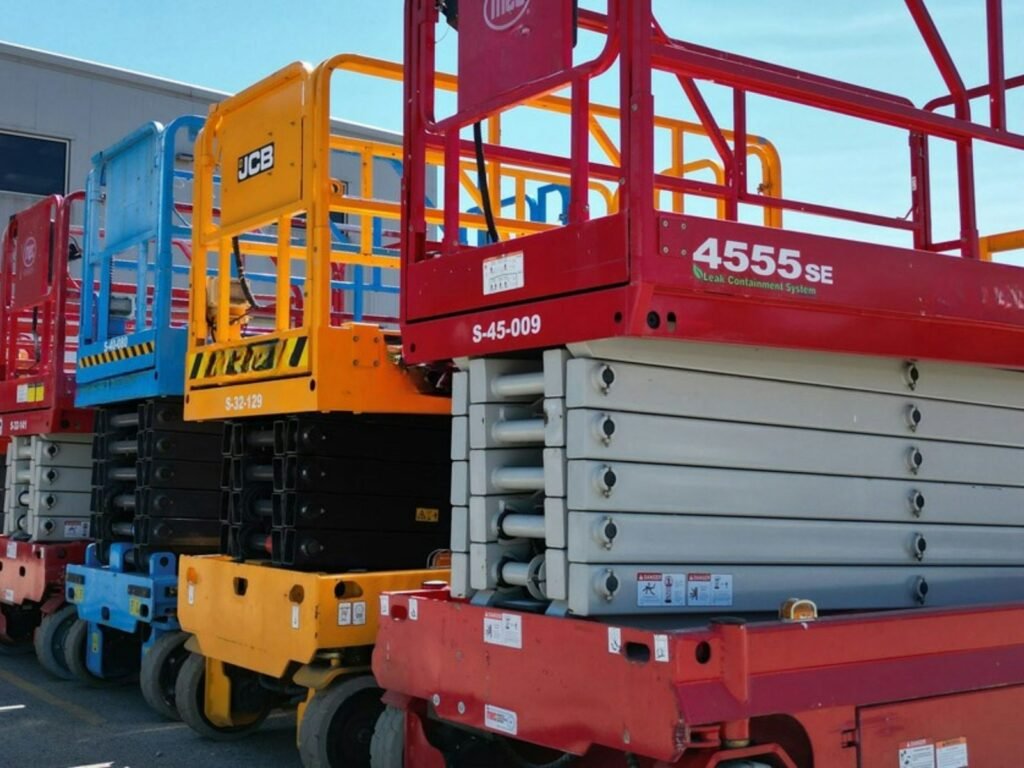
Our scissor lift hire Devon customers mostly need one thing: a safe, stable platform to work up to about 8 metres, indoors or out, without fumes. The Sunward 0807DC electric scissor lift does exactly that. It is battery powered, self-propelled and has a maximum platform height of 8m, which covers most warehouse racking, retail ceilings, signage, lighting and high-level maintenance. It is delivered from our Okehampton depot across Devon, Cornwall, Somerset and Dorset.

In this guide
The Sunward 0807DC at a glance
The 0807DC sits in our warehouse and cleaning range under access equipment. Key points:
- Maximum platform height: 8m.
- Power: battery electric, so no exhaust fumes inside buildings and low noise.
- Drive: self-propelled, so the operator can move it from the platform between work positions.
- Use: rated for indoor and outdoor use, on suitable firm and level ground.
Platform height is not the same as working height. Manufacturers usually quote working height as roughly 2m above platform height, to reflect a person’s reach. Measure the highest point you need to work at and we will confirm whether the 0807DC suits it, along with the platform’s safe working load for people, tools and materials.
Where an 8m scissor lift earns its keep
Warehouses and distribution units
Changing high-bay lights, fixing racking labels, maintaining roller shutter doors and checking sprinkler heads are all classic scissor lift jobs. Electric drive means you can work in a live warehouse without diesel fumes around stock or staff.
Retail and commercial fit-outs
Shopfitters and electricians use scissor lifts for suspended ceilings, cable tray, ductwork, signage and display installations in units from Exeter and Plymouth to the retail parks along the A30 and A38. A scissor lift gives a larger platform than a podium step, so two people and their materials can work side by side.
Schools, halls and agricultural buildings
Summer holiday maintenance in schools, sports halls and community buildings is a common booking. On farms, scissor lifts are used for lighting, cladding repairs and fitting gutters on portal frame sheds, provided the floor or yard is firm and level enough.
Scissor lift hire Devon: check the floor before you book
A scissor lift concentrates a lot of weight onto four small wheels, and that load moves as the machine drives. Before booking, check:
- Floor strength. Ground-bearing concrete slabs in modern warehouses are generally fine. Suspended floors, mezzanines, old timber floors and access covers need checking with whoever is responsible for the building. Ask us for the machine’s weight and wheel loads.
- Level and condition. Scissor lifts are designed to be raised on firm, level ground. Cracks, potholes, slopes and soft spots are a tip-over risk. Outside, avoid backfilled trenches and manholes.
- Access route. Measure doorways, corridors, lifts and ramps along the route in, and check the delivery vehicle can unload near an entrance.
- Overhead hazards. Look for beams, pipework, cable runs and roof lights that could trap the operator as the platform rises. Outside, keep well clear of overhead power lines.
- Charging. Plan where the lift will be charged overnight, close to a suitable socket and out of traffic routes.
What to measure before booking
Most access hires that go wrong do so because one measurement was missed. Before you contact us about scissor lift hire in Devon or elsewhere in the South West, gather these figures. Photos alongside them help even more.
| Measure | Why it matters |
|---|---|
| Height to the highest point you need to work on | Confirms whether an 8m platform gives you comfortable reach without overstretching |
| Narrowest door, gate or corridor on the route in | The lift has to physically get to the work area |
| Any lifts, ramps or steps on the route | Goods lifts have weight limits, and ramps need to be within the machine’s gradeability |
| Floor type and any suspended areas | Lets the building owner or engineer check the floor can take the wheel loads |
| Obstructions at height | Beams, ducts, sprinkler pipes and lights can create trapping points as the platform rises |
| Weight of people, tools and materials on the platform | Must stay within the platform’s rated safe working load |
| Charging point location | The battery needs charging overnight near a suitable socket |
We will give you the machine’s stowed dimensions, weight and platform load when you enquire, so you can compare like with like.
Delivery and handover
The lift arrives on our delivery vehicle and is unloaded at the point you have agreed, so tell us about kerbs, steps, gates and any height barriers in car parks on the way in. Someone needs to be on site to sign for it. At handover we will show the operator the controls, the emergency stop and the emergency lowering procedure, and point out the charging connection. When the job is finished, lower the platform fully, leave the machine charged and somewhere we can reach, and let us know it is ready to collect.
Training, inspection and the rules that apply
Hire from us is self-drive, so the person operating the lift must be trained and competent. HSE’s guidance on mobile elevating work platforms says operators should have formal training from a recognised provider, carry proof of training covering the MEWP category they are using, and be familiarised with the specific make and model. In practice, many sites ask for an IPAF PAL card covering static or mobile vertical platforms. Check what your client or site requires before the hire starts.
MEWPs must be thoroughly examined at least every six months under lifting equipment rules. Alongside that, the operator should carry out a pre-use check each day: controls, emergency lowering, guardrails, gate, tyres, battery charge and any warning labels. If anything is not right, do not use it and contact us straight away.
Rescue plan and supervision
Your work-at-height planning should include how a person would be brought down if the operator became unwell or the controls failed. Make sure someone on the ground knows how to use the emergency lowering system. Use barriers or a banksman where the lift works near pedestrians or forklifts.
Daily pre-use checks, step by step
A pre-use check takes a few minutes and should be done by the operator at the start of every shift. Work round the machine in the same order each time so nothing gets missed:
- Walk round the base. Look for damage to the chassis, tyres and wheels, hydraulic leaks on the floor, and anything loose or missing.
- Check the scissor pack. Look along the arms and pins for bent sections, cracks, missing clips or debris caught in the mechanism.
- Inspect the platform. Guardrails secure, entry gate closing and latching properly, floor clear and undamaged, and any extension deck locking in place.
- Read the labels. The safe working load, capacity and warning decals should be present and readable.
- Test the ground controls, including the emergency stop and the emergency lowering system, before anyone goes up.
- Test the platform controls: drive, steer, raise, lower, horn, tilt alarm and emergency stop.
- Check battery charge and the charger lead for damage.
If anything fails, tag the machine out of use and contact us. Do not try to repair it yourself. We will assess it and arrange a repair or a replacement, and hire charges are dealt with under our breakdown terms where the fault is not caused by misuse.
Guardrails, harnesses and staying in the platform
On a scissor lift, the guardrails are the main protection against falling. Keep both feet on the platform floor at all times, never stand on the mid-rail or toe board, and never use ladders, steps or boxes on the platform to gain extra height. If you cannot reach, lower down, reposition and go up again.
Whether a harness is needed depends on the work and the risk assessment. HSE guidance says that where a risk of falling from the platform remains, a harness with a short work restraint lanyard should be secured to an anchorage point provided by the manufacturer. Follow the machine’s instructions and your site rules, and check the current guidance if you are unsure.
Do not climb out of the platform onto racking, roofs or mezzanines at height unless the job has been specifically planned for it.
Scissor lift, tower or podium: quick comparison
| Option | Good for | Limitations |
|---|---|---|
| Electric scissor lift (0807DC) | Repeated high-level tasks, moving along a run of work, two-person jobs | Needs firm, level floor and adequate access route |
| Mobile aluminium tower | Uneven floors where a lift will not go, long stays in one spot | Slow to move and re-erect, needs trained erectors |
| Podium steps | Low-level, short tasks | Limited height and platform space |
We hire the scissor lift, not towers or podiums. If your job suits one of those better, ask us and we will point you in the right direction.
Working outdoors in Devon: wind and ground
The 0807DC can work outside, but the South West’s weather needs respect. Coastal sites from Exmouth to Bude and exposed upland sites around Dartmoor can see strong gusts with little warning, and wind funnelling between buildings or through a large open shed door can be stronger than the forecast suggests.
- Know the wind limit. HSE advises setting a maximum safe wind speed for operation. Check the manufacturer’s limit on the machine or in the manual and stop work, lowering the platform, before it is reached.
- Remember sail area. Sheet materials, banners and signage on the platform catch the wind. Plan lifts of large panels for calm days.
- Stick to firm, level surfaces. Tarmac and concrete yards are fine. Loose gravel, grass, soft verges and recently backfilled trenches are not, especially after a wet spell when Devon clay softens.
- Watch slopes. Many farmyards and car parks fall towards a drain. The machine’s tilt alarm will sound if it is out of level when raised. Do not override it.
- Keep well clear of overhead power lines, which run across many farmyards and rural sites.
After severe weather, inspect the lift before use, as HSE recommends.
Scissor lift hire Devon: three worked examples
These illustrative scenarios show how the planning comes together in practice.
LED lighting upgrade in an Exeter trade unit
An electrician needs to replace twenty high-bay fittings at around 7m in a portal-frame unit with a concrete floor. The 8m platform gives comfortable reach. The unit stays open, so the work area is coned off section by section, and the lift is charged overnight beside the office. A weekly hire covers the job with room for delays.
Summer works in a school hall
A facilities team plans to repaint high walls and service wall-mounted heaters during the holidays. The hall has a sprung timber floor, so the school confirms with its building surveyor that the floor can take the machine’s wheel loads, and floor protection boards are laid on the route. Fire exit widths are checked against the lift’s stowed width before booking.
Gutter repairs on a farm building near Holsworthy
A farmer needs to replace a section of gutter along a livestock shed. The yard is concrete but slopes to a central drain, so the work is planned along the level strip beside the building, and the overhead supply cable to the dairy is identified and avoided. Work is scheduled for a calm, dry day.
Planning the day: common mistakes to avoid
Most problems with access hire are avoidable with ten minutes of planning. These are the ones we see most often:
- Measuring to the ceiling, not the work. Measure to the fitting, beam or sign you need to reach, then allow for comfortable reach from the platform.
- Forgetting the doorway. A lift that cannot get through the fire exit is no use. Measure the narrowest point on the route.
- Not clearing the aisle. Stock, pallets and bins left in the work area slow everything down and create trip hazards on the platform route.
- Running the battery flat. Put it on charge at the end of every shift, not when it starts to slow.
- Overloading the platform. Count people, tools and materials against the rated load before going up.
When you contact us for scissor lift hire Devon-wide, send photos of the access route and floor if you can. It helps us spot problems before the delivery driver arrives, rather than on the day.
What affects the cost of your hire
We quote every job individually rather than publishing rates, because a quote for scissor lift hire Devon-wide depends on more than the machine. The main factors are:
- Length of hire. A single day suits a quick lamp change, but weekly hire is often better value for fit-outs and maintenance programmes, and it absorbs delays from other trades.
- Delivery distance and access. Transport is quoted separately from our depot near Okehampton. Town-centre deliveries with loading restrictions or a long walk from the unloading point may need a specific time slot.
- Out-of-hours delivery. If the lift must arrive before a shop opens or after it closes, tell us at the start so we can say what is possible.
- Hire structure. Long-term rental and Flex Hire spread the cost over a monthly fee, with servicing included.
- Insurance. Hired equipment is not automatically insured. Check your policy covers hired-in plant, or speak to our partner insurance4plant.co.uk.
Ask us for a written quote by email if you need one for a purchase order or a client’s approval.
Short hire, long-term or Flex Hire
A daily or weekly hire suits a one-off job such as a lighting upgrade. For fit-out contractors and facilities teams who need access equipment month after month, our long-term rental offers monthly rates with on-site servicing included. Scissor lifts are also included from Tier 3 of our Flex Hire account, which lets you swap between equipment in your tier for one flat monthly fee.
Booking ahead
A few days’ notice is usually enough, and same-day delivery is often possible across most of Devon and Cornwall subject to availability. For school holidays and planned shutdowns, book earlier, as these periods are busy for scissor lift hire Devon schools and businesses rely on.
Frequently asked questions
Can the 0807DC be used outside?
Yes, it is rated for indoor and outdoor use. Outdoors, it still needs firm, level ground, and wind conditions must be within the manufacturer’s limits.
Do I need an IPAF card to operate a scissor lift?
The legal requirement is adequate training and competence. An IPAF PAL card is the most widely recognised proof and many sites insist on one, so check with your site or client.
How long does the battery last?
It depends on how much driving and lifting you do. Most users charge overnight. Tell us your working pattern and we will advise.
Can you deliver to a town centre unit?
Usually, yes. Send the postcode, access details, any loading restrictions and the best unloading point.
Can a scissor lift be used on a mezzanine floor?
Only if the person responsible for the building confirms the mezzanine is designed to take the machine’s weight and wheel loads, and there is a safe way to get it up there. Ask us for the figures to pass on.
Does scissor lift hire in Devon include an operator?
No. Our hire is self-drive, so you provide a trained, competent operator. We will run through the controls and emergency lowering at handover.
What happens if the lift breaks down during the hire?
Stop using it, lower the platform using the normal or emergency controls, and call or WhatsApp us straight away. We will assess the problem and arrange a repair or replacement as quickly as we can. Do not attempt repairs without our agreement.
Book a scissor lift
WhatsApp or call 07841 036064 with your site postcode, working height, dates and floor details, and we will confirm availability. For written quotes and account set-up, use our contact form.