
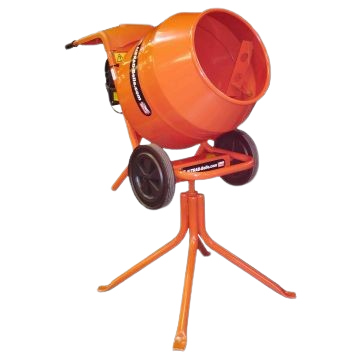
Concrete mixer hire comes down to one question: what are you mixing? For wet concrete and mortar, a drum mixer such as the Altrad Belle Mini Mix 150 or a Belle electric cement mixer does the job well. For semi-dry floor screed, resin-bound surfacing or stiff mixes, a Baron forced action mixer gives a far more even result. Both are available from our Okehampton depot with delivery across Devon, Cornwall, Somerset and Dorset.
In this guide
Drum mixer or forced action mixer: how they differ
A drum mixer tumbles the material. The drum rotates at an angle, fins inside lift the mix and drop it back on itself, and gravity does the rest. That works well when there is enough water in the mix for it to fold over, which is why drum mixers are the standard for general concrete, bricklaying mortar and render.
A forced action mixer works the other way round. The pan stays still and powered paddles drive through the material, so every part of the batch is pushed and turned regardless of how wet it is. That is what you want for semi-dry screed, which tends to roll into balls in a drum, and for resin-bound aggregates, where every stone needs an even coat of binder.
| Machine | Type | Best for | Less suited to |
|---|---|---|---|
| Altrad Belle Mini Mix 150 | Electric drum, 150 litre drum | Mortar, small concrete pours, post holes, garden walls | Large slabs, semi-dry screed |
| Altrad Belle electric cement mixer | Electric drum, various drum sizes | General site and domestic concrete and mortar | Resin-bound and very stiff mixes |
| Baron forced action mixer | Pan with powered paddles, various sizes | Floor screed, resin-bound surfacing, consistent concrete batches | Tiny one-off jobs where a drum would do |
Batch sizes: the drum size is not the batch size
The most common mistake we hear about is ordering a mixer by its headline drum volume and expecting that much concrete out of every load. A 150 litre drum does not produce 150 litres of usable mix. The drum has to be part-empty for the tumbling action to work, so the working batch is noticeably smaller. The plate on the machine or the manufacturer’s handbook gives the real figure, and we will tell you when you book.
Work out your total volume first. One cubic metre is 1,000 litres. A shed base 3m by 3m at 100mm deep needs 0.9 cubic metres, or 900 litres of concrete, before you allow for waste and uneven sub-base. That is a lot of batches for a small drum mixer and a long day for whoever is loading it.
When to think about ready-mix instead
If your pour runs into several cubic metres and needs to go in as one continuous slab, site mixing becomes slow and risks cold joints between batches. In that case a ready-mix delivery may be the better plan, with a mixer on site for the bedding, haunching and small pours that follow. If you are unsure, send us your dimensions and we will talk it through.
What each concrete mixer hire option suits
Altrad Belle Mini Mix 150
Listed on our hand tools and mixers page, the Mini Mix 150 is compact, electric and light enough to move around a garden or a tight terraced site. It is the right choice for setting fence posts, building a garden wall, bedding kerbs, or mixing mortar for a run of blockwork. Because it is electric, there are no exhaust fumes, which matters if you are working close to a house or in a partly enclosed space.
Altrad Belle electric cement mixer
The larger Belle electric mixers sit in our construction equipment range and come in different drum sizes. They suit builders doing extensions, footings top-ups and steady mortar supply for bricklayers, where you want more volume per batch than the Mini Mix gives.
Baron forced action mixer
The Baron is a heavy-duty machine built for resin, concrete and screed, also offered in different sizes. Flooring contractors use forced action mixers because a semi-dry sand and cement screed needs thorough, consistent mixing to lay and compact properly. Resin-bound driveway installers rely on the same action to coat aggregate evenly without crushing it.
Screed, resin and concrete: getting the mix right
Each material behaves differently in the mixer, so follow the product data sheet for anything proprietary. As general guidance:
- General concrete: add part of the water first, then aggregate and cement, then top up the water gradually. Too much water weakens the finished concrete, so aim for a workable mix rather than a runny one.
- Mortar: keep batches to what the bricklayer can use before it starts to stiffen. Consistent gauging (using the same bucket for sand and cement every time) keeps the colour even across a wall.
- Semi-dry screed: use a forced action mixer. The mix should hold together when squeezed in a gloved hand without water running out.
- Resin-bound aggregate: mix to the resin manufacturer’s timings exactly. Over-mixing can damage the aggregate, under-mixing leaves dry patches that show on the surface.
Power, setting up and cleaning down
Our Belle mixers are electric, so check what supply you have before delivery. Many construction sites run 110V tools through a transformer, while domestic jobs often use a 230V socket. Ask us which voltage the machine you are hiring runs on and we will confirm what you need. Use an outdoor-rated extension lead of a suitable rating, kept out of standing water.
Set the mixer on firm, level ground close to your materials and as near the pour as practical, so you are not barrowing wet concrete across a lawn. Put a board or sheet underneath to catch spills.
Clean the drum or pan as soon as you finish, before anything sets. A few shovels of coarse aggregate and water run for a couple of minutes will scour out most residue. Do not wash concrete slurry into a road gully or surface water drain, as these usually run straight to a stream. Let washings settle in a container or skip and dispose of the solids properly. Equipment returned with set concrete inside may be cleaned at your cost, as set out in our hire terms.
Safety: cement is harsher than it looks
Wet cement is highly alkaline and can cause serious skin burns if it is trapped against skin, for example inside a boot or glove. The HSE’s guidance on working with cement recommends waterproof gloves, washing cement off skin promptly and using eye protection. Our checklist for mixing days:
- Waterproof gloves that fit tightly at the wrist, safety glasses and long sleeves.
- Wellingtons with trousers worn over the top for large pours.
- Clean water and soap on hand for washing skin and an eyewash if you can.
- Never reach into a rotating drum or pan. Switch off and isolate before clearing a blockage.
- Keep children and pets well away from the machine and the wet concrete.
Working out quantities before your concrete mixer hire
Getting the volume right before you book saves a second trip to the builders’ merchant and tells you which mixer makes sense. Measure length, width and depth in metres and multiply them together to get cubic metres. Then add a margin for waste, spillage and an uneven sub-base. Around 10% is a sensible allowance on most small jobs.
Three illustrative examples
- Fence posts: twenty posts set in holes roughly 300mm square and 600mm deep need a little under 1 cubic metre of concrete in total once you take the posts themselves out. Bagged post mix suits a handful of posts, but for a long run a small drum mixer and bulk materials are often more practical.
- Garden wall footing: a strip 6m long, 450mm wide and 225mm deep is about 0.6 cubic metres. That is a comfortable morning with a Mini Mix 150 and a second person loading.
- Single garage base: 3m by 6m at 100mm deep is 1.8 cubic metres, nearer 2 with waste. With a drum mixer that is a long, steady day of batches, so either have help on hand or look at a larger Belle mixer, or ready-mix for the slab and the mixer for everything around it.
These are worked examples to show the method, not a design. Footing depths, slab thickness and mix strength for anything structural should come from your drawings, building control or an engineer.
Bags, bulk bags and how to order materials
For a few batches, bagged cement and bags of ballast or sharp sand are easiest to handle. For anything over about half a cubic metre, bulk bags of aggregate delivered by the merchant are usually more economical and save a lot of carrying. Ask for the bulk bags to be dropped as close to the mixer position as the lorry can reach, and keep cement dry and off the ground under a sheet or in a shed. Cement that has taken on moisture goes lumpy and should not be used for anything that matters.
Setting up an efficient mixing station
Most of the time on a mixing day is spent moving materials, not mixing them. A well-laid-out station can make the difference between finishing by lunch and still going at dusk.
- Put the mixer between the materials and the pour. Sand and aggregate on one side, cement and water on the other, and a clear barrow route to where the concrete is going.
- Use a gauging bucket. Measure every ingredient with the same bucket or shovel count so each batch matches the last. That matters for strength and, on visible work, for colour.
- Plan the barrow run. Lay scaffold boards over lawns and soft ground, and avoid ramps steeper than you can comfortably push a full barrow up.
- Bring in a carrier for longer runs. If the pour is at the back of a terrace or across a garden, a small tracked carrier saves a great deal of effort. Our Tracspider Elektro Joe is an electric tracked transporter with a tipping body, quiet enough for residential streets and with low ground pressure on lawns. On bigger sites, a dumper from our construction range does the same job.
- Keep a hose or water butt beside the mixer for topping up batches and for the clean-out at the end.
110V or 230V: power for an electric mixer
On construction sites, HSE guidance recommends reduced low voltage (110V) supplies for portable electrical equipment, because a fault at 110V is far less likely to cause a fatal shock. If you are working on a commercial site, expect the principal contractor to require 110V tools and a site transformer. On a domestic job, a 230V machine plugged into a socket protected by a residual current device (RCD) is common. Whichever you use:
- Check the lead and plug for damage before you start, and keep connections off wet ground.
- Use an extension lead rated for the mixer’s motor and fully unwound if it is on a reel, as a coiled drum can overheat.
- Route leads away from barrow runs and vehicle access so they are not cut or crushed.
- Switch off and unplug before cleaning inside the drum or pan.
Tell us which supply you have when you book and we will confirm the right voltage machine or what you need to run it.
Mixing in South West weather
Devon and Cornwall rarely see long hard frosts, but the weather still shapes a good mixing day. A few points to plan around:
- Cold: do not place concrete or lay mortar onto frozen ground or frosted blocks, and protect fresh work overnight if a frost is forecast. Hessian, insulation boards or polythene over the work all help. On Dartmoor and Exmoor the temperature can be noticeably lower than on the coast, so check the forecast for your site rather than the nearest town.
- Rain: heavy rain on a fresh slab washes cement out of the surface and leaves it weak and dusty. Have sheets ready and stop pouring if a downpour arrives. Wet ground also makes barrow runs hard work, so lay boards in advance.
- Warm, windy days: concrete and mortar stiffen faster and surfaces dry out before they cure. Mix smaller batches, keep materials in the shade, and cover or lightly mist fresh concrete so it cures slowly.
If a wet week is forecast and the job can wait, talk to us about moving the hire dates rather than fighting the weather.
Common concrete mixer hire mistakes
- Choosing by drum size alone. As above, usable batch size is smaller than drum volume. Ask us for the real working figure.
- Using a drum mixer for semi-dry screed. It balls up and the floor suffers. Book the Baron for screed.
- Adding water to rescue a stiff batch. Extra water makes concrete easier to place but weaker when it sets. Get the mix right at the start.
- Mixing more than can be placed. Concrete and mortar start to stiffen as soon as they are mixed. Size each batch to what the team can lay before it goes off.
- Leaving the clean-out until later. A drum or pan with set concrete in it is a long, hard job to clear and may lead to a cleaning charge.
- Forgetting the extras. Shovels, a gauging bucket, barrows, boards, a tamping beam, sheets and a hose all need to be on site before the first batch.
Delivery, handover and collection
When you book your concrete mixer hire, tell us the site postcode, where the mixer needs to go and anything about access: steps, narrow side passages, gravel drives or parking restrictions. On delivery we will set the mixer down as close to your chosen spot as is safe and show you the controls, how to tip the drum and how to stop it. You or someone you nominate needs to be there to sign the delivery note.
When the job is done, clean the mixer and leave it somewhere we can reach. Let us know when it is ready to go back. If the work runs on longer than planned, message us before the hire ends and we will extend it where availability allows. Builders who use mixers every week can ask about our long-term rental, which gives monthly rates with servicing included.
Frequently asked questions
Can I mix floor screed in a normal cement mixer?
You can try, but semi-dry screed tends to ball up in a drum mixer and the result is often uneven. A forced action mixer such as the Baron is the better tool for screed.
How long should I hire a concrete mixer for?
Our minimum hire is usually one day. For a weekend garden wall a day or two is often enough, while extensions and flooring jobs usually go on weekly hire. Ask us about a current quote for either.
Do you deliver mixers or can I collect?
Both. You can collect from Okehampton during opening hours or we can deliver, with same-day delivery possible across most of Devon and Cornwall subject to availability.
Do you hire breakers and other concrete tools too?
Our hand tool range is growing. Ask us what is available now and we will tell you, or point you in the right direction.
How much concrete can one person mix in a day?
It depends far more on how far the barrow run is, how materials are stored and how quickly the concrete can be placed than on the mixer. A second person loading or barrowing usually makes a bigger difference than a larger mixer. Tell us the job and we will suggest a sensible set-up.
Should I hire a mixer or order ready-mix?
For continuous slabs of several cubic metres, ready-mix is usually quicker and gives a consistent pour. For small pours, mortar and work spread over several days, a mixer is more practical. Many jobs use both.
What else should I hire with a concrete mixer?
That depends on the job. A carrier or dumper for long barrow runs, a plate compactor for the sub-base and a pressure washer for cleaning down are the common extras. Ask us what fits your job.
Book your concrete mixer hire
Tell us what you are mixing, roughly how much, your site postcode and your dates, and we will recommend the right mixer and a delivery slot. WhatsApp or call 07841 036064 (Mon to Fri, 7:30am to 5:30pm) or use our contact form for a written quote.