A new block-paved or gravel driveway is mostly a groundworks job: dig out, build a sub-base that will carry a car for decades, set the edges, then lay and consolidate the surface. Getting the driveway equipment hire right means having the right machine on site for each stage, and not paying for a digger to sit idle while you wait for kerbs to cure. Below is the sequence we see work on Devon and Cornwall drives, with the kit for each step.

In this guide
Before you hire: levels, drainage and permission
Spend an evening with a tape, string line and spirit level before you book anything. You need the finished level at the house (it should sit well below the damp-proof course), the level at the road or pavement edge, and where surface water will go. A fall of roughly 1:60 to 1:80 away from the house is a common target.
In England, a new or replacement front driveway over five square metres usually needs planning permission if it uses impermeable surfacing that drains onto the road. Permeable block paving, gravel, or directing water onto a lawn or border generally avoids that. The Planning Portal guidance on paving front gardens explains the rules; check with your council if you are in a conservation area. A new dropped kerb is a separate application to the highway authority.
Before any digging, find out what is under the drive. Gas, water and cable connections often run straight across front gardens. A free enquiry through LinesearchbeforeUdig plus a cable locator on the day is the minimum.
Stage 1: dig out and muck away
For a domestic block-paved drive taking cars, a typical build-up is around 150mm of compacted Type 1 sub-base, about 50mm of sharp sand bedding and a 50 to 60mm paving block. That means excavating roughly 250mm below finished level, and deeper where you hit soft spots. Around Okehampton and across mid and north Devon you often hit heavy Culm clay or broken shillet within a spade’s depth; clay soft spots need digging out and replacing, not just covering.
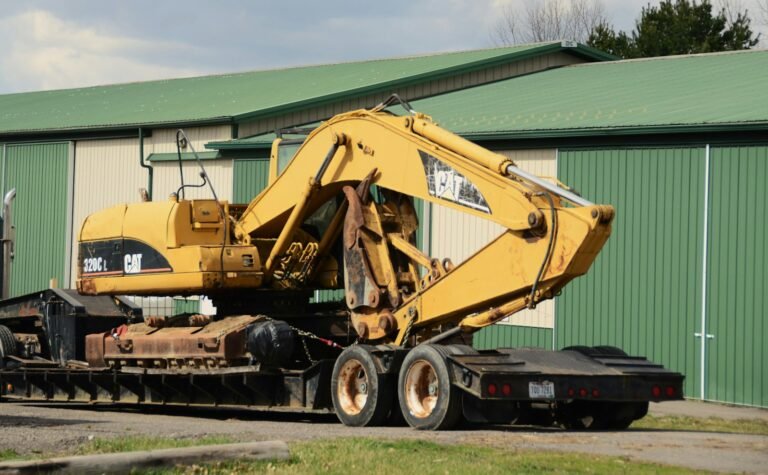
For most front drives a Sunward SWE 18UF zero tail swing excavator is the sweet spot. It turns within its own tracks, so you can dig tight against a house wall or boundary without swinging the counterweight into the brickwork. For a long rural drive or a double-width drive with a turning area, step up to the SWE 25UF or SWE 35UF from our construction range.
Muck away is where projects stall. Dig-out volume grows once it leaves the ground (soil bulks up by roughly a quarter or more), so plan for it:
| Drive area | Dig depth | In-ground volume | Approx. loose volume |
|---|---|---|---|
| 30m² (single car) | 250mm | 7.5m³ | 9 to 10m³ |
| 50m² (two cars) | 250mm | 12.5m³ | 15 to 16m³ |
| 80m² (with turning area) | 250mm | 20m³ | 25m³ or more |
A tracked dumper such as the Mechbadger or the Hyundai 500kg lets you move spoil from the back of the drive to a skip or grab lorry position at the road without wheeling barrows all day. Book the grab lorry or skips yourself and time the first collection for the end of day one.
Stage 2: edging and kerbs
Block paving needs a solid restraint on every edge or the blocks will creep. Edging kerbs are normally bedded and haunched in concrete, then left to go off before you compact against them. A small mixer saves hours here: the Altrad Belle Mini Mix 150 on our hand tools page handles a 150 litre drum, plenty for kerb haunching on a domestic drive. For larger pours, the Baron forced action mixer or Belle electric mixer are on the construction page.
This is the stage to send the digger back if you are on a daily hire. Edging and curing can take a couple of days, and there is no point paying for a machine that is parked.
Stage 3: sub-base and compaction
A drive fails from the bottom up. Lay Type 1 in layers of around 100mm and compact each layer fully before adding the next; trying to compact 200mm in one go leaves a soft lower layer that settles under tyres.
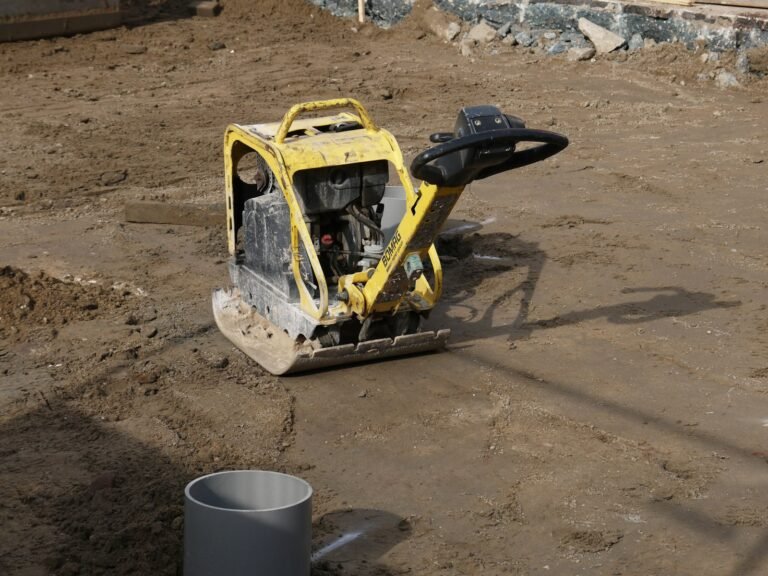
- Weber MT CF 3-II Hd forward plate: heavy-duty plate for sub-base on most domestic drives.
- Weber MT CR 3-III reversible plate: more weight and forward/reverse travel, useful on deeper sub-base and where you cannot turn the plate easily.
- Weber MT SRV 620-II rammer: for trench backfill if you have laid a drainage channel or ducting.
Lightly damp Type 1 compacts far better than dry or saturated stone. Make three or four passes per layer and check levels against your string lines as you go.
Stage 4: bedding, laying and cutting
Screed the sharp sand to an even depth with rails and a straight-edge, lay the blocks from a fixed edge, and keep off the screeded sand. Cutting blocks to fit edges and around manhole covers needs a disc cutter or block splitter; ask us what is currently available, as our hand tool range is growing. If you need a straight saw cut through existing tarmac or concrete where the new drive meets an old surface on your property, the Weber MT SM 82-3 pavement saw does it cleanly.
Cutting concrete blocks creates silica dust. Use water suppression or on-tool extraction and suitable masks; the HSE guidance on silica dust sets out what is expected on site.
Stage 5: consolidation and finishing
Once the blocks are down, brush in kiln-dried sand and consolidate. The Weber MT VPR 450 paving roller is built for exactly this job: it beds pavers evenly with much less risk of chipping or marking than running a bare plate over them. Brush in more sand and make a final pass.
Driveway equipment hire list at a glance
| Stage | Machine | Typical hire |
|---|---|---|
| Dig out | Sunward SWE 18UF or SWE 25UF | 2 to 4 days |
| Muck away on site | Mechbadger or Hyundai 500kg tracked dumper | Same days as digger |
| Kerbs | Altrad Belle Mini Mix 150 | A few days |
| Sub-base | Weber MT CF 3-II Hd or CR 3-III | 1 to 2 days |
| Block paving | Weber MT VPR 450 roller | 1 day |
| Moving the machine | Brian James 9ft or Indespension 10ft plant trailer | As needed |
A weekly hire on the core kit often works out simpler than juggling daily bookings, especially if weather interrupts. If you plan to tow driveway equipment hire kit yourself, the plant trailers page lists sizes; tell us your towing vehicle and the machine and we will confirm what pairs up.
Common driveway mistakes
- Skimping on dig depth to save on muck away.
- Compacting the sub-base in one thick layer.
- Forgetting a fall, so water pools against the garage door.
- Running a bare plate over finished blocks.
Choosing a surface: how it changes the kit list
The surface you choose decides how deep you dig, how much stone you import and which compaction kit you need on the last day. Settle this before you book, because it changes both the hire list and the length of the job.
| Surface | Typical dig below finished level | Key machines | Watch out for |
|---|---|---|---|
| Block paving | Around 250mm for cars | Mini digger, dumper, forward or reversible plate, VPR 450 paving roller | Edge restraint on every side |
| Permeable block paving | Often deeper, with open-graded stone instead of Type 1 | As above, plus care not to contaminate the stone with fines | Follow the manufacturer’s build-up exactly |
| Loose gravel | Around 150 to 200mm | Mini digger, dumper, forward plate | Gravel migrating onto the road; use a stabilising grid and a firm edge |
| Concrete slab | Depends on slab design | Mini digger, plate, mixer for small pours (larger pours normally use ready-mix) | Expansion joints and curing time |
| Tarmac or resin-bound | Base built as for block paving | Digger, dumper and plate for the base | The surface itself is a specialist laying job |
Many homeowners do the dig-out and sub-base themselves, then bring in a specialist for tarmac or resin. That split works well: the groundworks are where most of the labour sits, and the driveway equipment hire for that stage is straightforward.
Ground conditions across the four counties
What you find under the turf varies a lot across Devon, Cornwall, Somerset and Dorset, and it affects how deep you go and how long the digger stays.
- Mid and north Devon: heavy Culm clays and shales. Clay holds water and goes soft, so dig out soft spots and consider a geotextile membrane under the sub-base.
- Dartmoor fringes and Cornish granite areas: granite and the gritty, decomposed granite known locally as growan. It usually drains well, but you can meet boulders that slow a small digger.
- Around Exeter and east Devon: red sandstone and marl soils. Generally workable, though they can be sticky after rain.
- Somerset Levels and moors: soft clays and peat. Expect a deeper dig and a thicker sub-base, and take advice if the ground is very soft.
- Parts of Dorset: chalk and clay. Chalk can be firm, but it softens when saturated and should not be left exposed in wet weather.
If you do not know what you are dealing with, dig a trial hole with a spade a week before the hire starts. It costs nothing and tells you whether to plan for extra depth, extra stone and an extra day on the digger.
A worked example: a two-car drive in a day-by-day plan
To show how the hire fits together, here is an illustrative plan for a 50m² block-paved drive in front of a semi-detached house on the edge of Exeter, with a 2.5m-wide gap between the house and the boundary wall. It is a typical shape, not a real job.
- Day 1: SWE 18UF and Hyundai 500kg tracked dumper delivered first thing. Lift the old surface and start the dig-out, loading the first grab lorry at the end of the day.
- Day 2: finish the dig to about 250mm, cut out a clay soft spot near the gate, trim the formation level and lay membrane. Second grab lorry collection. Digger and dumper off-hired that evening.
- Days 3 and 4: set edge kerbs on a concrete bed with the Mini Mix 150 and haunch them. Leave to go off.
- Day 5: Type 1 delivered loose on the drive. Spread and compact in two layers with the CF 3-II Hd, checking levels against string lines.
- Days 6 and 7: screed the sand, lay and cut blocks.
- Day 8: brush in kiln-dried sand and consolidate with the VPR 450 roller.
In this example the digger is on site for two days, the plate for one, the mixer for a couple and the roller for one. Splitting the driveway equipment hire like this avoids paying for a machine that has nothing to do, but it only works if your materials arrive on time. If the Type 1 delivery slips, the plate booking slips with it, so confirm deliveries the day before.
Muck away, waste and your duty of care
A 50m² dig-out produces well over a dozen loose cubic metres of spoil, and what happens to it is a legal matter as well as a practical one. If you pay someone to take waste away, you have a duty to make sure they are allowed to carry it. Check that your skip firm or grab lorry operator is a registered waste carrier; the GOV.UK waste carrier registration page explains who needs to register, and the Environment Agency keeps a public register you can search.
Keep clean topsoil and subsoil separate from old concrete, tarmac and rubble where you can. Clean soil is often useful elsewhere in the garden, and mixed loads can cost more to dispose of. Old tarmac planings and broken slabs should never be buried under the new sub-base, because they create voids and soft spots.
What affects the cost of driveway equipment hire
We do not publish hire prices because the right package depends on the job, but these are the factors that move a quote up or down:
- Machine size: a 2.5 tonne digger costs more than a 1.8 tonne one, so match the machine to the access and volume rather than going big by default.
- Hire length: a weekly hire often works out better than several separate daily bookings.
- Delivery distance: delivery and collection from our depot near Okehampton is priced on location, so give us the full site postcode.
- Number of separate deliveries: sending the digger and the roller on different days means two journeys. Grouping kit where it makes sense reduces that.
- Insurance: not included automatically. Arrange cover before the hire starts.
- Weather slack: building in a spare day costs a little but saves rebooking if rain stops work.
Delivery day and collection
Our driver will need somewhere firm and level to unload, usually the road outside or the existing drive. Let us know about parking restrictions, narrow lanes, low branches and overhead cables when you book. On delivery, walk round the machine with the driver, check the controls you will use and note any existing marks.
Before collection, leave machines clean enough to inspect, parked somewhere accessible and with keys where we agreed. A digger left at the back of a finished drive behind new kerbs, with no way out that does not cross fresh blocks, is a common last-minute headache, so plan the exit route as part of the job.
Driveway safety checklist
- Services traced and marked before any digging.
- Pedestrians kept out of the working area, especially where the drive meets a public pavement.
- Seat belt worn in the digger and the dumper.
- Hearing protection and gloves for plate compactors, and limited time on vibrating tools.
- Dust control when cutting blocks or kerbs.
- No one working near the digger’s swing radius.
Frequently asked questions
Can I use a mini digger on a front driveway myself?
Yes, our hire is self-drive, but whoever operates the machine needs to be competent and suitably trained. Tell us your experience and we will advise on the right size.
Which plate compactor is best for a driveway sub-base?
For most domestic drives, a heavy-duty forward plate such as the CF 3-II Hd. For deeper sub-base or tight areas, a reversible plate like the CR 3-III.
Do I need a skip or a grab lorry?
A grab lorry suits larger dig-outs because it can reach over a wall, but it needs safe parking on the road. Skips on a public road usually need a council permit. We do not supply either, so book them early.
Is equipment insurance included?
No. Insurance is not automatically included; we point customers to insurance4plant.co.uk for plant hire cover.
How deep should a driveway sub-base be for vans or a motorhome?
Heavier vehicles need a thicker, well-compacted sub-base than the typical 150mm for cars, and soft ground needs more again. Follow the paving manufacturer’s guidance for the load, and if in doubt take advice from a groundworker or engineer.
Can I build a gravel drive without a digger?
On a small, level area with good ground, yes, by hand. Once you are moving more than a few cubic metres, a micro digger and dumper save days of barrowing.
Do I need the paving roller, or will a plate do?
A plate can mark or chip blocks unless it is fitted with a protective mat. The VPR 450 is designed for consolidating pavers, so it is the safer choice for finished block paving.
Book your driveway equipment hire
Send us your postcode, a rough drive size, access width and dates, and we will put together your driveway equipment hire package and a current quote. WhatsApp or call 07841 036064 (Mon to Fri, 7:30am to 5:30pm), or use our contact page for a written quote.