A patio that stays flat and drains properly comes down to three things: a firm, well-compacted base, a full mortar bed, and a fall that sends water away from the house. The patio equipment hire list is short (a way to dig, a plate compactor, a mixer and a cutter), but the order you use it in matters. Here is a step-by-step plan, with the machines we would put on a typical Devon or Cornwall patio job.

In this guide
Plan the levels and falls first
Water is the enemy of every patio. Two numbers set the design:
- Height against the house: the usual guidance is to keep the finished patio at least 150mm below the damp-proof course, so rain cannot splash or bridge over it. If your house has air bricks, they must stay clear and uncovered.
- Fall: slope the patio away from the house, commonly around 1:60 to 1:80. A 4m-deep patio at 1:60 drops roughly 65mm from the house to the outer edge. Riven natural stone wants the steeper end of that range; smooth porcelain can go shallower.
Decide where the water ends up. Running off onto a lawn or bed is simplest. Where the patio meets the house or slopes towards it, a linear channel drain connected to a soakaway or existing surface water drain is the usual answer. Mark out with pegs and string lines set to the finished levels before you dig.
Step 1: excavate to the right depth
A typical domestic build-up is around 100mm of compacted Type 1 sub-base, a 25 to 40mm mortar bed and the slab itself (around 20mm for porcelain, thicker for most sandstone and granite). Allow roughly 150 to 180mm below finished level, more where the ground is soft. Dig out all turf, roots and topsoil; organic material left under the base will rot and sink.
For a small patio, a spade and barrow are fine. Anything over about 15 to 20 square metres, or a patio where you are also cutting into a slope, goes much faster with a micro digger. The Sunward SWE 08B fits most side access and is light enough to work close to the house. A tracked dumper or the Tracspider 1000kg carrier from our construction range gets spoil out to the skip.
If you are cutting into a bank, think about what holds the soil back afterwards. A cut of more than a few hundred millimetres usually needs a proper retaining wall, not just a row of sleepers.
Step 2: lay and compact the sub-base
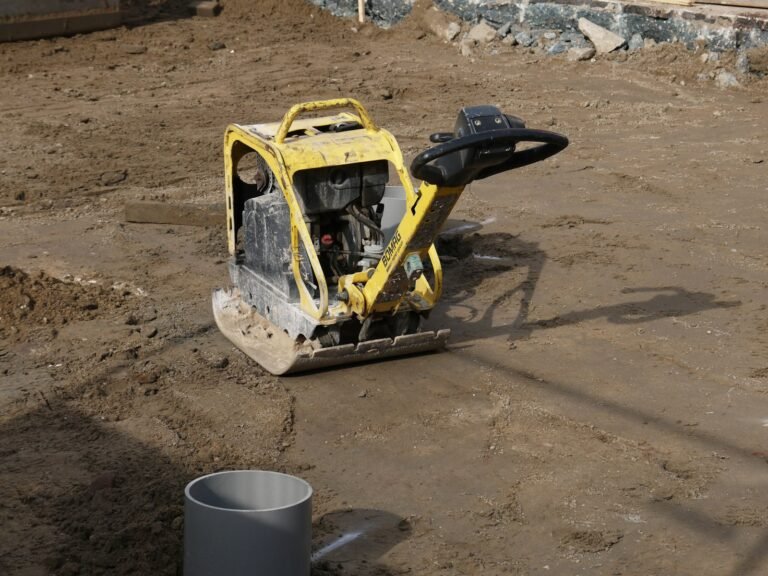
Spread the Type 1 in a single layer of around 100mm (or two layers if you need more depth), roughly shaped to the fall. Then compact it thoroughly. For patios, a light or mid-weight forward plate is ideal:
- Weber MT CF 1-III Hd: light-duty forward plate, easy to lift over a step or carry down a garden.
- Weber MT CF 2-II Hd: mid-range plate suited to path and patio sub-base, a little more compaction per pass.
Make several passes until the plate stops leaving a mark, and recheck your fall with a level and straight-edge. The sub-base should follow the finished fall so that the mortar bed can be an even thickness.
Step 3: mix and lay on a full mortar bed
Lay slabs on a full, solid bed of mortar rather than five dabs. Dot-and-dab leaves voids where water collects, freezes and cracks slabs, and gives the hollow sound you can hear when you walk on it.
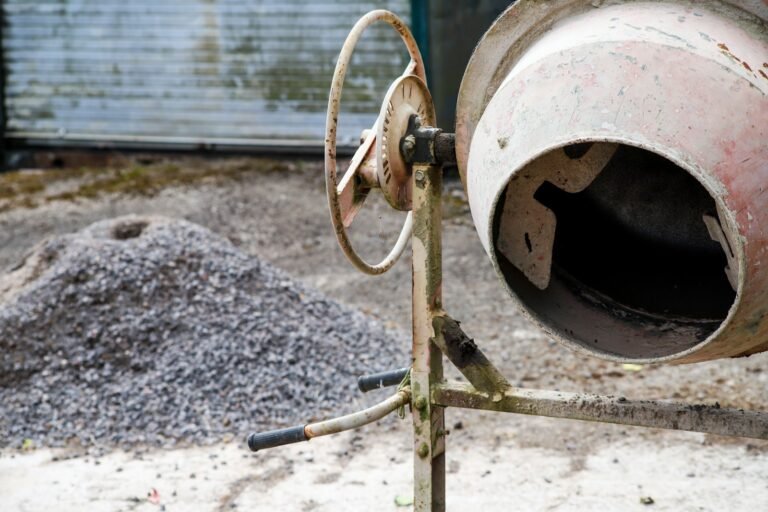
A typical patio uses more mortar than people expect, so a mixer earns its keep. The Altrad Belle Mini Mix 150 on our hand tools page has a 150 litre drum and is compact enough to sit near the patio. For larger areas or stiffer, semi-dry bedding mixes, a Baron forced action mixer handles concrete, screed and resin.
| Slab type | Bedding notes | Cutting notes |
|---|---|---|
| Porcelain | Full bed; use a priming slurry on the back of each slab so it bonds | Hard and brittle; needs a suitable diamond blade and steady feed |
| Sandstone | Full bed; check for a riven face and lay the right way up | Cuts easily but dusty; wet cutting keeps edges cleaner |
| Granite or slate | Full bed; heavy slabs, plan lifting | Dense; take your time and keep the blade cool |
| Concrete flags | Full bed | Generally the easiest to cut |
Lay each slab, tap down with a rubber mallet to your string line and fall, and keep joints even with spacers. Work out from a straight edge, usually along the house.
Step 4: cutting slabs safely
Edges, steps and drain covers all need cut slabs. The CRAMER battery disc cutter in our sports and landscaping range handles light cutting; for heavier work ask us what cutters are currently available, as the hand tool range is expanding. Whatever you use, cutting stone, concrete and porcelain releases respirable crystalline silica. Use water suppression or on-tool extraction and a properly fitted mask, and read the HSE guidance on silica dust before you start.
Step 5: jointing, curing and cleaning
Leave the bed to set before you point the joints. Brush-in jointing compounds and traditional mortar pointing both work; follow the manufacturer’s weather limits, because some compounds should not be used in heavy rain or frost. Keep foot traffic off for a day or two and furniture off for longer. If you are refreshing an old patio elsewhere in the garden, the Brendon 35KPE mobile power washer cleans moss and grime back to bare stone.
Your patio equipment hire list at a glance
| Job | Kit |
|---|---|
| Dig out (larger patios) | Sunward SWE 08B micro digger |
| Move spoil and stone | Hyundai 500kg tracked dumper or Tracspider carrier |
| Compact sub-base | Weber MT CF 1-III Hd or CF 2-II Hd |
| Mortar | Altrad Belle Mini Mix 150 or Baron forced action mixer |
| Cutting | Disc cutter (ask what is available) |
| Cleaning | Brendon 35KPE power washer |
Working out quantities before you order
Ordering materials and booking patio equipment hire go together, because the volume of spoil and stone decides whether you need a digger and dumper or just a spade and barrow. Here is an illustrative calculation for a 20m² patio (for example 4m by 5m) in 600mm by 600mm slabs. Treat it as a method, and use your own measurements.
| Item | Working | Approximate quantity |
|---|---|---|
| Excavation | 20m² × 0.17m | About 3.4m³ in the ground, closer to 4m³ or more once dug |
| Type 1 sub-base | 20m² × 0.1m compacted | About 2m³, roughly 4 tonnes |
| Mortar bed | 20m² × 0.03m | About 0.6m³ of mixed mortar |
| Slabs | 20m² ÷ 0.36m² per slab | About 56 slabs, plus 5 to 10% for cuts and breakages |
Four or five cubic metres of loose spoil is a small skip’s worth or more, and four tonnes of stone is a lot of barrow trips through a side gate. At that scale, a micro digger and a tracked dumper for a day or two pay for themselves in saved labour. Below about 10m², hand digging is usually realistic, though patio equipment hire still earns its place on small jobs: a plate compactor alone makes the difference between a patio that stays flat and one that sinks, and a mixer saves hours of hand mixing on laying days.
Drainage options in more detail
The fall gets water off the surface, but it has to go somewhere. The main options, from simplest to most involved:
- Run-off to a lawn or bed: the outer edge of the patio sits slightly above the lawn so water drains straight into the soil. Simple and cheap, but only works if the ground beyond takes water.
- Permeable joints: some jointing compounds let water through. They help, but they will not cope with a patio that falls towards the house.
- Linear channel drain: a slotted channel set into the patio, usually along the house wall or at a threshold, connected to a gully, an existing surface water drain or a soakaway.
- Soakaway: a pit or crate system that lets collected water soak back into the ground. It needs a percolation test and sensible siting away from buildings.
Never connect patio drainage to a foul drain without checking with your water company and building control. On the heavy clays of mid and north Devon, run-off to the lawn often struggles in winter, so a channel and soakaway, or a connection to an existing surface water drain, is worth planning from the start.
Planning rules and raised patios
A ground-level patio in a back garden does not usually need planning permission. Two common exceptions are worth knowing. First, paving a front garden: in England, over five square metres of impermeable surfacing that drains onto the road usually needs permission. Second, raised patios and decking: under householder permitted development, a raised platform must be no more than 30cm above the ground, along with other limits. The Planning Portal guidance on decking and raised platforms sets these out. Listed buildings and conservation areas have their own controls, so check with your council if either applies.
A worked example: a sandstone patio on a sloping garden
An illustrative job: a 4m by 5m Indian sandstone patio behind a 1930s semi in Plymouth, on a garden that rises gently away from the house. Side access is a 1.1m path. This is a typical layout, not a real customer project.
- Day 1: Sunward SWE 08B micro excavator and Hyundai 500kg tracked dumper delivered. Lift turf, dig out about 170mm and cut a shallow step into the rising ground at the back edge, where a low sleeper wall will hold the lawn.
- Day 2: trim levels, fit a linear channel drain along the house wall connected to the existing gully, and off-hire the digger and dumper.
- Day 3: Type 1 spread and compacted with a CF 2-II Hd plate to follow the fall away from the house wall towards the channel line.
- Days 4 and 5: slabs laid on a full mortar bed with the Mini Mix 150 running beside the patio. Cuts made with dust suppression.
- Day 7 onwards: joints pointed once the bed has set and the weather is dry.
Note the fall here. Because the garden rises away from the house, a fall away from the house would push water into the bank, so the designer has sloped the patio towards a channel drain instead. Getting this decision right before the digger arrives is more valuable than any piece of patio equipment hire.
Ground conditions and weather in the South West
Clay soils, common across much of mid Devon and in parts of Somerset and Dorset, move as they wet and dry. Dig out all soft and organic material and do not skimp on sub-base depth. Granite areas around Dartmoor and in Cornwall usually drain well but can throw up boulders, which a micro digger handles better than a spade.
Weather matters more for patios than for most groundworks. Mortar and many slurry primers have minimum temperatures, so avoid laying when frost is forecast, and cover fresh work if heavy rain is coming. Porcelain in particular relies on a good bond, and a wet, cold week can spoil it. In the South West the most reliable laying weather tends to be late spring through early autumn, but there are good dry spells in every season if your hire is flexible.
What affects the cost of patio equipment hire
- Patio size: it decides whether you need a digger at all.
- Access: narrow access points you towards a micro digger and a small dumper rather than larger kit.
- Hire length: a weekly rate can be simpler than several daily bookings if weather is uncertain.
- Number of deliveries: grouping the plate and mixer into one drop saves a journey.
- Location: delivery from our depot near Okehampton is priced on distance, so give us your full postcode.
- Insurance: not included automatically; allow for cover before the hire starts.
Common patio mistakes
- Leaving topsoil or roots under the sub-base.
- Building the patio too close to the damp-proof course or over air bricks.
- Forgetting a fall, or sending it towards the house.
- Laying slabs on dabs of mortar instead of a full bed.
- Skipping the priming slurry on porcelain.
- Pointing joints in wet or frosty weather.
Delivery day and setting up the work area
Think about where everything will sit before the lorry arrives. Slabs are heavy and fragile at the corners, so have them dropped as close to the patio as the delivery vehicle can safely get, on a firm base and stacked on their edges or pallets. Bulk bags of sand and Type 1 want to be near the mixer and the patio, not blocking the route the dumper needs.
When we deliver machines, our driver will unload on a firm, level surface, usually the drive or the road outside. Lay boards or ground protection along the route to the back garden if the lawn is soft. Set the mixer up on level ground with a board underneath to catch spills, near a water supply, and keep cement bags off the ground and covered.
Aftercare in the first year
A new patio needs a little attention while it settles. Keep heavy planters and furniture off until the bed and joints have fully cured, following the product guidance. Brush out leaves and soil regularly so moss and weeds do not get a hold in the joints. If you use a pressure washer for cleaning, keep the lance moving and use a lower setting near joints; blasting directly into fresh pointing can lift it. Check falls after the first heavy rain: puddles that sit for hours point to a low slab worth lifting and rebedding before winter frost gets into it.
Frequently asked questions
Do I need a plate compactor for a small patio?
Yes. Even a small area benefits from properly compacted sub-base, and a light plate like the CF 1-III Hd is easy to handle. Treading stone in by foot leaves soft spots that sink later.
How long should I hire patio equipment for?
For a typical garden patio, the digger is needed for a day or two and the plate for a day, while the mixer is busiest across the laying days. Tell us your size and we will suggest a sensible hire period.
Can I lay a patio in winter?
You can dig and prepare in most weather, but mortar and many jointing products should not be used when frost is likely. Check the product data sheets.
Can a micro digger get through my side gate?
Often, but measure the narrowest point and send it to us with photos so we can confirm before delivery.
How thick should the sub-base be under a patio?
Around 100mm of compacted Type 1 suits most foot-traffic patios on firm ground. Soft or clay ground may need more, and any area that will take a vehicle needs a driveway build-up.
Should I use a forward or reversible plate on a patio?
A light or mid-weight forward plate such as the CF 1-III Hd or CF 2-II Hd suits most patios. Reversible plates are heavier and are better kept for deeper sub-base on larger areas.
Can I lay a patio over old concrete?
Sometimes, if the concrete is sound, level and drains correctly, but it raises the finished level and may bring it too close to the damp-proof course. Many people break it out and start again.
Ready to start your patio
Send us the patio size, access width, postcode and dates, and we will confirm your patio equipment hire and a current quote. WhatsApp or call 07841 036064 (Mon to Fri, 7:30am to 5:30pm), or contact us for a written quote by email.