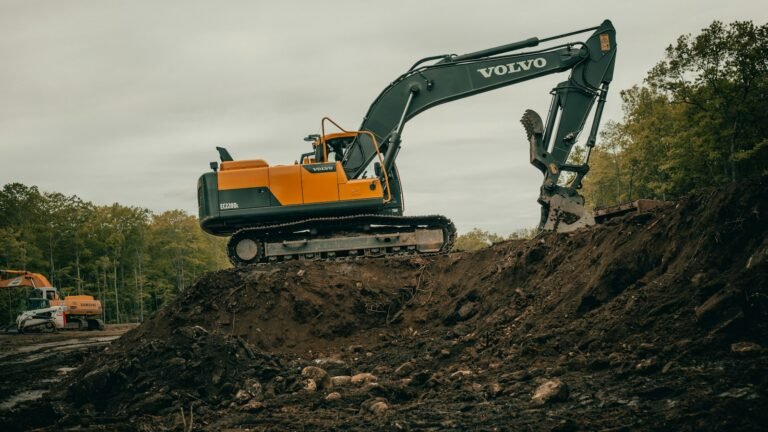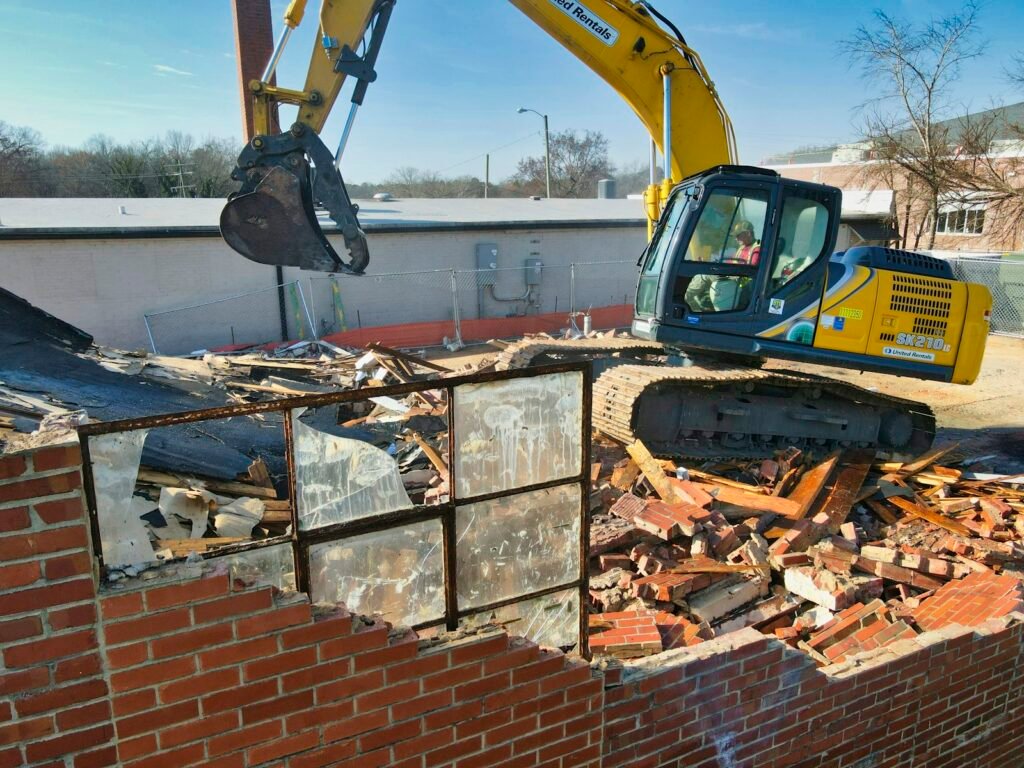
Demolition equipment hire for a small job, such as taking down a garage, an old outbuilding, a garden wall or a concrete yard, usually means an excavator sized to the structure, a dumper to move the debris, and possibly a crusher to recycle the hardcore. Before any machine arrives, though, you need an asbestos survey, disconnected services and, for most buildings, notice to the council. This guide covers the checks, the kit and the method for small demolition work.

In this guide
Before you start: the essential checks
Demolition is construction work, and the HSE treats it as one of the higher-risk activities. The HSE demolition guidance sets out the main duties. In summary:
- Asbestos survey: a refurbishment or demolition survey by a competent surveyor must be carried out before work starts. Buildings put up before 2000 can contain asbestos in roof sheets, soffits, floor tiles, pipe lagging and textured coatings.
- Asbestos removal: anything found must be dealt with properly before demolition. Higher-risk asbestos work must be done by an HSE-licensed contractor.
- Services: electricity, gas and water must be disconnected and confirmed safe by the relevant providers. Check for buried services around the structure too.
- Notice to the council: in most cases you must notify the local authority at least six weeks before demolition starts. Some small buildings are exempt, so check with your council’s building control team.
- Planning: demolition in a conservation area, or of a listed building, may need consent. Check with your planning authority.
- Method: CDM 2015 applies, and the method should be worked out by a competent person who has considered the structure, stability and hazards.
More on the asbestos survey
A refurbishment and demolition survey is intrusive: the surveyor may need to lift floors, open up walls and break into the roof to find asbestos hidden in the building fabric, so the area must be empty while it is done. HSE says it must be carried out by a competent surveyor and strongly recommends using an accredited surveying organisation. Its page on arranging an asbestos survey explains the types of survey. Keep the report, as anyone working on the structure needs to see it.
More on the demolition notice
Under section 80 of the Building Act 1984, demolishing a building or structure of more than 50 cubic metres generally requires notice to the local authority at least six weeks before work starts, with copies to neighbouring occupiers and the gas, electricity and water providers. The council may respond with a notice setting conditions, such as how the site must be left or how neighbouring buildings must be protected. There are exemptions, so ask your council’s building control team.
This is general information, not legal advice. Check the current guidance for your project.
A realistic timeline for small demolition
The machines are usually the quickest part of a demolition job. The weeks before they arrive are what make it safe and legal.
- Eight weeks or more before: commission the asbestos survey and contact the service providers about disconnections, which can take time to arrange.
- Six weeks or more before: serve the demolition notice on the council where it applies, and check planning if the building is listed or in a conservation area.
- Two to four weeks before: arrange any asbestos removal, book skips or waste collections, confirm insurance and send us details for demolition equipment hire.
- The week before: confirm services are disconnected in writing, tell the neighbours, and complete the soft strip of fittings and timber.
- Demolition days: set the exclusion zone, bring down the structure, sort waste as you go and break out the slab.
- Afterwards: crush or remove hardcore, level and compact the ground, and off-hire each machine as soon as it is finished.
Choosing demolition equipment hire by job size
| Job | Excavator | Support kit |
|---|---|---|
| Garden wall, shed base, small patio | Sunward SWE 18UF or SWE 20F | Hyundai 500kg tracked dumper |
| Single garage, lean-to, outbuilding | Sunward SWE 35UF | Mechbadger tracked dumper, skip |
| Larger outbuilding, old farmyard slab | Sunward SWE 60UF | SWL 2830 skid-steer, Dragon 400 crusher |
| Agricultural building bases, heavy slabs | Sunward SWE 90UF | Dragon 450 crusher, dumpers |
Good demolition equipment hire starts with access and the structure, not the biggest machine available. The SWE 90UF is listed on our construction page for heavy demolition and bulk digging. For most domestic jobs, though, a 1.8 to 3.5 tonne machine is plenty, and easier to get on site. Work from the access you have: a big machine that cannot reach the structure safely is no use.
Demolishing a house or anything with significant height, structural complexity or a party wall is a job for a specialist demolition contractor, not DIY.
Breakers and attachments
Hydraulic breakers and other demolition attachments are not part of our listed fleet. Ask us what is available for your machine and job, and we’ll tell you or point you in the right direction. Handheld breakers sit within our expanding hand tools range, so check current availability when you enquire.
For many small jobs, an excavator with a standard digging bucket is enough. Blockwork walls and thin slabs can often be pulled down or levered up with the bucket, working from an edge. Thick or reinforced slabs are different, and trying to force them with a bucket strains the machine and the operator. Tell us the slab thickness if you know it, or send a photo of a broken edge, and we will suggest the most sensible approach.
A safe method for small demolition
- Strip out first: remove doors, windows, timber, fixtures, glass and anything recyclable by hand before the machine starts.
- Set an exclusion zone: keep people well outside the area where debris could fall, including the reach of the excavator arm.
- Work top down: take the roof off, then the walls in a controlled sequence. Pull material away from the machine and never undermine a wall so it falls towards the cab.
- Watch for hidden hazards: old fuel tanks, buried cables, voids and unstable lintels. Older rural buildings may hide inspection pits, wells or soakaways, so probe the floor before tracking a machine across it.
- Stop when unsure: if a wall or roof behaves differently from what you expected, stop, clear the area and reassess. Speed matters far less than control.
- Break out the slab last: once the superstructure is clear, break out foundations and slabs and stockpile hardcore separately.
Operators must be trained and competent on the machine they are using. Our hire is self-drive unless otherwise agreed.
Illustrative example: taking down an old sectional garage
This is a made-up example to show the thinking, not a real job. A homeowner in Barnstaple wants to remove a single precast concrete sectional garage with a corrugated roof, plus its slab, to make room for a parking bay.
- Survey: garages of this type often have cement roof sheets that may contain asbestos. The survey confirms what is there, and the roof is removed by competent people following HSE guidance before anything else happens.
- Strip out: the door, guttering, any electrics (after disconnection) and timber are removed by hand.
- Panels: the precast panels are usually bolted together and can be unbolted and lowered in a controlled order, rather than smashed, which keeps the work slower but far more predictable.
- Slab: a Sunward SWE 25UF or SWE 35UF breaks out the base, with a Hyundai 500kg tracked dumper running the broken concrete to a skip on the drive.
- Ground: the formation is levelled and compacted with a Weber MT CR 3-III plate ready for the new parking surface.
The same garage at the end of a long garden with only a side passage would push the choice down to a smaller excavator and a narrower dumper. Access decides the kit.
Sorting, recycling and waste
Sorting waste is where demolition equipment hire really pays back. Separate the waste as it comes down: metals, timber, hardcore and general waste. Clean concrete and brick can be crushed with a Dragon 400 or 450 jaw crusher and reused as fill or sub-base, which cuts down skip and lorry movements on narrow lanes. Crushing and reusing waste has its own exemption and permit rules, so check those before you start. Everything else must go to a licensed waste site with the right paperwork.
Clearing and reinstating the site
Once the structure is down and the waste has gone, the ground usually needs work before the next stage. Demolition sites are full of mixed soil, brick fragments and old foundations. A Flexiever towable screener separates usable topsoil from rubble, so you can keep the soil for landscaping. Fill and level voids left by old footings, then compact the formation in layers with a Weber MT CR 7 or CR 3-III reversible plate before any new slab or hardstanding goes down.
If the plot is going back to garden, the Captain 26HP compact tractor with a Conagri MEGA stone burier prepares a clean seedbed. If a new building is going up, talk to your engineer about whether the old foundations can stay or must come out.
Rural and farm demolition in the South West
Much of the small demolition work across Devon and Cornwall involves farm buildings: lean-to sheds, old block pig pens, dairy parlours and concrete yards. These often bring their own issues. Older barns may be built of cob, stone or slate and could be listed or valued locally, so check with the planning authority before you touch them.
Many mid-twentieth-century farm buildings have cement sheet roofs and cladding that need an asbestos survey just like any domestic garage. Farm sites are also usually at the end of narrow lanes, so tell us about weight limits, tight bends and gateways, and allow for a smaller delivery vehicle or extra trips if needed.
Common demolition mistakes
- Starting before the asbestos survey. Disturbing asbestos by accident puts you, your family and neighbours at risk and can turn a simple job into a contaminated site.
- Assuming the power is off. A switched-off consumer unit is not a disconnected supply. Get written confirmation from the provider.
- Pulling walls towards the machine. Always plan the fall direction so material falls away from the cab and away from people.
- Undersized or oversized machines. Too small and it struggles with slabs; too big and it can’t work safely in the space.
- Mixing waste streams. Mixed waste costs more to dispose of and can’t be crushed. Separate it as it comes down.
- Forgetting the boundary. Walls shared with neighbours, or structures close to their property, raise party wall and stability questions.
- No plan for the slab. Concrete bases are often thicker or more heavily reinforced than expected. Tell us what you know when you book.
What affects the cost of demolition equipment hire
We don’t publish prices, but these factors shape any quote.
- Machine size and number: an excavator alone, or an excavator, dumper and crusher together.
- Hire length: weekly hire usually works out better than several daily hires.
- Delivery distance and access: charged from our depot near Okehampton; restricted access may need a smaller vehicle or extra trips.
- Cleaning: demolition is dirty work, and machines returned caked in dust and mud may incur a cleaning charge.
- Damage: demolition is hard on machines. Careful operation, and proper insurance, protect you from unexpected costs.
Insurance for demolition hire
Insurance is not automatically included in our hire. Demolition carries a higher risk of damage to the machine and to neighbouring property, so check that your policy covers hired-in plant and third-party liability for this kind of work before the machine arrives. Our partner insurance4plant can help if you need plant hire cover.
Dust, noise and mud
Concrete, brick and block dust contain silica. Keep material damp with a hose or the Brendon 35KPE mobile power washer, and make sure everyone wears suitable respiratory and hearing protection. Warn neighbours before you start and keep to sensible hours. At the end of each day, clean mud and debris from the road; the pressure washer helps here too.
Breaking concrete and working excavators close to houses also creates vibration. Keep an eye on neighbouring walls, greenhouses and fragile garden structures, and stop to reassess if anything moves or cracks. Plan to load skips and lorries during sensible hours, and keep the public highway clear; a skip on the road needs a permit from the highway authority, and debris on the pavement is a hazard to passers-by.
Glossary of demolition terms
- Soft strip: removing fittings, fixtures, timber, glass and non-structural items by hand before machine demolition starts.
- Refurbishment and demolition survey: the intrusive asbestos survey required before structural work, carried out by a competent surveyor.
- Section 80 notice: the notice of intended demolition given to the local authority under the Building Act 1984.
- Exclusion zone: the area kept clear of people because debris could fall or be thrown into it. It must be big enough to contain debris if the structure collapses.
- Top-down demolition: taking a structure down from the roof downwards, in a controlled sequence, to keep it stable.
- Arisings: the materials produced by demolition, such as hardcore, timber and metal.
- Formation: the prepared, compacted ground on which a new slab, path or hardstanding is built.
- CDM 2015: the Construction (Design and Management) Regulations, which apply to demolition just as they do to building work.
Frequently asked questions
Can I demolish my own garage?
Many people do take down a small single-storey garage themselves, particularly sectional concrete or timber garages that come apart in a predictable way, but only after an asbestos survey, disconnecting services and checking whether you need to notify the council. If in doubt, use a demolition contractor.
What size excavator do I need to knock down an outbuilding?
For a typical single-storey brick or block outbuilding, a 3.5 tonne machine is usually suitable. Heavy concrete bases may justify a 6 or 9 tonne excavator.
Do you hire hydraulic breakers?
They are not in our listed fleet. Ask us and we’ll tell you what we can offer or suggest where to look.
Is it worth hiring a crusher for a small demolition job?
Only if you have a reasonable volume of clean hardcore and a use for it on site, such as a new track, hardstanding or sub-base. Otherwise a skip is simpler. Remember that crushing waste has its own exemption and permit rules, so check those before booking a crusher.
Should I tell my neighbours before demolition?
It is good practice, and where a section 80 notice applies, neighbouring occupiers should receive a copy anyway. Let them know the dates, working hours and how you’ll control dust and noise. If a structure is on or near a boundary, check whether the Party Wall etc. Act 1996 applies.
Do I need a licensed contractor to remove asbestos?
Higher-risk work, such as most work on asbestos insulation and insulating board, must be done by an HSE-licensed contractor. Some lower-risk work can be done without a licence but still has legal requirements. Your survey report and HSE guidance will tell you which applies.
How long should I hire the excavator for?
Hire it for the demolition and slab break-out only, once the soft strip is complete. For a small garage or outbuilding that is often a few days; our hire FAQs explain how to extend if the job runs over.
Talk to us about your demolition job
Send us photos, the site postcode, access details and dates, and we’ll put the right demolition equipment hire package together. WhatsApp or call 07841 036064, or use our contact form. For a run of demolition and clearance jobs, ask about Flex Hire.