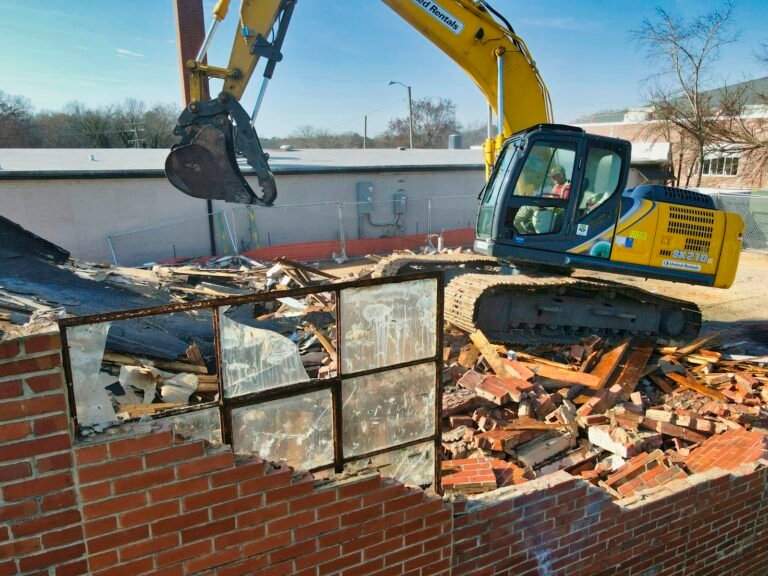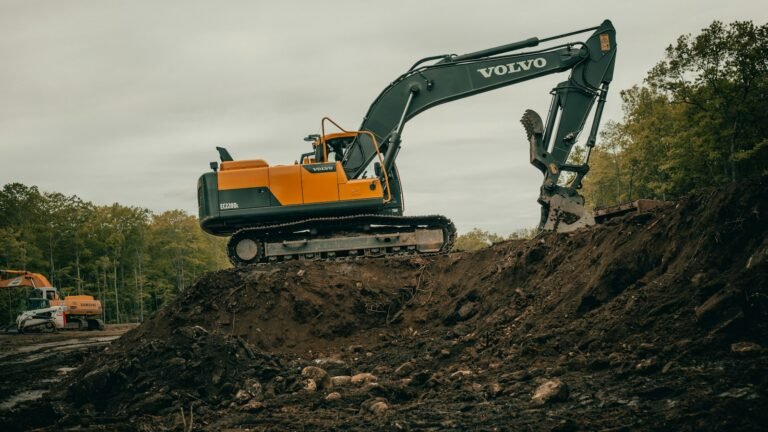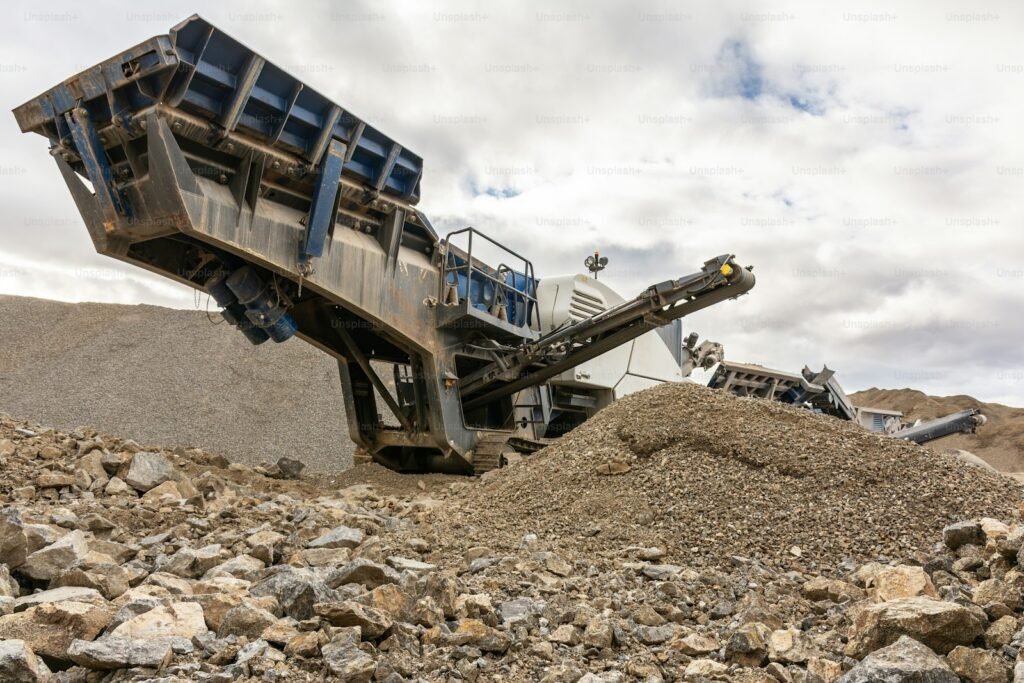
Concrete crusher hire lets you turn demolition rubble into usable hardcore on the same site, rather than paying to skip it away and then paying again for new stone. We hire the Dragon 400 and Dragon 450 tracked jaw crushers from our depot near Okehampton, built for concrete, brick and aggregate. This guide covers how on-site crushing works, where concrete crusher hire pays, how to prepare the material and set out a crushing day, what to do with the output, and the waste rules you need to check before the crusher starts.

In this guide
How a tracked jaw crusher works
A jaw crusher has one fixed jaw and one moving jaw set in a V shape. Material is fed into the top, and the moving jaw squeezes it against the fixed jaw until the pieces are small enough to drop through the gap at the bottom. Adjusting that gap changes the size of the output. Tracks mean the crusher can move itself around site and position close to the rubble pile, which cuts down on double handling.
Both Dragon models handle concrete, brick and aggregate. The Dragon 450 offers higher output for larger demolition and recycling jobs, while the Dragon 400 suits smaller sites and tighter access.
| Model | Type | Typical use |
|---|---|---|
| Dragon 400 tracked crusher | Jaw crusher | Barn and outbuilding demolition, extension clear-outs, smaller recycling jobs |
| Dragon 450 tracked crusher | Jaw crusher, higher output | Larger demolition, yard and slab removal, ongoing recycling |
Dragon 400 or Dragon 450?
Choose by volume and access. The Dragon 400 is the better fit for smaller jobs, tighter gateways and sites where the crusher has to move around between rubble heaps. The Dragon 450 offers higher output for larger demolition or recycling, where getting through the material faster saves hire days and keeps the excavator busy. Tell us roughly how much rubble you have and what it is, and we’ll recommend one.
Where concrete crusher hire pays its way
On-site crushing makes most sense when you have a decent volume of clean hard material and a use for it on the same job. Common examples in our area include:
- Demolishing old farm buildings, block sheds and concrete yards, then reusing the crushed material for new tracks and hardstandings.
- Breaking out driveways, patios and slabs on house renovation and extension projects.
- Clearing a redevelopment site of foundations and floor slabs before new building starts.
- Recycling stockpiles of broken concrete and brick that have built up in a yard over the years.
The saving comes from three directions: fewer skips or tipper loads leaving site, less new aggregate coming in, and fewer lorry movements on narrow lanes. How much you save depends entirely on volume, haulage distances and local tipping costs, so work out your own figures before deciding. If you only have a few tonnes, a skip may still be simpler.
Preparing material for the crusher
A jaw crusher is tough, but it isn’t a bin. Good preparation protects the machine and gives you a cleaner product:
- Separate out contaminants. Remove timber, plastic, metal fixings, roofing felt, insulation and plasterboard. Plasterboard in particular contaminates recycled aggregate.
- Check for asbestos first. Any building old enough to contain it should be surveyed before demolition. Asbestos-containing materials must never go through a crusher.
- Size the feed. Break large slabs down so pieces fit the jaw opening. An excavator with a breaker or a pulveriser helps here. Ask us about options.
- Deal with reinforcement. Cut back protruding rebar and mesh where possible so it doesn’t snag in the jaws.
- Feed steadily. An excavator feeding at a consistent rate gives better output than tipping in huge loads at once.
Step by step: setting up a crushing day
A well-run crushing day is mostly about flow: rubble in at a steady rate, crushed material out without the stockpile backing up into the crusher. A typical sequence looks like this:
- Pre-sort the rubble the day before, pulling out timber, metal, plastics and plasterboard and breaking oversize slabs.
- Position the crusher on firm, level ground, with the feed side facing the rubble pile and the discharge conveyor pointing at open ground for the stockpile.
- Set up water suppression before starting, with a hose or bowser ready to damp the feed and the stockpile.
- Carry out the daily checks shown at handover: fluid levels, guards, emergency stops and the jaw area clear.
- Feed steadily with an excavator, keeping the hopper topped up but not overloaded. Stop and clear any bridging pieces safely, with the machine isolated, never by hand while running.
- Move the stockpile before it reaches the conveyor, using a loader, skid steer or dumper.
- Shut down and clean at the end of the day: clear the jaw area, wash off dust and check for damage.
Setting out the crushing area
Pick a firm, level spot with room for the rubble pile on one side, the excavator feeding position, and space for the crushed stockpile to build up where the machine discharges. Keep pedestrians well away from the feed hopper and discharge area, and agree hand signals between the excavator driver and whoever runs the crusher. Leave room to remove the finished stockpile without moving the crusher.
Waste rules: check before you crush
Demolition rubble is classed as waste, even on your own land, and crushing it is a regulated activity. In England this commonly involves:
- A T7 exemption (treating waste bricks, tiles and concrete by crushing), which is registered with your local authority rather than the Environment Agency. See GOV.UK’s treating waste exemptions page.
- A mobile plant permit for crushing. Mobile crushing and screening is a Part B activity regulated by local authorities, and Defra’s process guidance note for mobile crushing and screening sets out how those permits work. Whether one is needed depends on the plant and how it is used, so ask the council.
- A U1 exemption (use of waste in construction) to reuse the crushed material, for example as hardcore for a track or building base. It is registered with the Environment Agency, lasts three years and has limits on waste types and quantities. GOV.UK’s U1 guidance says the waste must be suitable for the job, uncontaminated, and not treated under the U1 itself, which is why crushing is covered separately.
Which of these applies depends on your site, the operator and the quantities involved. Speak to your local council’s environmental health or pollution team and the Environment Agency before you start, and check the current guidance, as rules change. This is general information, not legal advice.
A sensible order of events
- Get the asbestos survey done and any asbestos removed by the right contractor before demolition.
- Estimate the tonnage you will crush and reuse, and what you will use it for.
- Ask the council about T7 registration and any mobile plant permit, and register any U1 exemption with the Environment Agency.
- Book the crusher and the supporting excavator once the paperwork is in hand.
- Keep simple records of what you crushed and where it went, in case anyone asks.
Safety around a jaw crusher
A crusher is a powerful machine with moving jaws, conveyors and material that can be thrown from the feed or discharge. A few rules keep everyone safe:
- Only trained, competent people operate it. Hire is self-drive unless agreed otherwise, so the hirer is responsible for operator competence.
- Set an exclusion zone around the hopper, jaw and conveyor, and keep pedestrians out while it is running.
- Never climb on the machine or reach into the hopper while it is running. Stop, isolate and wait for everything to come to rest before clearing a blockage.
- Keep guards in place and know where every emergency stop is before you start.
- Wear the right PPE: hard hat, eye protection, hearing protection, gloves, safety boots and suitable respiratory protection where dust can’t be fully controlled.
- Manage noise. HSE’s guidance on the Control of Noise at Work Regulations sets daily exposure action values of 80 and 85 dB(A), and crushers can easily exceed them close up.
Insurance isn’t automatically included with our hires; we refer customers to insurance4plant.co.uk for plant hire cover.
Dust, noise and neighbours
Crushing concrete and brick produces dust that can contain respirable crystalline silica, which HSE identifies as a serious long-term health risk in construction (see its silica dust guidance), so use water suppression, damp down stockpiles, and make sure anyone working close by has suitable respiratory protection. Crushers are also noisy. Position the machine as far from neighbouring homes as practical, keep to sensible working hours, and let neighbours know in advance. On farms, think about livestock in nearby fields too.
Output size, screening and getting a better product
Jaw crushers make a mixed product: a range of sizes from dust up to the size set by the jaw gap. For general fill and farm tracks that mix is often exactly what you want, because the fines help it bind when compacted. For other uses you may want to separate it.
- Close the jaw setting for a finer product, accepting slower output.
- Screen the output to separate fines from larger stone. Our Flexiever towable screener, on the sports and landscaping range, is designed for topsoil and aggregate separation. Ask us whether it suits your material.
- Keep material types apart where you can. Clean concrete makes a more consistent product than mixed brick and concrete with mortar.
- Re-crush oversize rather than leaving lumps that will cause soft spots when compacted.
Screening and re-crushing take time, so decide how good the product needs to be before you start. A farm track base can take a coarse, mixed product. A sub-base under a building will have a specification to meet.
Using the crushed material
Crushed concrete makes good general fill and hardcore for farm tracks, yard bases, temporary haul roads and under-slab fill. Where the material forms part of an engineered structure, such as a road sub-base or a building’s foundations, check with your engineer or building control whether recycled aggregate meets the specification. You may need to screen it to remove fines or oversize pieces.
Test a small area first: spread and compact a trial strip, drive over it and check how it holds before committing the whole stockpile to a track or base.
Typical uses on farms and rural sites include track bases and repairs, gateway hardstandings, yard sub-base, backfill behind retaining walls and around drainage, and temporary site roads. Keep the crushed material clean once it is made: don’t let it get mixed back with topsoil or rubbish in the stockpile.
Once crushed, spread and compact it in layers with a suitable plate compactor or roller rather than dumping it in one deep lift.
Does crushing pay? What affects the numbers
We don’t publish hire prices, so WhatsApp us for a current quote. Whether concrete crusher hire beats skips and new stone on your job depends on:
- Volume. A few tonnes rarely justify a crusher. Larger demolition, slabs and yards often do.
- Haulage distance. In rural Devon and Cornwall, tipping sites and quarries can be a long way from site, so each lorry movement costs more.
- Use on site. Crushing pays best when the product replaces stone you would otherwise buy, for tracks, bases or fill on the same job.
- Material quality. Clean concrete crushes quickly. Mixed rubble full of timber and plaster needs sorting time and may still produce a poorer product.
- Paperwork. Exemptions and permits take time and may carry charges, so factor them in.
- Labour and supporting plant. You need an excavator to feed and a way to move the stockpile.
Run your own figures for skips or tipper loads out and aggregate in, then compare them with the crusher, delivery and supporting plant. On the right job the saving is significant, and you take lorries off narrow lanes as a bonus.
Hire periods: weekly, long-term or Flex
A one-off barn demolition may only need the crusher for a few days, and weekly hire is our most popular period. If you’re recycling material over several months, ask about long-term rental with on-site servicing included.
Contractors who need a crusher on and off alongside excavators should look at Flex Hire. Tier 2, at £895 +VAT and delivery per month, includes crushers along with smaller excavators, with swaps any time, servicing included and no long-term contract. Confirm which tier covers the machines you need when you enquire.
Delivery is quoted by distance from our depot. The crusher arrives on a suitable vehicle and needs a firm unloading point; our driver will run through the controls, daily checks and safety stops at handover. When you’ve finished, call to off-hire and get a reference number, because hire charges run until it is issued.
A worked example: an old farm building and yard
Here is an illustrative scenario. A block-built farm building with a concrete floor and a cracked concrete apron in front is being removed in mid Devon, and the farmer wants a new stone track to a field gate. An asbestos survey has cleared the building, and the cement sheet roof has been removed by a licensed contractor where required.
- Demolition: a 9-tonne excavator pulls down the walls and breaks out the floor and apron, sorting timber and steel into separate heaps.
- Crushing: with the right exemption or permit in place, the Dragon crusher processes the blockwork and concrete over a few days, fed by the excavator.
- Reuse: the crushed material is spread in layers along the new track line and compacted with a reversible plate.
The result is a new track built largely from the old building, with far fewer lorries on the lane than skipping everything away and buying in stone.
Common mistakes with on-site crushing
- Crushing before the paperwork. Starting without the right exemption or permit risks enforcement. Sort it first.
- Feeding contaminated rubble. Plasterboard, timber and plastic ruin the product and can damage the machine.
- Letting the stockpile back up. If crushed material builds up under the conveyor, the machine stops. Keep it moving.
- Running dry. Without water suppression, dust spreads across site and to neighbours.
- Clearing blockages by hand. Always stop and isolate the machine before dealing with a jammed piece.
Frequently asked questions
Do I need a licence to crush concrete on my own site?
You’ll usually need the right exemption or permit in place, even on your own land. Check with your local authority and the Environment Agency before starting.
Can a jaw crusher handle brick and block as well as concrete?
Yes. The Dragon crushers are designed for concrete, brick and aggregate. Keep out timber, plastic, metal and plasterboard.
Who operates the crusher?
Hire is self-drive unless agreed otherwise, so you need a trained, competent operator. If you don’t have one, ask us and we’ll discuss what we can arrange.
Can the crusher get onto a farm or narrow site?
The tracked design helps once it’s on site, but delivery still needs suitable access. Send us the postcode and gateway width.
How much material do I need to make crushing worthwhile?
There’s no fixed threshold. Compare the cost of skips or tipper loads and new stone with the cost of concrete crusher hire and supporting plant for your actual volumes.
Can I crush concrete with reinforcement in it?
Lightly reinforced concrete can often be processed once protruding bar and mesh are cut back. Heavily reinforced sections are better broken and cleaned first. Ask us about your material.
Arrange concrete crusher hire
Tell us roughly how much material you have, what it is, the site postcode and your dates. WhatsApp or call 07841 036064 for a current quote, see the full construction range, or use our contact page for written quotes.