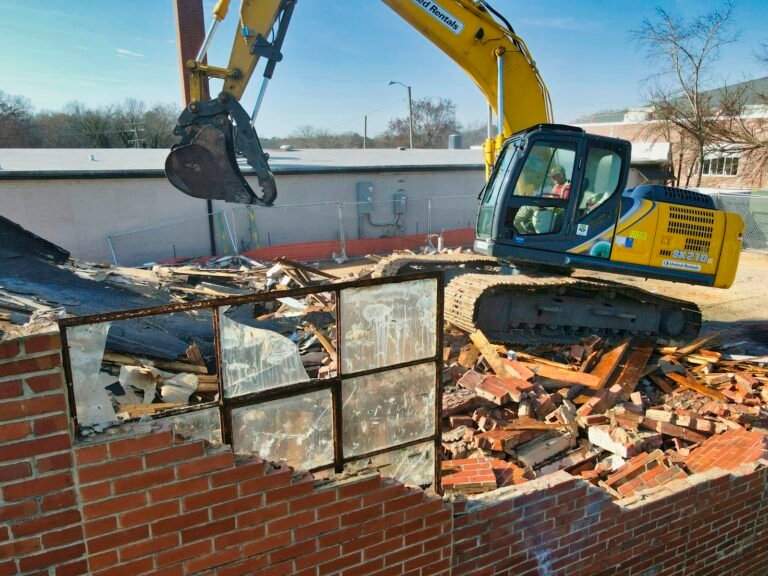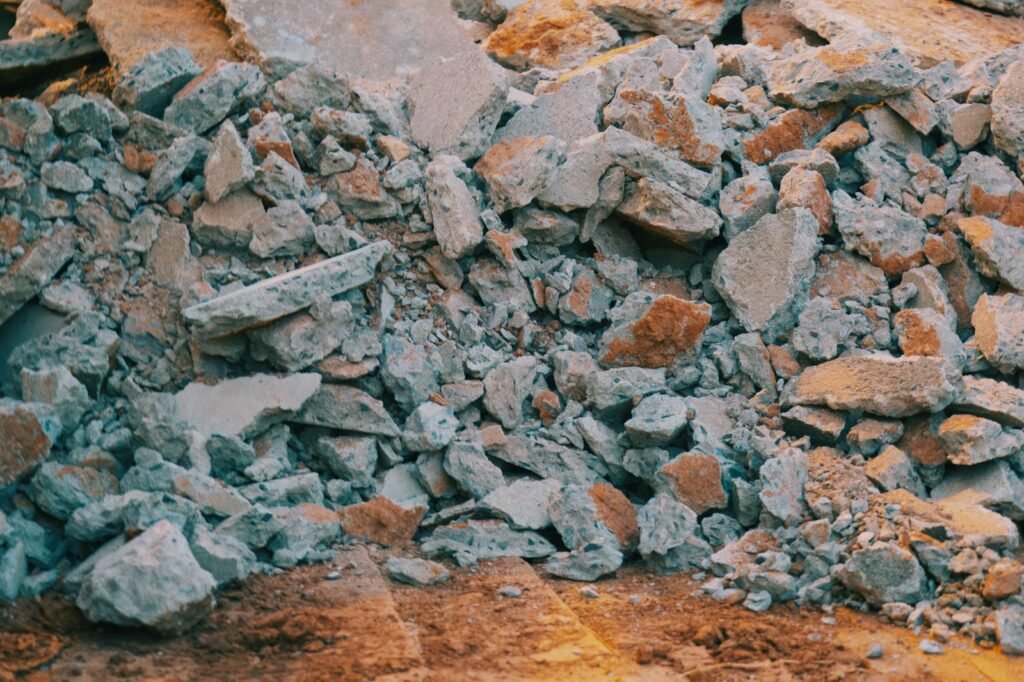
Recycling concrete on site means feeding broken slabs, blockwork and brick through a crusher and turning it into hardcore you can use straight back on the job. It is worth it when you have a decent volume of clean rubble going out and a need for fill, sub-base or track material coming in. If you only have a few skip-loads, or nowhere to use the crushed material, a skip or muck-away is usually simpler. This guide sets out how to make that call, the waste rules to check, and the kit involved.

In this guide
How on-site crushing works
A tracked jaw crusher such as the Dragon 400 or the higher-output Dragon 450 is walked into position near your rubble pile. An excavator loads material into the hopper, the jaws break it down, and a conveyor drops the crushed product into a stockpile beside the machine. From there it is moved with a dumper or loader to wherever it is needed.
The output is a mixed, angular aggregate that compacts well. Typical uses are sub-base under yards and hardstandings, filling low spots, building up haul roads and farm tracks, and backfilling around foundations where the specification allows recycled material. Check your engineer’s or building control’s requirements before you use it under a structure.
Is recycling concrete on site worth it? The cost comparison
We won’t quote figures here because every site is different, but the comparison always comes down to the same items. Price both columns for your job and the answer is usually obvious. Recycling concrete on site also cuts the number of heavy lorries on rural roads, which neighbours and parish councils tend to notice.
| Sending it away and buying in | Crushing on site |
|---|---|
| Skip hire or grab lorry loads out | Crusher hire for the days you need it |
| Disposal or tipping charges per load | An excavator to feed the crusher (often already on site) |
| Bought-in hardcore or sub-base delivered | A dumper or loader to move the output |
| Lorry movements on narrow lanes and through villages | Fuel, operator time and water for dust control |
| Time waiting for collections and deliveries | Registering any waste exemption you need |
Crushing tends to pay off on jobs such as breaking out an old farmyard slab, clearing a demolished outbuilding, or stripping a concrete drive before a rebuild. It is also attractive on remote Devon and Cornish sites, where every lorry load out and in is a long round trip on single-track roads. Where it rarely pays is a small domestic job with a couple of tonnes of mixed rubble and no use for the crushed material afterwards.
Estimating your volume before you book
The single most useful thing you can do before ringing round is work out roughly how much material you have. Crusher hire periods, the size of excavator you need and whether crushing beats skips at all all depend on it.
Measuring a slab or hardstanding
For a slab, multiply length by width by thickness. A farmyard of 20m by 15m at 150mm thick is 45 cubic metres of solid concrete. Concrete weighs roughly 2.4 tonnes per cubic metre, so that slab is in the region of 100 tonnes of material. Once broken out it takes up considerably more room than it did in the ground, because of the voids between the lumps, so expect the rubble heap to look much bigger than the slab did.
Estimating a demolished building
Buildings are harder. Count the walls, multiply length by height by thickness for each, add any concrete floor, and subtract window and door openings. A single-storey blockwork outbuilding produces far less clean crushable material than people expect once the roof, timber, glazing and fittings are stripped out. Photos and rough dimensions sent on WhatsApp are enough for us to give you a sensible view.
Illustrative example
Take a smallholding near Holsworthy breaking out an old 12m by 8m concrete pad, 200mm thick, to lay a new track. That is about 19 cubic metres, or roughly 45 tonnes. At that volume, a short hire of a Dragon 400 fed by a mid-size excavator is a sensible starting point to talk through with us, provided the rubble is clean and pre-broken before the crusher arrives.
The crushed output then goes straight onto the new track route instead of leaving the site in lorries and coming back as bought-in stone. Your own figures will differ, so treat this purely as a way of thinking it through.
Preparing rubble for the crusher
The crusher will only produce clean, usable aggregate if you feed it clean material. Most of the hassle on crushing jobs comes from skipping this step.
- Remove contaminants: timber, plastic, membranes, cables, plasterboard, insulation and general rubbish all need picking out first.
- Never crush anything that might contain asbestos. Old cement sheet roofing and some floor tiles are the usual suspects. Get it surveyed and dealt with by a specialist before crushing starts.
- Keep soil separate: muddy rubble crushes into a dirty product that won’t compact properly.
- Size the pieces: slabs must fit the jaw opening. Large sections may need breaking down first; ask us what breaking options are available for your job.
- Deal with reinforcement: cut back protruding bar and tell us about any heavy reinforcement when you enquire so we can advise.
- Stockpile sensibly: keep the pile within easy reach of the feeding excavator to cut down on tracking about.
Recycling concrete on site, step by step
Every job is different, but a well-run crushing day follows the same pattern. Getting the order right saves hire days.
- Survey first. Confirm there is no asbestos in the structure or the rubble, locate any buried services with a utility search and a cable locator, and decide where the crushed stockpile will go.
- Register what you need. Sort out any waste exemption or permit before the crusher arrives, not on the morning it starts.
- Break out and sort. Break slabs and walls into pieces that will fit the jaw, and sort them into clean concrete and brick, soil, and rubbish. Pull out timber, plastic and metal as you go.
- Set up the crushing area. Choose firm, level ground with room for the crusher, the feeding excavator and a dumper to turn. Keep the stockpile of output well away from the infeed pile so the two never mix.
- Set up dust suppression. Run a hose or water supply to the feed and the conveyor discharge before you start.
- Crush steadily. Feed at an even rate rather than overloading the hopper. Watch for steel or debris that has slipped through and stop the machine before clearing anything.
- Move and lay the output. Take the crushed material to where it is needed and lay it in layers, compacting each one.
- Clean down and off-hire. Clean the crusher, check fuel and fluid levels, and call us for a formal off-hire reference.
Waste rules: exemptions and permits
Broken concrete and brick are legally waste once they come out of the ground or the building, even if you plan to reuse them on the same site. In England, small-scale crushing of waste bricks, tiles and concrete can fall under a T7 waste exemption, which is registered with your local council rather than the Environment Agency. Councils publish the conditions, which include limits on how much is treated per hour and how much is stored at once. Larger or ongoing crushing operations generally need a permit instead.
Using the crushed material in construction, such as a track, hardstanding or drainage work, may need a separate U1 exemption, registered with the Environment Agency. The GOV.UK guidance on the U1 exemption sets out the tonnage limits over its three-year registration and the requirement that the waste is suitable for the job and free of contaminants such as plastic, asbestos and oil.
Exemptions also have rules on how long waste can be stored before use; under U1, waste should not be stored for more than 12 months before it is used. Registration may carry a charge, and the full list of exemptions is in the GOV.UK waste exemption guides.
If you are recycling concrete on site as part of a bigger project, the waste rules sit alongside planning conditions, any flood risk consent near watercourses, and your normal duty of care for waste that does leave the site. Keep notes of what was crushed, how much, and where it went.
This is general information, not legal advice. The rules change, so check the current guidance and speak to your council’s environmental team before you start. Selling crushed material off site raises further questions, so take advice first.
Where crushed concrete can and cannot go
Recycled aggregate is a good material, but it is not a substitute for every type of stone. Match it to the job.
| Use | Suitable? | Notes |
|---|---|---|
| Farm and estate tracks | Usually yes | Lay on a drained formation, compact in layers, finish with a camber |
| Yard and car park sub-base | Usually yes | Check any specification you are working to |
| Filling low spots and levelling | Often | Standalone land levelling may need different consent from construction use |
| Haul roads and temporary site access | Yes | One of the most common uses on larger sites |
| Under house foundations or structural slabs | Only if approved | Your engineer or building control decides |
| Pipe bedding and drainage surround | Usually not | Drainage normally specifies clean, graded stone |
Mixed concrete and brick produces a softer, more variable product than clean concrete alone. That is fine for a track base or fill, but if the job has a tight specification, keep the two separate and crush them as different batches.
Common mistakes on crushing jobs
- Booking the crusher before the rubble is ready. Breaking out, sorting and picking out rubbish take longer than crushing. Have the pile prepared before the crusher arrives.
- Undersizing the feeding excavator. A machine that struggles to lift slabs or reach the hopper slows the whole operation. Tell us the size of the biggest pieces so we can match the excavator.
- No plan for the output. If the crushed material has nowhere to go, you have just moved the problem. Decide where it will be used first.
- Forgetting water. Dry crushing is unpleasant, unsafe and unpopular with neighbours. Check you have a supply.
- Clearing a blockage with the machine running. Always stop the crusher and isolate it before reaching into the jaw, hopper or conveyor.
- Ignoring the paperwork. Registering an exemption is quick; dealing with an enforcement visit is not.
Dust, noise and the neighbours
Crushing concrete releases fine dust that contains respirable crystalline silica, so dust control is a health issue as well as a courtesy to neighbours. Damp the rubble and the crusher feed with a hose or other water supply, keep the conveyor drop height low, and stop if the wind is carrying dust towards houses, livestock or a road.
Jaw crushers are loud. Site the machine as far from neighbouring properties as practical, keep to reasonable working hours, and give nearby households a heads-up before you start. Everyone working near the crusher needs hearing protection and suitable respiratory protection, and nobody should be standing near the hopper or conveyor discharge while it runs.
Crushing on South West sites: practical points
Many of the crushing jobs in Devon and Cornwall are on farms and rural plots rather than city centre sites, and that changes the planning. Narrow lanes and weight-restricted bridges can limit what lorries reach the site, which is part of why crushing appeals in the first place, but the crusher and excavator still need to be delivered. Send us the postcode and any access restrictions you know about so we can plan the delivery from our depot near Okehampton.
Wet weather is the other factor. Clay ground on parts of the Culm Measures in north and west Devon turns soft quickly, and a tracked crusher and excavator working in one spot can churn the ground. If you can, set up on an existing slab, hardstanding or a pad of crushed material from the first run. Rubble also crushes better and produces less mud when it has had a chance to drain.
Older farm buildings in the region are often built from cob, rubble stone or slate rather than concrete and block. Cob is earth, not aggregate, and will not crush into usable stone. Natural stone may crush, but very hard granite from around Dartmoor is tougher on the machine than concrete. Tell us what you are crushing when you enquire.
The kit for a typical crushing job
Most crushing setups need three or four machines working together. Everything below is available from our construction equipment range.
- Crusher: Dragon 400 for smaller jobs, Dragon 450 where you want more output.
- Feeding excavator: a Sunward SWE 35UF works for modest volumes; the SWE 60UF or SWE 90UF make light work of feeding all day and handling heavy slabs.
- Moving the output: a Mechbadger tracked dumper or the Sunward SWL 2830 tracked skid-steer loader. On farms, a tractor and trailer from our agricultural range can move larger volumes along a track route.
- Compaction: once the recycled aggregate is laid, a Weber MT CR 7 reversible plate or CF 3-II Hd forward plate compacts it in layers.
If you crush regularly across several jobs, our Flex Hire account includes crushers from Tier 2 upwards, with swaps between machines as the work changes.
Frequently asked questions
Can I crush brick and block as well as concrete?
Yes, jaw crushers handle brick, block and concrete. Mixed material gives a mixed product, which is fine for fill and tracks but may not meet a tighter sub-base specification.
Do I need an exemption to crush rubble on my own farm?
Often yes. Rubble is waste even on your own land, so check with your local council about a T7 exemption and with the Environment Agency about using the material, before crushing starts.
How long will I need the crusher?
It depends on volume and how well the rubble has been prepared. Tell us roughly how much you have and we’ll suggest a sensible hire period, with daily or weekly options. Our hire FAQs explain how extensions and off-hire work if the job runs longer.
Is crushed concrete good enough for a farm track?
Laid in layers and compacted properly, recycled concrete makes a hard-wearing track base. A well-drained formation and a cambered finish matter as much as the material.
Who is responsible for the exemption, me or the hire company?
On self-drive hire, the person or business carrying out the crushing and using the material is responsible for registering and complying with any exemption or permit. We supply the machine; the waste activity is yours. Check the details with your council and the Environment Agency.
Can I crush concrete with steel reinforcement in it?
Lightly reinforced concrete can often be processed once protruding bar has been cut back, but heavy reinforcement is a different matter. Tell us about it before you book and we will advise whether the crusher is the right tool and how to prepare the material.
What do I need to have on site for delivery?
Firm, level access wide enough for the delivery vehicle, a safe area to unload, and someone to sign for the machines. If the crusher is going to a field, check the ground will carry a loaded lorry first.
Talk to us about your rubble
Send us a photo of the pile, the site postcode and what you want to use the crushed material for, and we’ll tell you whether recycling concrete on site makes sense and which machines to put together. WhatsApp or call 07841 036064, or use our contact form for a multi-machine quote.