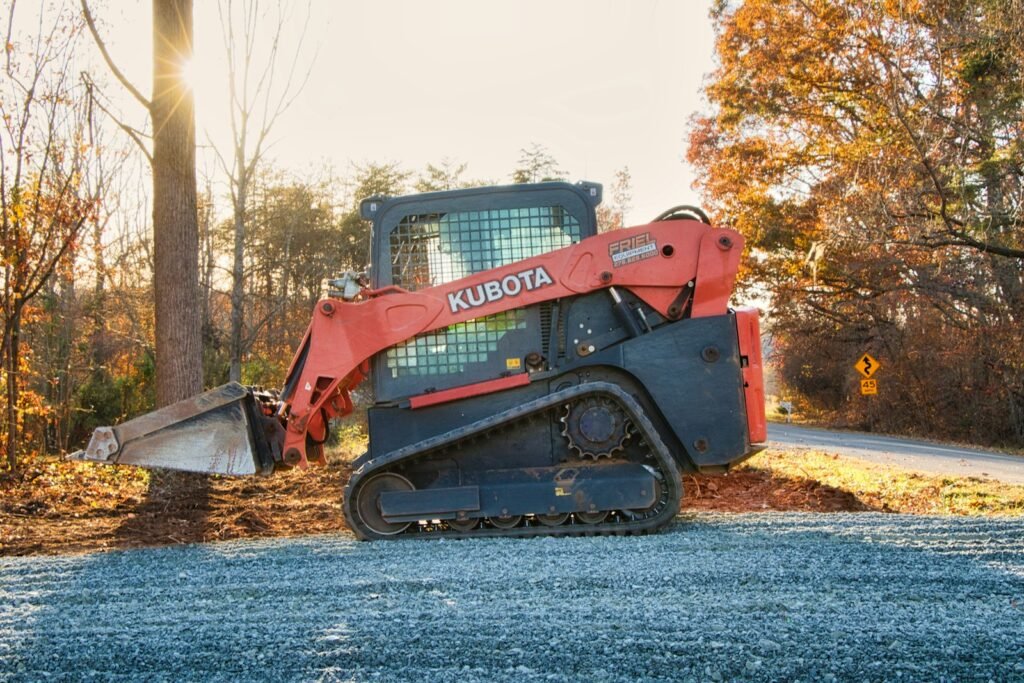
Skid steer hire gives you a compact, nimble loader that can grade, scrape, load and carry on sites too tight for a tractor loader or wheeled shovel. From our depot near Okehampton we hire the Sunward SWL 2830, a tracked skid-steer loader suited to landscaping, site preparation, farm yard work and clearing up after groundworks.

In this guide
The tracks give it better grip and lower ground pressure than a wheeled skid steer, which matters on the soft, wet ground common across Devon and Cornwall. This guide covers what it can do, how to grade a level finish, how it compares with other loaders, and how to plan skid steer hire so the machine is working from the moment it comes off the lorry.
How a skid steer works
A skid steer loader has fixed tracks or wheels on each side and steers by driving one side faster than the other, or in opposite directions to spin on the spot. Loader arms either side of the cab raise and tilt the attachment on the front. The result is a very short, manoeuvrable machine that can work in a space little bigger than itself.
Because it turns on the spot, a skid steer can scuff turf and loose surfaces when spun hard. Tracks reduce that compared with tyres, and smooth, wide turns reduce it further.
On sticky clay, which you’ll find across much of mid and north Devon, mud can pack into the tracks and running gear. Clean it out at the end of each day so the tracks stay correctly tensioned and the machine keeps steering properly the next morning.
Tracked or wheeled?
Wheeled skid steers are common on concrete yards and hard sites, where tyres are quick and cheap to run. Tracks cost more to maintain but transform the machine on soft, wet or uneven ground, spreading the weight so it floats rather than sinks, and giving far more grip on slopes and loose material.
For most jobs in the South West, where even a firm site can turn soft after a week of rain, a tracked machine like the SWL 2830 is the safer bet. The main thing tracks dislike is constant spinning on abrasive surfaces, so keep turns smooth on concrete and stone.
What the Sunward SWL 2830 is good at
Grading and levelling
Spreading and levelling topsoil, sub-base or arena surfaces is where a tracked skid steer shines. The operator can back-drag with the bucket to get a smooth finish, then make final passes with the bucket floated or angled. It’s a quicker way to prepare a lawn area, a patio base or a building pad than hand raking.
Loading and carrying
Loading spoil into dumpers or trailers, moving heaps of aggregate, clearing stockpiles and carrying material across site. On jobs where an excavator digs and a skid steer loads and tidies, the two machines complement each other well.
Landscaping and garden projects
Larger domestic and commercial landscaping schemes often have limited access and lots of material to move: topsoil in, spoil out, gravel spread. A compact tracked loader handles all three.
Farm and equestrian work
Scraping out yards and sheds, mucking out loose housing, moving bedding and maintaining arena and gallop surfaces. In older farm buildings with low beams and tight doorways, a skid steer can often reach where a tractor loader can’t. Watch the overall height with the arms raised.
Winter housing is when many farms find a compact loader most useful. Scraping passageways and feed areas daily, clearing out calf pens and moving bedding all suit a machine that can turn inside a narrow shed. After housing ends, the same machine can clean out the building ready for pressure washing and tidy the yard before turnout.
Equestrian arenas and gallops
Arena surfaces need regular levelling to stay safe for horses. A tracked skid steer can redistribute surface material that has drifted to the track edges and level the base before a new surface goes down. Work gently, keep the bucket just skimming, and avoid digging into the membrane or drainage layer beneath.
Site clean-up
Scraping mud off haul roads, clearing rubble after demolition and tidying a site before handover. Pair it with the Brendon mobile power washer for a proper finish on hard surfaces.
How to grade a level finish with a skid steer
Grading is where a tracked skid steer earns its keep, and where a little technique makes a big difference. The basic method for spreading and levelling topsoil or sub-base:
- Set your levels first. Pegs with marked heights, string lines or a laser level. Without a reference, it is easy to create a smooth surface that is still out of level or has no fall.
- Dump material in small heaps across the area rather than one big pile, so you are spreading short distances.
- Spread forwards with the bucket slightly tilted and just skimming the surface, knocking the tops off the heaps and filling the low spots.
- Back-drag with the bucket flat or floating, reversing slowly over the spread material. This is the step that gives the smooth finish.
- Check against your pegs or lines regularly and correct as you go. Taking a little off is much easier than bringing material back.
- Compact in layers where the surface needs to carry weight, using a plate compactor or roller, then make final trimming passes.
Work in straight, overlapping runs and keep turns smooth and wide. Spinning on finished material leaves scuffs that you then have to grade out again.
Skid steer hire vs other loaders
| Machine | Strengths | Consider instead when |
|---|---|---|
| Sunward SWL 2830 tracked skid steer | Compact, turns on the spot, good on soft ground, grading and loading | You need fast travel over long distances on hard surfaces |
| Venieri 1.63D pivot loader | Articulated steering, kinder to turf, 1,850kg tip load, good visibility | Ground is soft and access is very tight |
| Mini excavator | Digging below ground level, trenches, foundations | The job is mostly spreading and loading rather than digging |
| Captain 26HP compact tractor with loader | Towing implements as well as light loading | The job needs a heavier loader or tight-space work |
The Venieri pivot loader is on our agricultural hire range, and the Captain compact tractor with loader is on our sports and landscaping hire page. If you’re torn between them, tell us the job and the ground and we’ll recommend one.
Ground conditions across the South West
The ground you are working on changes how a skid steer behaves. Across mid and north Devon, heavy Culm clay is sticky when wet and hard as brick in a dry summer, so plan grading for the days in between and clean the tracks often. Around Dartmoor and Bodmin Moor, granite-derived soils are free-draining and gritty, with plenty of stone, which is easier to spread but harder on tracks if you spin on it.
Coastal sites can be sandy and loose, where tracks give good flotation but the machine can dig in if turned sharply. On the Somerset Levels, peat and soft alluvium may not carry much weight at all when wet, so ground mats or a stone haul route may be needed.
Whatever the ground, avoid working saturated soil if you can. Grading wet clay smears and compacts it, which spoils drainage on lawns and paddocks for months. If the job can wait for a dry spell, it usually should.
Attachments
A general-purpose bucket handles most grading and loading. Other skid steer attachments, such as pallet forks, grabs or sweepers, depend on availability and compatibility, so tell us what you plan to do and we’ll confirm what can be supplied with the SWL 2830. Always check the attachment is properly locked on before lifting, and remember that the machine’s rated operating capacity applies to the whole load including the attachment.
Operator notes and safe working
Hire is self-drive unless agreed otherwise. The operator must be trained and competent, and on commercial sites a CPCS or NPORS card for skid steer loaders is normally expected. Skid steers are easy to learn but have particular hazards:
- Getting in and out. Lower the arms and attachment fully to the ground and switch off before entering or leaving the cab. Never climb in or out with the arms raised.
- Restraints. Use the seat belt or restraint bar every time. They are part of the protective structure.
- Load height. Carry loads low. A raised bucket makes the machine unstable, especially on slopes.
- Slopes. Travel straight up and down. With a loaded bucket, keep the heavy end uphill.
- Passengers. Never carry people in the bucket or on the machine.
- Visibility. Rear vision is limited. Keep pedestrians out of the working area and use a banksman where needed.
- Daily checks. Track tension, hydraulic hoses, pins, lights and safety interlocks.
On domestic jobs, think about everyone else on site. Children and pets are drawn to machinery, and a skid steer reversing across a garden has limited rear visibility. Fence off the working area, agree when the machine will be running, and switch off whenever someone needs to approach.
The Provision and Use of Work Equipment Regulations (PUWER) require anyone using work equipment to be adequately trained, and that applies on farms and private land as well as construction sites. If you are new to skid steers, take time in an open area to get used to the steering before working near buildings, fences or people.
Insurance is not included automatically with our hires. You can arrange plant hire cover through our partner insurance4plant.co.uk.
Planning delivery and site prep
Have a firm, level area ready for unloading and mark out underground services, drains and septic tanks before grading. Use utility plans and LinesearchbeforeUdig before you cut levels, as shallow cables and pipes are easily caught by a bucket edge. Remove large stones and debris from areas you plan to level. If you’re preparing a lawn or arena, decide your finished levels first and set out pegs or string lines. A skid steer moves material quickly, so it’s easy to take off too much.
As an example, a typical sequence for a new gravel parking area might run like this: strip the turf and topsoil and stockpile it for reuse, cut down to formation level, lay a geotextile membrane if the ground is soft, spread sub-base in layers with the skid steer, compact each layer with a plate compactor, then spread and level the gravel finish. The loader does the moving and levelling; the compactor does the consolidating. Hiring both for the same week keeps the job flowing without waiting for one machine to arrive.
A worked example: levelling a paddock area for a field shelter
Here is an illustrative plan for a common rural job: levelling an area of sloping paddock for a mobile field shelter and a hardstanding in front of it. It shows the sequence, not a particular customer’s site.
- Mark out the shelter footprint plus a margin, and decide where water will drain so the base doesn’t become a pond.
- Strip the turf and topsoil with the skid steer and stockpile it to one side for dressing the edges later.
- Cut and fill to level: take material from the high side and spread it on the low side in thin layers, tracking over each layer to firm it.
- Lay a geotextile and sub-base for the hardstanding area, spread with the bucket and compacted with a plate.
- Dress the edges with the saved topsoil and grade it into the surrounding field so there is no step for animals or mowers.
On firm ground with good access this is often a one or two-day job. On a wet, sloping site it can take longer, which is why many customers book a week and use the remaining days for tidying yards and tracks.
What to tell us when you enquire
A good first message means a fast, accurate quote. Send us these details on WhatsApp and we’ll confirm whether the SWL 2830 is the right machine, or whether a pivot loader, compact tractor or mini excavator would suit better:
- The job: levelling, loading, yard scraping, arena work, site clean-up, and roughly how big the area is.
- The ground: grass, clay, stone, sand, concrete, and how wet it is at the moment.
- The narrowest access width and any height limits such as doorways or beams.
- Where the delivery vehicle can safely stop and unload.
- Your dates and how long you expect to need the machine.
- Any attachments you think you need, and whether you need a compactor as well.
Delivery, handover and off-hire
The SWL 2830 is delivered on a suitable vehicle and unloaded at the agreed point. Our driver will run through the controls, restraint, daily checks and attachment locking, and someone on site should sign the delivery note. The machine arrives with a full tank and should go back full, and our terms require white diesel only.
At the end of the hire, clean the worst of the mud from the tracks and bucket, park the machine with the arms down where our vehicle can reach it, and call or WhatsApp us to off-hire. Hire charges run until you have an off-hire reference number, so don’t rely on telling the driver.
Common mistakes on skid steer hires
- Grading without levels. A smooth surface isn’t the same as a level one. Set pegs or lines first.
- Spinning on turf and finished surfaces. Counter-rotating on the spot tears grass and scuffs gravel. Use gentle, wide turns.
- Overfilling the bucket with wet material. Wet clay is heavy. A brimming bucket raised high makes the machine unstable, especially on slopes.
- Working with the arms raised near buildings. Check the clearance under beams, doorways, gutters and overhead cables before lifting.
- Hiring the loader without the compactor. Spread material needs compacting in layers if it is going to carry weight. Order both together.
Hire periods and what affects the cost
A small levelling job might take a day, but most landscaping and site preparation suits a weekly hire, our most popular period. For months of yard maintenance or a long build, ask about long-term rental at monthly rates with on-site servicing included. What you pay for skid steer hire depends on the period, the delivery distance from our depot, any extra attachments, and whether the machine comes back clean and full. WhatsApp us for a current quote.
Frequently asked questions
Can I hire a compactor at the same time?
Yes. Our Weber MT forward and reversible plates pair well with the skid steer for sub-base and hardstanding work, and both can usually come on the same delivery.
Can a skid steer dig?
It can scrape, cut shallow levels and reduce heaps, but it isn’t designed for trenches or deep digging. Use a mini excavator for that.
Will it fit through a garden gate?
It’s a compact machine, but widths vary between gates. Send us the narrowest measurement on the access route.
How long should I hire a skid steer for?
A small levelling job might take a day. Most landscaping and site preparation suits a weekly hire.
Can I use a skid steer on a lawn?
Yes, with care. Tracks are much kinder than tyres, but avoid spinning on the spot and lay boards on the main route if the ground is wet.
Do I need a ticket to operate a skid steer?
On commercial sites a CPCS or NPORS card is normally expected. On private land, the operator still needs to be trained and competent. See our hire FAQs for more on training and responsibilities.
Book skid steer hire
Send us your postcode, dates, the job and the access width. WhatsApp or call 07841 036064 for a current quote, browse the construction fleet, or use our contact page for written quotes.