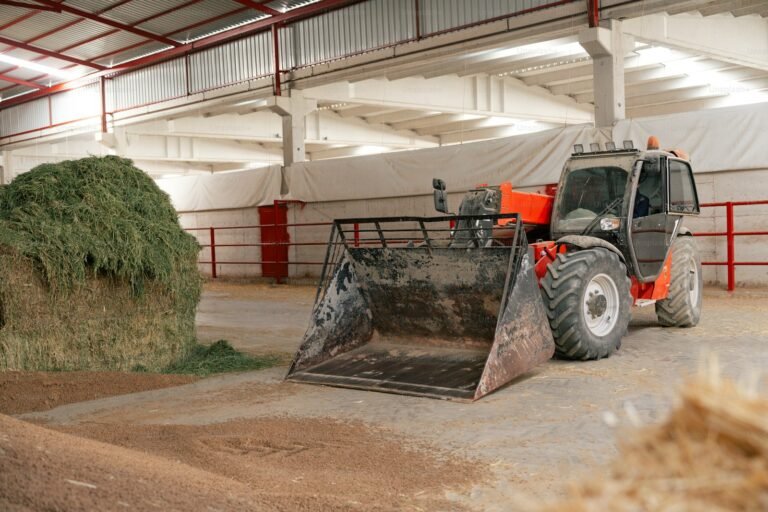
Telescopic pivot loader hire gives you a compact, articulated loader that can reach higher than a standard yard loader yet still fits through low doorways and turns inside cattle sheds and stable blocks. Our Venieri 1.63D has a 53HP Kubota engine, a 1,850kg tip load, Z-parallel loader kinematics, a Stage V engine and all-terrain tyres. We hire it from our Okehampton depot to farms, equestrian yards, landscapers and estates across Devon, Cornwall, Somerset and Dorset.

In this guide
What a telescopic pivot loader is
A pivot loader steers by bending in the middle. The front and rear halves of the chassis are joined by an articulation joint, so the machine follows its own wheel tracks and turns in a much tighter space than a rigid-frame loader of the same size. “Telescopic” means the boom extends, giving you extra lift height and reach for stacking bales, loading high-sided trailers or reaching into a feeder.
The Venieri 1.63D sits on our agriculture equipment page under loaders. Its key figures:
- Engine: 53HP Kubota, Stage V emissions.
- Tip load: 1,850kg.
- Kinematics: Z-parallel linkage.
- Tyres: all-terrain, for yards, tracks and grass.
Tip load is not working load
This is the point most often misunderstood. The 1,850kg tip load is the weight at which the machine starts to tip forward under test conditions. The load you can safely handle day to day is lower, and it changes with the attachment, how far the boom is extended, how high the load is and how far the machine is articulated. On an articulated loader, capacity drops when it is turned, because the rear counterweight swings away from the line of the load.
Always check the load chart for the attachment you are using, keep loads low when travelling, and straighten up before lifting to full height where you can. If you are unsure what a bale, bag or pallet weighs, find out before you lift it.
Why the Z-parallel linkage matters
The Z-shaped linkage gives strong breakout force at the bucket, which helps when digging into a muck heap, a pile of compacted bedding or a stockpile of aggregate. The parallel element keeps forks or a pallet level as the boom rises, so loads do not tip back or slide forward. In practice that means you can switch from bucket work in the morning to moving palletised feed or bagged materials in the afternoon without fighting the machine.
Telescopic pivot loader hire for yards and tight buildings
Livestock and equestrian buildings
Older Devon and Cornish farm buildings were not built for modern machinery. Low beams, narrow doorways and tight internal turns rule out a telehandler in many cattle sheds, calf pens and stable blocks. A compact pivot loader can get inside to muck out, spread bedding and push up feed, which saves hours with a fork and barrow.
Bale and feed handling
With a suitable attachment, the telescopic boom lets you stack and destack bales, load trailers and fill ring feeders. Check the bale weight against the load chart, as wet silage bales are heavier than they look.
Landscaping and groundworks support
On landscaping jobs the 1.63D moves topsoil, gravel, sand and bulk bags around a site, loads dumpers and skips, and carries materials over lawns and tracks on its all-terrain tyres. Its compact size suits gardens and estates where a larger machine would cause damage.
Attachments and choosing the right tool
A loader is only as useful as the tool on the front. Before your telescopic pivot loader hire starts, think about every job on your list and which attachment each needs:
| Job | Typical attachment | Things to watch |
|---|---|---|
| Mucking out, loading soil and aggregate | General-purpose bucket | Dense, wet material reaches the load limit with the bucket only partly full |
| Palletised feed, fertiliser, bagged materials | Pallet forks | Check fork spacing and pallet weight against the load chart |
| Bales | Bale handler or spike suited to the bale type | Wet silage bales are heavier than dry hay or straw |
| Bulky bedding and loose muck | Muck fork or grab | Wide loads restrict visibility when travelling |
| Bulk bags of sand or aggregate | Forks or a suitable lifting attachment | Use the bag’s lifting loops correctly and keep the bag low when moving |
Tell us what you need when you book and we will confirm which attachments are available for your dates. Each attachment changes the safe working load, so check the load chart for the tool you are using, not just the machine.
Changing attachments safely
Swapping from bucket to forks takes a few minutes, but it is a common point for accidents. Park on level ground, lower the attachment to the floor and follow Safe Stop before leaving the seat. Once the new tool is picked up, check visually that the locking pins or quick-hitch locks are fully engaged on both sides, and test it with a gentle crowd and lift before taking a load. An attachment that is not locked can drop without warning.
Pivot loader or telehandler?
| Venieri 1.63D pivot loader | Merlo P40.14 telehandler | Mechbadger tracked telehandler | |
|---|---|---|---|
| Main strength | Compact, tight turning, fits low buildings | Height and reach: 14m, 4t lift, stabilised | Tracked, tight access, material placing |
| Best for | Yards, sheds, stables, bale and feed work | Construction sites, high stacking, roofing materials | Soft or awkward ground, landscaping access |
| Less suited to | Heavy lifts at height | Low buildings and tight yards | Fast travel across a large farm |
The Merlo sits on our construction page and the Mechbadger on our sports and landscaping page. If you are not sure which one your job needs, send us photos of the building and the heaviest load.
Driving an articulated loader well
Pivot loaders feel different from tractors and skid steers. The machine bends in the middle, the rear swings out as you turn, and stability changes with articulation and boom position. A few techniques make a big difference:
- Watch the rear when turning. On an articulated machine, the back end swings inside the turn. Check for gate posts, stanchions and people on both sides before turning in a tight shed.
- Straighten up before lifting high. Capacity and stability are best with the machine straight. Lift to height only when you are lined up with the stack or trailer.
- Extend the boom last. Raise first and extend only as much as needed, then retract before moving off.
- On slopes, keep the load uphill and travel straight up or down rather than across. Avoid turning on a slope with a raised load.
- Slow down on rough ground. All-terrain tyres grip well, but bouncing over ruts with a load raised can tip the machine or drop the load.
- Use the Safe Stop routine: bucket or forks lowered to the ground, handbrake on, controls neutral, engine off and key removed before leaving the seat.
Mistakes we see most often
- Treating tip load as working load, as explained above.
- Turning with a raised, extended boom, which combines the two things that reduce stability most.
- Driving into a heap at speed to fill the bucket. It strains the loader and the articulation joint. Approach steadily and crowd the bucket as you lift.
- Ignoring tyre pressures. Soft tyres make the machine wallow and reduce stability, especially when lifting.
- Letting muck build up around the articulation joint and rams, which hides leaks and speeds up wear.
Worked example: mucking out a cattle shed
Here is an illustrative job on a mid Devon farm. A straw-bedded shed holding young stock over winter needs clearing in spring, but the doorway is low and the internal passage between pens is narrow, ruling out the farm’s telehandler.
- Measure first. The farmer checks the doorway height and width and the tightest internal turn, and sends the figures with photos. We confirm the 1.63D fits.
- Plan the flow. A trailer or muck spreader is parked outside the door on firm ground so each bucket goes straight from the pen to the trailer with the shortest possible carry.
- Clear pen by pen, working from the back of the shed towards the door so the loader never crosses ground it has already cleared and bedding is not trampled back in.
- Use the telescopic reach to tip into a high-sided trailer without having to drive up a ramp.
- Finish by washing down the loader, particularly around the articulation joint, before it goes back.
A job that takes days with a fork and barrow can often be done in much less time, with far less strain on the people doing it.
Equestrian yards and stable blocks
On livery and private yards the same principles apply on a smaller scale. A pivot loader can clear muck heaps, move bedding bales from the barn to the stables, spread arena surface and carry hay round to field shelters. Because horses are easily startled, plan loader work for when horses are turned out or settled, keep the machine away from tie-up areas, and warn everyone on the yard before you start. Check that yard surfaces and drain covers can take the machine’s weight.
Before you hire: practical checks
- Measure doorways and headroom on the buildings the loader needs to enter, and ask us for the machine’s height and width.
- Weigh your heaviest load, including bales, bags and pallets, and compare it with the load chart.
- Choose the attachment: bucket, pallet forks or another tool. Tell us what you need and we will confirm what is available.
- Check ground conditions on slopes, tracks and yards, especially wet concrete and steep ramps.
- Plan delivery access to the yard for our lorry.
Daily checks and looking after the machine
A few minutes each morning prevents most breakdowns and keeps the hire running smoothly:
- Engine oil, coolant and hydraulic oil levels.
- Hoses and rams for leaks, chafing or damage, particularly around the articulation joint and boom.
- Tyres for cuts and correct pressure, and wheel nuts secure.
- Attachment locking pins fully engaged before lifting.
- Lights, horn, seat belt and any warning lights on start-up.
- Grease points greased as the handbook describes, especially when working in muck and water.
Muck and bedding work is hard on any loader. Knock off build-up around the articulation joint at the end of the day, and wash the machine down before it goes back. If something does not feel right, stop and WhatsApp us. We will assess it and arrange a repair or replacement as quickly as possible.
Lifting rules and examination
When a loader is used to lift loads on forks or lifting attachments, it counts as lifting equipment under LOLER. HSE says that unless an examination scheme sets other intervals, lifting equipment should be thoroughly examined at least every 12 months, and lifting accessories every 6 months. Our machines are maintained and examined as part of managing our fleet, and you can ask us for the current paperwork.
Your part during the hire is to plan lifts sensibly, use the right attachment, carry out daily checks and report faults straight away. HSE’s guidance on thorough examination of lifting equipment gives the detail if you need it for your own records or an audit.
Stacking bales safely
Bale stacks fall in predictable ways. Build on firm, level ground, keep stacks to a height that is stable for the bale type and condition, and stagger bales so the stack is bonded rather than built as separate columns. Lift and place bales with the machine straight and the boom no higher than needed, and never let anyone stand near or climb on a stack while the loader is working. Destack from the top down, never by pulling bales from the bottom or side.
Operators, safety and hire terms
Hire is self-drive, so the operator must be trained and competent. HSE guidance under the Provision and Use of Work Equipment Regulations says only workers who have received appropriate training should drive self-propelled work equipment. Many operators hold a training certificate for telescopic or loading machines. Check what your insurer or client expects.
Basic habits keep you safe: wear the seat belt, keep people out of the working area, travel with the boom retracted and the load low, and never lift people on a loader. Insurance is not included in the hire, so check your cover or speak to our partner insurance4plant.co.uk.
The pivot loader is included in Tier 4 of our Flex Hire account, at £1,495 +VAT and delivery per month, alongside the 4WD tractor and full fleet. For shorter jobs, daily and weekly hire are available.
Delivery, access and what affects the cost
We deliver the Venieri on our own transport and unload it at your yard, so tell us about the access: lane widths, weight limits on bridges, overhead cables at the yard entrance and a firm, level spot to unload. Someone needs to be there to sign for it, and we will run through the controls, attachments and daily checks at handover.
We quote each telescopic pivot loader hire individually. The main factors are the length of hire, the attachments you need and the delivery distance from our depot near Okehampton. A week’s hire often works out better value than a few separate days for spring clean-outs, and it gives you room to work around the weather. For regular use through the year, Flex Hire Tier 4 includes the pivot loader alongside the rest of the fleet.
Useful extras for loader jobs
Many customers add other kit to the same delivery. A pressure washer from our range is useful for cleaning down sheds and the machine afterwards, and a trailer helps on landscaping jobs where material needs moving further than the loader should travel. Tell us the whole job and we will suggest a sensible package rather than one machine at a time.
Message us with your postcode, dates and the jobs on your list, and we will come back with a recommendation and a quote.
HSE’s agriculture health and safety pages cover safe loader and machinery use on farms.
Frequently asked questions
Can the Venieri 1.63D lift 1,850kg?
No. 1,850kg is the tip load. The safe working load is lower and depends on the attachment, boom extension and articulation, so check the load chart.
Will it fit in my cattle shed?
Compact pivot loaders are designed for exactly this, but measure your doorways and headroom and send us the figures before booking.
Is telescopic pivot loader hire available by the week?
Yes. Daily, weekly, monthly and Flex Hire are all options. WhatsApp us for a current quote.
How does a pivot loader compare with a skid steer?
A skid steer such as our Sunward SWL 2830 tracked loader is very compact and grips well on soft ground, but it turns by skidding, which can scuff surfaces. The pivot loader steers by articulation, is kinder to concrete and grass, and its telescopic boom gives more reach for loading trailers and stacking.
Can it load a high-sided trailer or muck spreader?
Yes, that is one of the main reasons people choose a telescopic pivot loader. The extending boom gives extra height for tipping over trailer sides. Check the load chart for the boom position and attachment you are using.
Can I drive the loader on the road between fields?
Ask us before planning any road travel. The machine’s road equipment, your licence and your insurance all need to be in order.
What happens if the loader breaks down during the hire?
Stop work, lower any load and call or WhatsApp us. We will assess the problem and arrange a repair or replacement as quickly as possible, so your telescopic pivot loader hire is not left standing idle. Please do not attempt repairs yourself without our agreement.
Book the Venieri pivot loader
WhatsApp or call 07841 036064 with your postcode, dates, the job and your heaviest load. For written quotes or account enquiries, use our contact form.