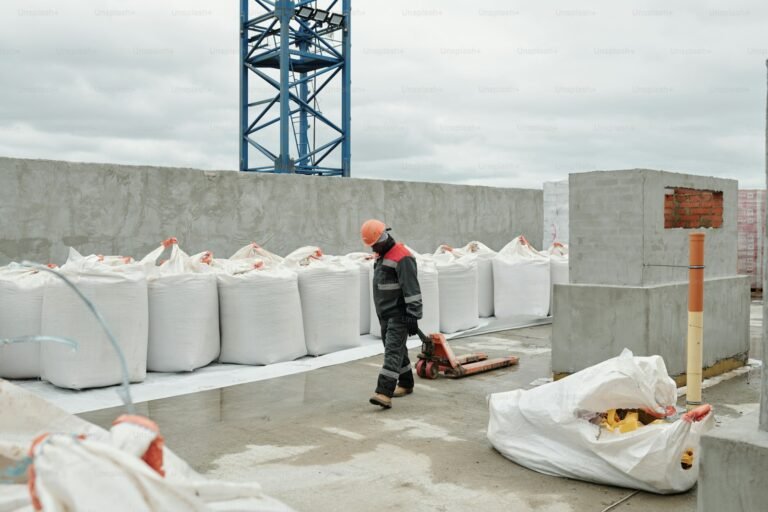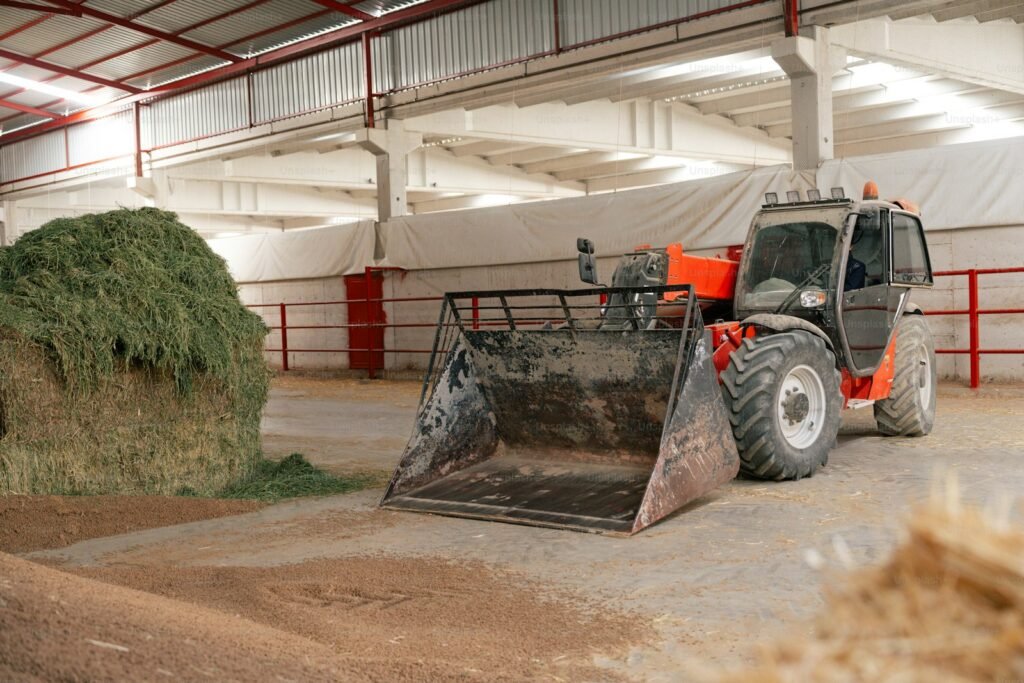
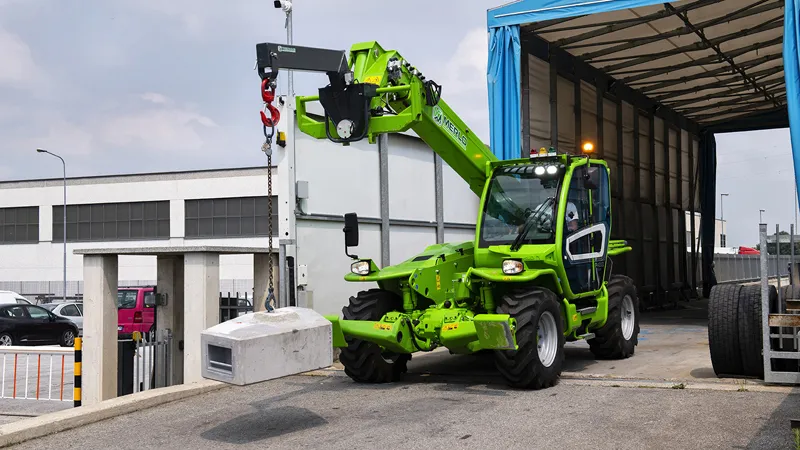
Full-size telehandlers are brilliant on a building site with a hardcore haul road. They are much less useful in a back garden reached through a side gate, on a waterlogged fairway or on a sloping estate lawn. That is where tracked telehandler hire comes in. Our Mechbadger tracked telehandler is a compact machine for lifting and placing materials where access is tight and the ground is soft, and it sits alongside the Merlo P40.14 for jobs that need real height and capacity. This guide helps you choose.
In this guide
Why tracks make a difference
Tracks spread a machine’s weight over a much larger area than four tyres. In practice that means less sinking, less rutting and better grip on wet grass, mud and loose ground. On many South West sites that is the difference between working and waiting for it to dry out.
The heavy clay soils found across much of mid and north Devon hold water through the winter, and a wheeled machine can churn a lawn or field entrance into a mess in a few passes. Golf courses and sports grounds have the same problem: the surface has to be playable the following day. A compact tracked machine lets you get material where it is needed with far less damage to put right afterwards.
Mechbadger or Merlo: which telehandler?
| Mechbadger tracked telehandler | Merlo P40.14 telehandler | |
|---|---|---|
| Size | Compact | Full-size |
| Undercarriage | Tracks | Wheels, with stabilisers |
| Headline spec | Ask us for the current lift and reach figures | 14m reach, 4t lift |
| Best ground | Soft, wet, uneven or sensitive surfaces | Firm hardstanding and haul roads |
| Best access | Narrow routes, gardens, courses, estates | Open sites with space to manoeuvre and set up |
| Typical jobs | Placing bags, pallets and materials on landscaping and grounds work | Loading out at height, roofing materials, block packs to scaffold |
If your job needs height, such as loading out a scaffold on a two-storey build, the Merlo is usually the answer. Details are on our construction equipment page. If the job is mostly about getting a load across difficult ground and setting it down accurately, start with the Mechbadger.
Jobs suited to tracked telehandler hire
- Landscaping in rear gardens: moving pallets of paving, sleepers and bulk bags from the drive to the work area.
- Golf course and sports ground projects: placing bunker sand, rootzone, drainage stone and irrigation materials with minimal turf damage, often booked through our Hole in One Rentals line.
- Estate and woodland work: handling timber, posts and fencing materials on soft or sloping ground.
- Farm jobs off the yard: moving materials into fields and along tracks when a wheeled loader would bog down.
- Self-build and extension sites with poor access, where a full-size machine would not fit between houses.
Planning the lift
Any telehandler is lifting equipment, and at work the Lifting Operations and Lifting Equipment Regulations 1998 (LOLER) require lifts to be properly planned, supervised and carried out safely. The HSE’s LOLER guidance sets out the duties; check the current guidance for your site. A simple plan for each type of lift covers:
- The load: weight, size and how it will be picked up, such as forks or another suitable attachment.
- The route: gradients, soft spots, drains, steps, trees and overhead cables.
- The set-down point: firm, level and clear of people.
- Capacity: check the machine’s load chart for the reach and height you need, not just its maximum lift.
- Exclusion zone: keep everyone clear of the machine and the load while it is moving.
- Weather: wind, rain and failing light all reduce safety margins.
Operator training
Our hire is self-drive unless otherwise agreed, so the person operating the telehandler must be trained and competent. On construction sites, principal contractors commonly expect a recognised card scheme such as CPCS or NPORS for telehandlers. On a private garden or farm, the legal duty to make sure operators are competent still applies to employers and the self-employed. If you are unsure whether your training covers a compact tracked machine, ask us before you book.
Access checklist before delivery
A compact machine opens up sites a big telehandler cannot reach, but it still needs a route in. Before you book, check:
- The narrowest gate, path or gap between buildings on the route.
- Any steps, retaining walls or steep ramps the machine would have to cross.
- Where our delivery vehicle can safely park and unload, especially on narrow Devon and Cornish lanes.
- Drain covers, septic tank lids and shallow services that may not take the weight.
- Overhead power lines, phone wires and branches over the working area.
Photos on WhatsApp help us give you a quick answer, and we can suggest alternatives such as our Dragon LT1000 dumpy bag lifter or Tracspider tracked carrier if access is tighter still. All the compact options are on our sports and landscaping page.
On golf courses and sports grounds, talk to the head greenkeeper or groundsman about the route before work starts. They will know where irrigation lines, drainage runs and soft spots are, and which areas must be left untouched before a fixture or competition. Agree a route, mark it, and stick to it for every trip so any recovery work is confined to one strip.
Combining machines on one delivery
Most tracked telehandler hire jobs involve other kit. A garden landscaping project might pair the Mechbadger with a Sunward mini excavator, a tracked dumper and a plate compactor. A golf course drainage job might add a Mak Brent trencher and a UTV. Booking together means one delivery and one collection, and a single point of contact for the job.
How to read a load chart
Every telehandler has a load chart, usually in the cab and in the operator’s manual. It is the most important document on the machine, and the one most often ignored. The headline maximum lift only applies with the boom retracted and low. As the boom extends and rises, the safe load falls, sometimes sharply.
- Find the weight of the load. Use the delivery note or the label on the pallet. Pallets of paving, blocks and sleepers are often much heavier than they look.
- Measure where it has to go. Work out how far out from the machine and how high the set-down point is.
- Find that point on the chart. Charts show boom angle and extension as arcs or zones, each with a maximum load.
- Compare. If the load is heavier than the chart allows at that position, you need to get closer, set it down lower, split the load, or use a bigger machine.
- Allow for the ground. Charts assume the machine is on firm, level ground. A slope or a soft spot reduces your margin.
When you enquire about tracked telehandler hire, tell us the heaviest load and where it needs to go. We will check it against the Mechbadger’s chart, and if it is outside what the machine can do safely, we will say so and suggest the Merlo or another approach.
Using a banksman
On a cramped garden or a busy course, the operator often cannot see the set-down point, the back of the machine and the people nearby all at once. A competent banksman or signaller fixes that. Agree hand signals before work starts, make sure the banksman stays where the operator can see them, and stop immediately if contact is lost. Only one person should give signals at a time. On a domestic job, that might be the landscaper’s labourer; it should never be a curious homeowner wandering into the working area.
Thorough examination and daily checks
A telehandler is lifting equipment, so under LOLER it needs regular thorough examination by a competent person. The HSE’s page on thorough examinations sets the default intervals at every 12 months for most lifting equipment and every 6 months for lifting accessories and anything used to lift people, unless an examination scheme says otherwise. If your site or client needs to see paperwork, ask us for the current record when you book.
The operator should still check the machine at the start of every shift:
- Tracks free from cuts, missing parts and debris, with tension looking even on both sides.
- Forks or attachment straight, free from cracks and properly locked onto the carriage.
- No hydraulic leaks under the machine or around the boom, and hoses undamaged.
- Any load indicator or warning systems working as the manual describes.
- Controls returning to neutral, seat belt working, horn and lights operational.
- Fluid levels checked; under our terms, daily fuel, oil and hydraulic checks are the hirer’s responsibility.
If anything looks wrong, park the machine safely, stop using it and call or WhatsApp us. Do not attempt repairs yourself.
Working on slopes and soft ground
Tracks are the reason to choose this machine, but they do not cancel out the basics of stability. Most telehandler overturns happen when a raised or extended load meets a slope, a soft spot or a sharp turn.
- Travel with the load low and the boom retracted, raising it only when you are at the set-down point.
- Go straight up and down slopes as the manual advises, not across them, and never turn on a gradient with a raised load.
- Watch for hidden soft spots such as old trenches, soakaways, septic tanks and recently filled ground.
- Use ground mats or boards on very soft lawns and across delicate surfaces.
- Turn gently on tarmac and block paving. Sharp counter-rotation can scuff hard surfaces, so make wider turns or protect them.
- Stop when conditions change. Heavy rain softens ground quickly, and wind affects tall, light loads such as sheets and boards.
Overhead power lines
Rural Devon and Cornwall are crossed by overhead lines running over gardens, fields and farm tracks, often lower than people expect. A telehandler boom that touches or comes close to a live line can be fatal. Before work starts, identify every overhead line near the route and working area, plan lifts so the boom stays well away, and mark the danger zone on the ground if needed. If the work has to happen near a line, contact the local electricity network operator first; they can advise and in some cases arrange for the line to be made dead or diverted.
Worked examples
These scenarios are illustrative, to show where tracked telehandler hire fits.
Sleeper retaining wall in a sloping garden
A landscaper is building a sleeper retaining wall at the bottom of a sloping rear garden. Packs of oak sleepers and bags of post mix are delivered to the drive. The Mechbadger carries each pack down the side path and across the lawn on boards, setting the sleepers beside the wall line so they can be lifted into place by hand rather than carried the length of the garden. A mini excavator digs the footing on the same delivery.
Drainage on a golf course
A club is installing new drainage across two wet fairways. Bulk bags of drainage stone are dropped at the maintenance yard. The tracked telehandler moves bags along an agreed route to each run, placing them where the trencher crew needs them, while a UTV carries pipe and fittings. Tracks keep damage to a single strip that is easy to repair.
Fencing on a wet hillside
A farm is renewing a boundary fence on a steep field that stays wet all winter. Pallets of posts and rolls of stock netting are placed at intervals along the line by the tracked machine, which copes with ground where a wheeled loader would spin and rut.
Self-build between neighbouring houses
A self-builder is putting up a timber-frame home on an infill plot with a narrow gap between neighbouring houses. A full-size telehandler cannot get past the front of the plot. The compact tracked machine carries block packs, bagged aggregates, timber and insulation from the road-side drop to the back of the plot, and places them at low level beside the build, so the trades are not barrowing materials down a narrow passage all week.
Long, awkward items are planned separately, while the Merlo is booked for the one day when materials have to go up to the first floor from the open front of the site.
Common mistakes with tracked telehandler hire
- Judging capacity by the headline figure rather than the load chart at the actual reach and height.
- Skipping the route walk, then finding a step, a manhole or a soft spot halfway through the garden with a load on the forks.
- Driving with the load raised for a better view, which reduces stability.
- Not agreeing the route with the groundsman or homeowner, so the whole lawn gets tracked instead of one strip.
- Using a machine without the right training, or letting someone else on site have a go.
- Leaving the machine unsecured overnight. Lower the forks to the ground, remove the key and park away from public paths; our terms make you responsible for its security during the hire.
- Underestimating delivery access. Our lorry still needs to reach a safe unloading point.
What affects the cost of tracked telehandler hire
We do not publish hire rates; each quote reflects the job. The main factors are:
- Hire length. Daily, weekly and monthly hire are available, and weekly is the most popular because landscaping and drainage jobs rarely finish on schedule.
- Delivery distance from our depot near Okehampton, quoted separately.
- Other kit on the same delivery, which shares transport.
- Weekend use, which may be charged extra on a weekly hire.
- Insurance, which is not automatically included. Contractors usually have hired-in plant cover; others can ask about our partner insurance4plant.
Contractors who need lifting kit regularly alongside other machines may find Flex Hire works out better than repeated short hires; ask us which tier covers the machines you use. Payment, deposits and off-hire are explained on our hire FAQ page.
Frequently asked questions
How much can the Mechbadger tracked telehandler lift?
Lift capacity varies with how far the boom is extended and raised. Tell us the load and where it needs to go, and we will check it against the machine’s load chart before you book.
Will a tracked telehandler damage my lawn?
Tracks cause far less damage than wheels, but turning sharply on wet turf can still scuff the surface. Make wide turns and lay ground protection on very soft areas.
Do I need a CPCS card to hire a telehandler?
We need the operator to be trained and competent. Many construction sites require a CPCS or NPORS card, so check your site’s rules.
Can I hire a tracked telehandler with an operator?
Hire is self-drive unless otherwise agreed. Ask us about your job and we will tell you what we can arrange.
Can I use a tracked telehandler to lift people?
No. Never lift people on forks, pallets or a bucket. Lifting people needs equipment designed and approved for that purpose, and LOLER sets stricter examination requirements for it.
Is a tracked telehandler better than a mini digger for moving materials?
For pallets, sleepers and bags that need lifting and placing, yes. A mini digger can move small loads, but it is a digging machine first. Many jobs use both.
How does the machine get to my site?
We deliver on our own transport from Okehampton. The delivery vehicle needs a safe place to unload, ideally hardstanding close to the start of your route. Send us photos of the road and drive when you book.
Book a tracked telehandler
WhatsApp or call 07841 036064 (Mon–Fri, 7:30am–5:30pm) with the load, the access route, your site postcode and dates. For written quotes, fleet enquiries or account set-up, use our contact page or email info@conagri.co.uk.