Land drainage is about getting excess water off and out of the soil before it damages crops, grass, livestock ground or your garden. In the South West, with high rainfall and plenty of compacted gateways, wet ground is common. The fix is not always new pipes. Sometimes it is breaking a compacted layer, clearing a blocked ditch or repairing an old drain outlet. This guide helps farmers, smallholders, estate managers and owners of large gardens work out what is causing the wet ground, which method suits it, and which equipment does the job.

In this guide
Signs your land has a drainage problem
Before spending on any work, be sure the problem is drainage and not something else. Look for these signs:
- Standing water that lingers for days after rain, not just hours.
- Rushes, sedges, mosses and other wet-loving plants spreading through grassland.
- Poached ground where livestock cannot be turned out without damage.
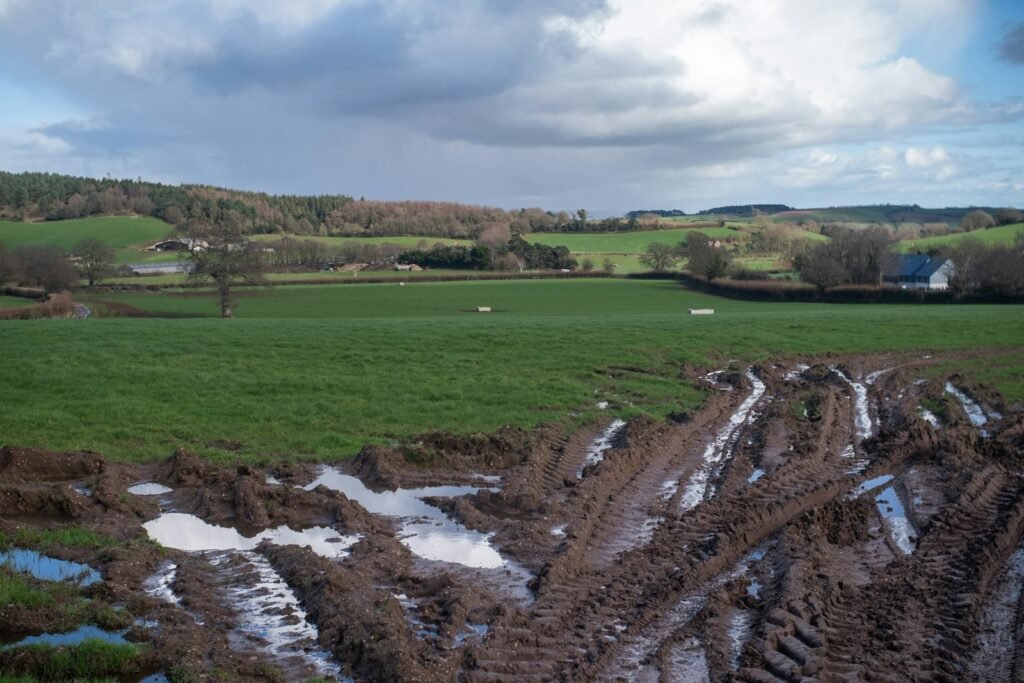
- Tractors and machinery rutting or getting stuck long after neighbours are working.
- Patchy crop growth, yellowing and shallow roots in the wettest areas.
- Grey, blue or mottled subsoil with a sour smell when you dig a hole, a sign of waterlogging.
- In gardens, a lawn that stays spongy all winter and moss that takes over the grass.
Dig a few inspection pits about 60cm to a metre deep in wet and dry areas of the field. You will learn more in an afternoon with a spade than from any amount of guesswork.
What causes wet ground
Compaction
Heavy machinery, livestock and working ground when it is wet all create compacted layers, often a plough pan just below cultivation depth or a surface cap. Water sits on top of the pan even if the subsoil beneath could drain it. This is very common in gateways, headlands, tramlines and areas used for winter feeding.
Heavy clay soils
Clay holds water and drains slowly. Parts of Devon, Somerset and Dorset have heavy clay soils where water struggles to move down, so it needs help to move sideways into drains instead.
High water table and springs
Low-lying land, valley bottoms and fields with springs or seepage lines at the foot of a slope stay wet because the groundwater itself is high. On the Somerset Levels, much of the land depends on managed water levels. Here, the solution is often intercepting water before it reaches the field, or accepting that some land is best kept as wet grassland.
Failed or blocked old drains
Many fields already have clay tile or plastic pipe drains laid decades ago. Over time, outlets get buried, ditches silt up, roots grow in and pipes collapse. A wet stripe across a field often marks a failed drain line. Repairing an existing system is usually much cheaper than starting again.
Land drainage methods compared
Match the method to the cause. This table summarises the main options and where they fit.
| Method | What it does | Best for | Equipment |
|---|---|---|---|
| Subsoiling | Breaks compacted layers so water can move down | Compacted fields and headlands on otherwise free-draining soil | Nardi FAST 3m ripper with a suitable tractor |
| Mole drainage | Forms unlined channels in clay subsoil feeding into pipe drains | Heavy clay with stable subsoil, linked to a permanent drain system | Mole plough: ask us |
| Piped field drains | Perforated pipe laterals carry water to a main and outfall | Heavy land, high water table, spring lines | Excavators, Mak Brent trenchers, dumpers |
| French drains and soakaways | Gravel-filled trench, often with pipe, intercepts and carries water | Gardens, yards, track edges, foot of slopes | Mini excavator or trencher, dumper |
| Ditch maintenance | Restores capacity of open ditches and outfalls | Every drained field, as the system is only as good as its outlet | 6t or 9t excavator |
| Turf aeration and slitting | Improves surface drainage of grass and sports turf | Lawns, paddocks, golf courses, sports pitches | Selvatici vertical drainage aerator, Negri pedestrian aerator |
Subsoiling with the Nardi ripper
If inspection pits show a compacted layer with better-draining soil beneath, subsoiling is often the first and cheapest step. A subsoiler, or ripper, pulls legs through the ground just below the compacted layer, lifting and cracking it so water and roots can move down.
Our Nardi FAST 3m high-speed ripper is PTO driven and covers a 3m working width. It needs a tractor with enough power and weight to pull it, and our John Deere 6155R (155HP, 4WD) is available to hire with it. Both are on our agricultural equipment hire page.
Getting the timing and depth right
- Work when the soil is dry enough to shatter. In wet soil, the legs just smear a slot, and you can make the compaction worse.
- Set depth from your inspection pits. Aim just below the bottom of the compacted layer, not as deep as the machine will go.
- Check results. Dig a pit after the pass to see whether the pan has cracked across the full width.
- Do not re-compact it. Avoid heavy traffic and livestock on the ground while it is wet straight afterwards.
Subsoiling does not fix a high water table or failed pipes. It works best where the soil beneath can carry water away once the pan is broken, or where it helps water reach existing drains.
Mole drainage on clay land
On heavy clay, mole drains are a well-established way to move water sideways. A mole plough pulls a bullet-shaped foot through the subsoil, forming an unlined channel. The channels drain into permanent pipe laterals, usually laid at right angles with a gravel backfill that connects them.
Mole drains only last in stable clay with little sand or stone. They need the right soil moisture when pulled, and they have to be renewed every few years. They are not suited to light or stony soils, which covers much of the land on the edge of Dartmoor and Exmoor.
Mole ploughs are not part of our fleet. Ask us and we’ll tell you what’s available or point you in the right direction. We can supply the tractor, excavators and trenchers for the piped part of the scheme.
Laying piped laterals and mains
For heavy land, spring lines and high water tables, a piped system is usually the permanent land drainage answer. A typical scheme has perforated lateral drains running across the slope or in a herringbone pattern, feeding a larger main that discharges to a ditch or watercourse through a protected outfall.
Trenchers or excavators
Our Mak Brent trenchers cut narrow, neat trenches fast with less spoil than a bucket. The MAK 40 wheeled trencher cuts to 40cm and suits garden drains, lawns and sports field laterals on firm ground. The MAK 60 tracked trencher reaches 60cm and handles rougher ground and deeper runs. Both are listed on our sports and landscaping equipment page.
Field drains are often laid deeper than 60cm, and mains and outfalls deeper again. For those, use an excavator with a narrow bucket. A Sunward SWE 35UF or SWE 60UF handles most field drainage; a SWE 90UF suits long mains and ditch work. See our construction equipment hire page for the full excavator range.
Step-by-step: laying a piped drain run
- Survey falls. Use a level or laser to set a steady fall from the top of each lateral to the outfall. Avoid dips where silt collects.
- Locate the outfall first. Make sure the ditch is deep and clear enough to take the water, with the pipe end above normal ditch water level.
- Mark out the runs. Spacing depends on the soil. Heavy clay needs laterals closer together than lighter soils. Take advice for larger schemes.
- Dig from the outfall upwards. That way the trench drains as you go.
- Lay pipe on a firm base to fall. Wrapped or unwrapped perforated pipe depending on the soil. Fit rodding points on long runs.
- Backfill with clean stone. Bring permeable fill close to the surface on heavy land so water can reach the pipe. Keep topsoil for the final layer.
- Protect the outfall. Use a rigid pipe end with headwall or rip-rap and a vermin grid.
- Record it. Map the runs and outfalls for whoever looks after the land next.
Our tracked dumpers move stone along the trench line without rutting the field, and the Bailey 10-ton low loader trailer brings machines and materials between fields or farms.
French drains and garden drainage
For large gardens, paddocks and yards, a French drain is often the simplest fix. It is a trench filled with clean stone, usually with a perforated pipe in the base and a geotextile wrap to keep soil out. Put one across the slope above a wet area to intercept water, or along the edge of a lawn, track or building to carry water away.
The water needs somewhere to go: a ditch, a soakaway in permeable ground, or an approved connection. Do not connect garden drainage into a foul sewer, and check before you discharge onto a neighbour’s land or a highway. A micro or mini digger, or the MAK 40 trencher, handles most garden runs.
Aerating lawns and sports turf
On grass, much of the problem is often in the top few centimetres: compaction and thatch that stop water soaking in. The Selvatici 1.2m vertical drainage aerator is towed behind an ATV or UTV and slits deep into the turf, suiting golf courses, sports pitches and paddocks. The Negri pedestrian aerator is a walk-behind machine for fine turf, greens and lawns. Aeration works best combined with sanding or top dressing, and a Flexiever towable screener can prepare dressings from stockpiled soil.
Ditches, outfalls and the rules on watercourses
Most land drainage depends on ditches carrying the water away. A ditch full of silt and vegetation backs water up the drains and into the field. Regular maintenance, cleaning out silt and keeping outfalls clear, is often the best-value drainage work you can do.
Riparian responsibilities and consents
If you own land next to a watercourse, you have responsibilities as a riparian owner, including letting water flow naturally and keeping the banks and channel clear of obstructions. The GOV.UK guidance on owning a watercourse explains this.
Work in, over or near a watercourse can need permission. For main rivers, you may need a flood risk activity permit from the Environment Agency. For ordinary watercourses, consent is usually from the lead local flood authority or, where one covers the area, the internal drainage board, as in parts of Somerset. Building a new outfall, culverting or changing a ditch are typical examples. Check before you start.
Farming Rules for Water
The Farming Rules for Water require farmers and land managers in England to take reasonable precautions to prevent soil erosion and run-off, and set minimum distances for spreading fertilisers and manures and siting manure stores and feeders near watercourses. The guidance notes field drains as a risk factor, since drains can carry nutrients and soil straight to a ditch.
In practice, that means thinking about land drainage alongside soil management: avoid spreading onto waterlogged or recently drained ground before heavy rain, and do not let cultivation or drainage work send soil into the ditch. This is general information, so check the current guidance for your farm.
When to do land drainage work in the South West
Timing makes or breaks drainage work. Machinery on wet ground causes the compaction you are trying to fix, and trenches in saturated clay smear and collapse.
- Late spring to early autumn is usually the main window, ideally during a dry spell and after silage or harvest.
- Subsoiling needs dry soil, so late summer after harvest is often ideal.
- Avoid wet autumns and winters for heavy machinery on soft land. Delaying a few weeks is better than doing damage.
- Winter is useful for observation. Walk the fields in heavy rain, note where water collects and where drains are running.
- Ditch work can be done in drier periods, but consider wildlife and the rules for working in watercourses.
Planning a drainage scheme
What to ask before you hire
- What is the cause of the wet ground, and have you confirmed it with inspection pits?
- Are there existing drains, and where do they outfall?
- Is the receiving ditch or watercourse able to take more water, and do you need consent?
- How deep and long are the runs, and is a trencher or an excavator better suited?
- Can the ground carry the machines now, or should you wait?
- Where will stone be delivered and how will it reach the trench?
Illustrative scenarios
A smallholding near Holsworthy with a paddock that poaches every winter might find a compacted layer at around 30cm. A pass with the Nardi ripper behind the John Deere 6155R in late summer, plus clearing the field ditch with a 6 tonne excavator, could solve most of it.
A large garden on clay near Taunton with a lawn that stays waterlogged might need a French drain across the top of the slope dug with the MAK 40 trencher, a soakaway or ditch outfall, and a programme of aeration. A sports club might combine Selvatici slitting with a few sand-backfilled laterals.
Delivery and working on farm
Tell us where the tractor and implements should be dropped, whether a lorry can reach the yard or field gate, and the best route in. A ripper or trencher left in a firm yard is far easier to deliver and collect than one in a soft field. If anything goes wrong mid-job, call or WhatsApp us and we will assess it and arrange a repair or replacement.
Plan stone deliveries to arrive as the trenching starts, not days before, so heaps do not block gateways or sink into wet ground.
Common land drainage mistakes
- Laying new drains when the real problem is a compacted layer or a blocked outfall.
- Working wet ground and causing more compaction.
- Laying pipe without a consistent fall, leaving dips that silt up.
- Backfilling heavy land with clay so water cannot reach the pipe.
- Forgetting the outfall, or burying it below ditch water level.
- Changing a ditch or outfall without checking whether consent is needed.
- Not recording where the drains run.
Frequently asked questions
How deep should field drains be?
It varies with soil and crop, but field laterals are commonly laid deeper than garden drains, often somewhere around 60cm to a metre, with mains deeper again. Mole drains in clay are shallower. For larger schemes, take advice from a drainage specialist or agronomist.
Is subsoiling enough to fix wet fields?
Only if the cause is compaction and the soil below can drain. If the water table is high, the soil is heavy clay or old drains have failed, subsoiling alone will not solve it, though it often helps.
Can I use a trencher for land drainage?
Yes, for shallower runs. The MAK 40 cuts to 40cm and the MAK 60 to 60cm, which suits gardens, sports fields and many shallow laterals. For deeper field drains and mains, an excavator is the better tool.
Do I need permission to clear a ditch?
Routine maintenance of your own ditch is often part of your responsibilities as a landowner, but work that alters a watercourse, or work on a main river, can need a permit or consent. Check the GOV.UK guidance and with your local authority or drainage board first.
What tractor do I need for the Nardi ripper?
A 3m subsoiler needs plenty of power and traction. We hire the John Deere 6155R alongside it, so you know the combination is matched. If you plan to use your own tractor, ask us first.
How do I improve drainage in a lawn?
Start with aeration and top dressing to tackle surface compaction. If that does not work, a French drain or a few piped laterals to a soakaway or ditch will carry the water away.
Book land drainage equipment
From our depot near Okehampton, we deliver tractors, rippers, trenchers, excavators, dumpers and aerators across Devon, Cornwall, Somerset and Dorset. WhatsApp or call 07841 036064 (Mon–Fri 7:30am–5:30pm) with your site postcode, the area to drain, dates and access details, or use our contact page for a written quote.