Trencher hire is the fastest way to cut a long, narrow, even trench for land drains, irrigation pipe or a cable duct, with far less spoil and turf damage than a digger. We hire two Mak Brent machines from Okehampton: the MAK 40 wheeled trencher, which cuts to 40cm deep, and the MAK 60 tracked trencher, which cuts to 60cm and handles rougher ground. This guide explains which to choose, when a mini digger is the better tool, and the services checks you must do before the chain goes into the ground.

In this guide
How a trencher differs from a digger
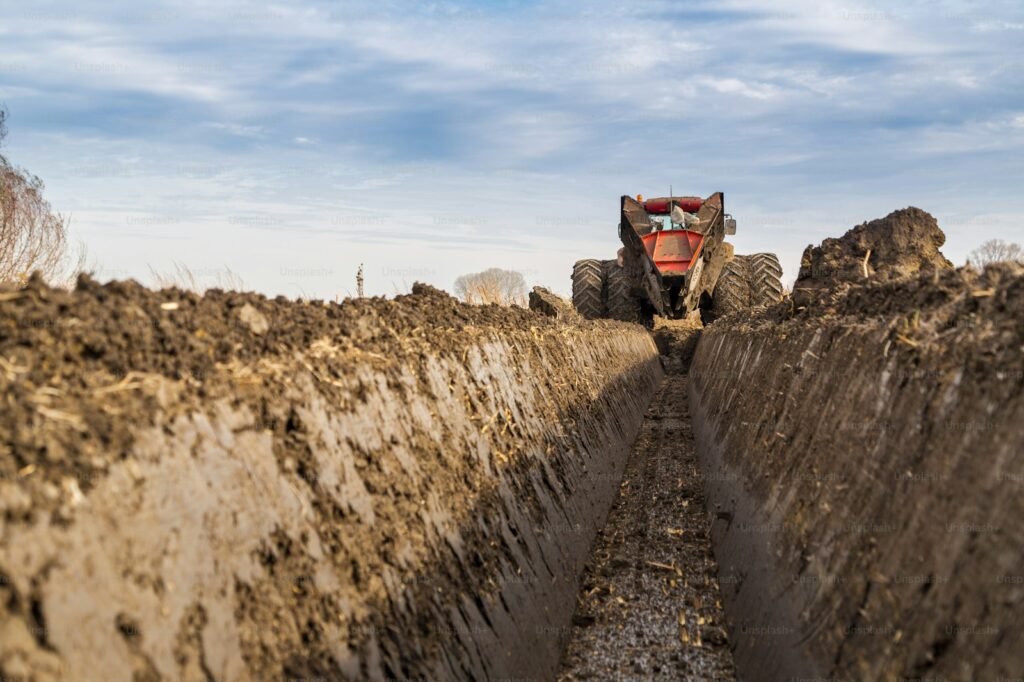
A trencher uses a digging chain, a bit like a heavy chainsaw chain with teeth, running round a boom. You lower the boom to depth and walk or track the machine backwards, and it cuts a slot of consistent width and depth while throwing spoil neatly to one side.
That makes it ideal for long, straight runs of narrow trench. A mini excavator digs a wider trench, moves more soil and leaves more mess on a lawn or sports pitch, but it copes far better with big stones, deep excavations, chambers and short awkward sections.
MAK 40 or MAK 60: which trencher hire suits your job?
| Mak Brent MAK 40 | Mak Brent MAK 60 | |
|---|---|---|
| Undercarriage | Wheeled | Tracked |
| Maximum depth | 40cm | 60cm |
| Best ground | Lawns, turf, reasonably even and stone-free soils | Rough ground, slopes, heavier soils |
| Typical jobs | Irrigation lines, shallow drainage, garden lighting ducts | Deeper drainage runs, field and pitch drains, longer runs over rough ground |
If the job is shallow and on decent turf, the wheeled MAK 40 is lighter and easy to handle. If you need more depth or the ground is uneven, soft or sloping, the tracked MAK 60 is the safer choice. Both are listed under groundworks on our sports and landscaping equipment page.
Typical trenching jobs in the South West
Sports pitch and golf course drainage
Many pitches and fairways in Devon and Cornwall sit on heavy soils that hold water through the winter. Lateral drains cut with a trencher, backfilled with gravel and tied into a main carrier drain, are a common fix. As the home of Hole in One Rentals, we often pair trenchers with our Selvatici drainage aerator and Flexiever screener for this kind of work.
Irrigation
Greens, tees, nurseries and large gardens need irrigation pipe laid at a consistent depth. A trencher cuts a slot just wide enough for the pipe and lets the turf be laid back with minimal scarring.
Cables and ducts
Power to a garden office, workshop, field shelter or electric gate is often run in a duct through a trenched slot. Your electrician will specify the cable type, duct and depth, and the work must meet the wiring regulations, so agree the route and depth with them before you hire.
Land drains and soakaway feeds
Short runs of perforated pipe feeding a soakaway, or field drains on a smallholding, are a good fit for the MAK 60 where the depth is within its reach.
Check for underground services before trenching
A trencher chain will cut straight through a cable or pipe, and you may not know until something stops working, or worse. HSE’s guidance HSG47, Avoiding danger from underground services sets out the approach: plan, locate and dig safely. In practice that means:
- Get service plans for the area from the utility companies. LinesearchbeforeUdig is a free search for many networks, though it does not cover every owner.
- Look for clues on site: meter boxes, inspection covers, street lights, poles, marker posts and freshly reinstated ground.
- Scan the route with a cable avoidance tool operated by someone trained to use it, and mark what you find.
- Hand dig trial holes to confirm the position of anything detected before mechanical cutting nearby.
- Remember private services: farm water mains, septic tank pipes, old land drains and private cables often appear on no plan at all.
Plans can be inaccurate, so treat them as a starting point. Check the current guidance and stop work if you hit anything unexpected.
Tips for a clean trench
- Mark the line with string or spray paint and walk it before starting.
- Lift turf first on lawns and sports surfaces so it can be relaid neatly.
- Do a short test cut to check depth and how the chain copes with the soil.
- Work at a steady pace. Forcing the machine through stony ground wears teeth and can make the boom jump.
- Keep spoil on one side and leave room to backfill.
- Avoid very wet conditions on heavy clay, where spoil smears and wheels or tracks churn the surface.
To backfill and compact around pipes in a narrow slot, a trench rammer or the Weber MC 85 trench roller from our construction equipment range is far better than heeling it in by foot.
For land drains, lay the perforated pipe on a level, even bed with a steady fall towards the outfall, then backfill with clean gravel to the depth your drainage design calls for before returning topsoil. Check the fall with a level as you go. A drain that dips and rises along its length will hold water and silt up in the low spots.
When to hire a mini digger instead
A trencher is not the answer to every trench. Choose a mini excavator if the ground is full of large stones or granite boulders, as it often is near Dartmoor and on parts of Bodmin Moor, if you need depth beyond 60cm, if you need a wider trench for larger pipes or chambers, or if the run is short and full of bends. Our Sunward micro and mini diggers, such as the Sunward SWE 08B micro excavator, fit through garden gates.
Planning a drainage scheme before you trench
Trencher hire is quick, so it is tempting to start cutting straight away. A drainage run that has no fall or nowhere to discharge will not work however neat the trench, so plan the layout on paper first.
- Find the outfall. Every drain needs somewhere to go: a ditch, a soakaway or an existing carrier drain. Work back from there.
- Check the levels. Use a laser level, a dumpy level or a long straight edge to confirm there is a steady fall from the top of the run to the outfall. Your drainage designer or supplier will advise on the fall to aim for.
- Choose a layout. Sports pitches and lawns commonly use lateral drains running across the slope into a main carrier drain, often in a herringbone or grid pattern.
- Decide depth and spacing. These depend on the soil and the use. Heavy clays need closer spacing than free-draining loams. Check that the depth you need is within the MAK 40’s 40cm or the MAK 60’s 60cm.
- Plan the backfill. Order gravel and pipe in advance, and decide where spoil will go.
- Check permissions. If the scheme discharges into a ditch or stream, or you plan to culvert or alter a ditch, you may need consent from the lead local flood authority (usually the county or unitary council) or an internal drainage board. Ask them before you start.
On a sports ground or golf course, a drainage contractor or agronomist can design the scheme while you supply the labour and the machine. That combination often makes trencher hire good value for clubs.
A worked example: draining a wet corner of a sports field
This is an illustrative scenario, not a real club. A village cricket and football ground in mid Devon has a corner that lies wet from November to March, on heavy clay over shale. A ditch runs along the boundary hedge, a few metres below the playing surface.
- Design: a drainage adviser recommends a short main carrier drain running down to the existing ditch outfall, with laterals across the wet corner feeding into it.
- Checks: the club confirms with the county council that connecting to the existing outfall needs no further consent, and scans the area for the floodlight cables that run near the pavilion.
- Machine: the tracked MAK 60 is chosen because the carrier needs more depth than the MAK 40 offers and the corner is soft.
- Timing: the work is done in late spring, when the clay is moist but firm, so the machine does not mark the outfield.
- Finish: pipe is laid on a gravel bed with a steady fall, gravel is backfilled close to the surface, and the area is top dressed and overseeded.
Volunteers do the labour over a weekend on a weekly hire, with a dumper to move gravel. The key decisions, depth, layout and permission, were made before the machine arrived.
Step by step: trenching a cable or irrigation run
This method suits a typical garden, paddock or course run with the MAK 40 or MAK 60.
- Agree the route and depth with your electrician or irrigation designer, and mark it out with string or line paint.
- Do the services checks described above, including trial holes where anything is detected.
- Lift the turf in strips along the line, roll it and keep it damp in the shade if it is going back down.
- Set the depth and make a short test cut at the start to check the trench is the depth you need.
- Cut the run at a steady pace, keeping the spoil to one side.
- Clean out the base with a trenching shovel so pipe or duct sits on an even bed.
- Lay the pipe or duct, with any marker tape or bedding your electrician or designer specifies.
- Backfill in layers, compacting as you go, then relay the turf and water it in.
Ground conditions across the four counties
We deliver trenchers across Devon, Cornwall, Somerset and Dorset, and the ground changes a lot between them. This general guide helps you set expectations before the machine arrives.
| Ground | Typical areas | Trenching notes |
|---|---|---|
| Granite and moorstone | Dartmoor and Bodmin Moor fringes | Large stones can stop the chain. Test first and consider a mini digger. |
| Shaley stone (shillet, killas) | Much of mid and west Devon and Cornwall | Trenchable, but slower and harder on teeth. Steady pace. |
| Heavy clay | Culm country of mid and north Devon, Somerset vales | Cuts well when moist. Smears and sticks when wet, sets hard in drought. |
| Red sandy loams | Around Exeter and east Devon | Usually easy going with few stones. |
| Soft, wet ground | Low-lying land such as the Somerset Levels | The tracked MAK 60 copes better. Trench sides may slump. |
| Chalk with flints | Parts of Dorset | Flints are abrasive and wear teeth. Expect slower progress. |
If you are unsure, send us photos of a hand-dug test hole along the route when you enquire about trencher hire. It tells us more than any map.
Working safely with a trencher
A digging chain is designed to tear through soil and roots, and it will do the same to boots and clothing. Hire is self-drive, so the operator must be competent and have read the instructions.
- Wear safety boots, gloves, eye protection and hearing protection, and avoid loose clothing.
- Keep feet and hands well away from the chain and the spoil auger while the engine is running.
- Stop the engine and wait for the chain to stop before clearing stones, roots or blockages.
- Keep other people, children and animals well back, especially on public sites and in gardens.
- Fence or cover open trenches that are left overnight, particularly near paths, play areas and livestock.
- Take care on slopes and near trench edges, which can give way on soft ground.
Common mistakes
The most frequent problems we hear about are trenching before the services check, cutting a drain with no fall, and starting in saturated clay that smears and clogs the chain. Others include forcing the machine through stony ground at speed, which wears teeth and makes the boom jump, and leaving spoil heaped where it slides back into the trench in the rain. A little planning avoids all of them.
What affects the cost of trencher hire
We do not publish hire prices. WhatsApp us for a current quote. These factors shape it:
- Machine: the wheeled MAK 40 and tracked MAK 60 are priced differently.
- Hire period: daily for a single run, weekly for a drainage scheme.
- Delivery: quoted separately, based on distance from our depot near Okehampton.
- Ground: stony ground slows progress and can lengthen the hire.
- Preparation: having the route marked, services checked and turf lifted before delivery saves hire days.
- Extras: compaction equipment, a dumper or a mini digger for chambers and outfalls.
- Insurance: not included automatically.
Golf clubs and grounds teams with a season of drainage work can compare repeated trencher hire with a Flex Hire tier, which lets them swap kit for one monthly fee.
Delivery, handover and return
Tell us the postcode, the access route and where the trencher needs to be unloaded. On golf courses and sports grounds, let us know about paths and any surfaces our vehicle should avoid. Someone should sign the delivery note and look the machine over with the driver, and we can run through the controls if you ask.
Before you start each day, check the fuel and oil levels, look over the chain and teeth for damage or missing teeth, and make sure the guards are in place. Our terms ask hirers to check fluid levels daily, and it is also the best way to spot a problem before it stops the job. If a tooth breaks or the chain jumps off, stop and call or WhatsApp us rather than attempting a repair. Unauthorised repairs can cause further damage and may leave you liable for it.
When the job is done, knock off the worst of the soil, leave the trencher where our vehicle can reach it and call or WhatsApp us to off-hire. Charges run until the off-hire is confirmed. Our hire FAQs cover payment, delivery and returns.
Frequently asked questions
How wide a trench does the trencher cut?
Trench width depends on the chain fitted. Tell us the pipe or duct size and we will confirm whether the trenchers suit.
Can a trencher cut through tree roots?
Smaller roots, usually yes. Large roots slow it down and can damage the chain, and cutting roots close to trees can harm them, so plan the route with care.
Do I need training to use a trencher?
Hire is self-drive, so the operator needs to be competent. We will run through the controls on delivery if you ask.
Is trencher hire available by the day?
Yes. Daily hire suits a single run, and weekly hire suits drainage schemes that take longer.
Can I backfill a land drain with the spoil?
Usually not around the pipe. Land drains are normally backfilled with clean gravel to the depth your design specifies, with topsoil only on top. Spoil, especially clay, blocks the flow of water to the pipe.
How much trench can I cut in a day?
It depends on the ground, depth and how much preparation is done. Stone-free turf goes much faster than shaley or flinty ground. Tell us the job and we will suggest a hire period.
Is the tracked trencher suitable for sports pitches?
Yes. The tracked MAK 60 spreads its weight, which helps on soft ground, and it reaches the depth many pitch drains need. Work when the surface is firm enough to avoid marking it.
Book trencher hire
WhatsApp or call 07841 036064, Monday to Friday 7:30am to 5:30pm, with the trench length and depth, the ground type, your postcode and dates. We will confirm the right machine and send a current quote. For written quotes, use our contact page.