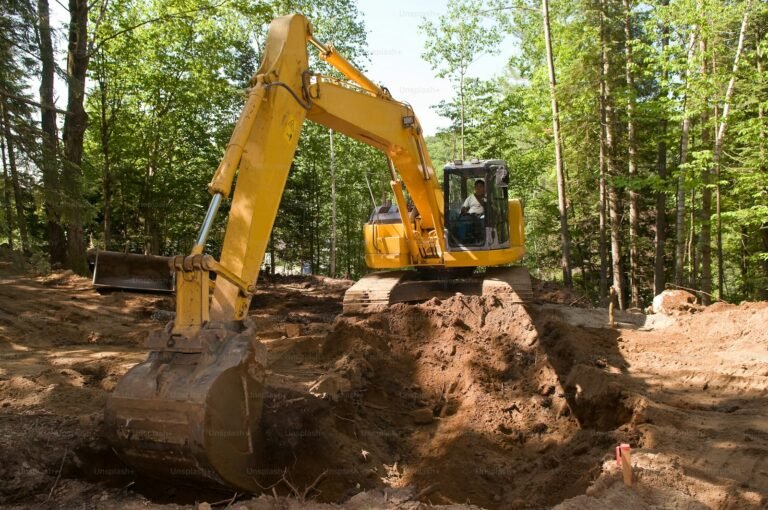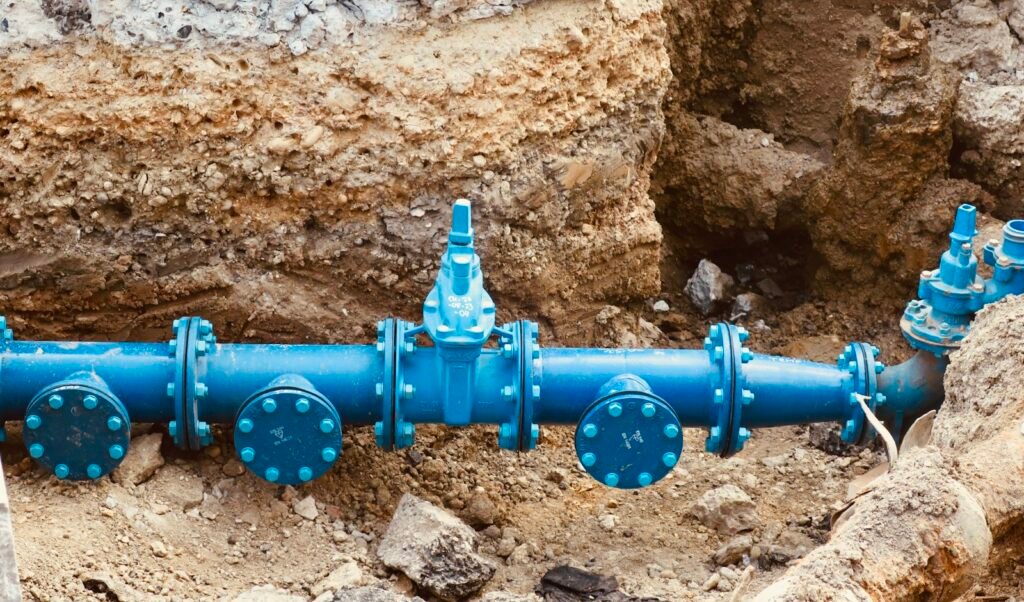
Before you dig with a mini digger, trencher or post hole borer, you need to know what is already in the ground. Striking an electricity cable can kill, a damaged gas pipe can lead to an explosion, and even a cut water main or fibre line can mean large repair bills and angry neighbours. The safe approach, set out in HSE’s guidance HSG47, has three parts: plan the work using utility records, locate services on site with detection equipment, and then dig carefully by hand near anything you have found. This guide walks through each step in practical terms.

In this guide
This is general information. Read the HSE guidance and get competent help for higher-risk work.
Why it matters, even on a small job
People tend to assume services only run under roads. In reality, they cross gardens, driveways, verges and fields. A house will usually have its own electricity supply cable and water pipe running from the boundary, and many properties also have cables to garages, garden offices, outbuildings and outdoor lights that appear on no plan at all.
Under our hire terms, identifying and marking underground services is the hirer’s responsibility, and we cannot be held responsible for damage to buried services during delivery or operation. So the checks you make before you dig sit squarely with you.
Step 1: plan before you dig
HSE’s guidance HSG47, Avoiding danger from underground services treats planning as the first element of a safe system of work. In practice, planning means gathering records.
Utility plans
Utility companies hold records of their networks. LinesearchbeforeUdig (LSBUD) is a free online service where you enter details of your work area and receive a response showing which participating asset owners have apparatus nearby. Those owners then send plans or clear the enquiry. LSBUD covers a large share of Great Britain’s networks but not every owner, so you may need to contact others directly, such as the local water company or electricity network operator.
Private services
Utility plans usually stop at the property boundary. Private services often matter more on domestic and farm jobs, and nobody will send you a plan of them. Think about:
- Electricity cables to outbuildings, gates, pumps, lighting and electric vehicle chargers
- Private water supplies from springs or boreholes, common on farms across rural Devon and Cornwall
- Septic tanks, treatment plants, soakaways and the pipes between them
- Oil or LPG pipework from tanks, as many rural properties are off the mains gas network
- Field drains, often old clay pipes, in farmland
- Telecoms and fibre lines to the house
Before you dig, ask the owner, previous contractors and neighbours. Look for clues: manhole covers, stopcock lids, marker posts, patched tarmac and straight lines of different grass growth in dry weather.
Treat plans as a guide only
Records show approximate positions. Depths change when ground levels are altered, and older services may not be recorded at all. Always assume there may be something the plans don’t show.
Step 2: locate services on site
Once you have the records, find the services on the ground. The usual tools are a cable avoidance tool (CAT) and a signal generator (Genny).
- CAT: a hand-held detector that picks up signals from buried metallic cables and pipes, particularly live power cables and those carrying a radio signal.
- Genny: a transmitter that puts a signal onto a metallic service, or into the ground, so the CAT can trace it more reliably.
Detectors need training to use properly. They will not reliably find plastic water or gas pipes, clay drains or cables carrying no current. That is why detection is a step, not the final answer. We don’t list CATs in our hire fleet, so ask us and we’ll point you in the right direction, or use a specialist survey company on complex sites.
Mark every service you locate with spray paint or pegs along its line, and keep the marks visible while you work. Marks fade in rain and get scraped off by tracks, so refresh them each morning. Taking a few photos of the marked-out area before you dig also gives you a record of what you found and where.
Step 3: dig safely near services
HSG47’s third element is safe excavation. The core principles are:
- Hand-dig trial holes to expose and confirm the position and depth of any service near your planned dig.
- Use hand tools near services. Spades and shovels with a careful approach are safer than picks, forks or powered breakers close to a located line.
- Keep the machine away from the indicated line of a service until it has been exposed by hand.
- Re-scan as you go deeper, as signals and positions can change with depth.
- Treat every service as live unless the owner has confirmed it is dead and isolated.
- Support exposed services rather than leaving them hanging in a trench.
The detail matters, so the next section sets out what HSG47 actually says about distances and technique.
What HSG47 says about distances and technique
HSG47 is a long document, but a handful of points come up on almost every small job. These are summarised from the third edition; read the full guidance for anything beyond simple domestic or farm work.
- Plans are not enough. HSG47 says plans alone should not be relied on to identify and locate services, are not always drawn accurately to scale, and should not be used to judge distances or depths. Never assume a depth, as cables may be shallower than expected.
- Use a signal generator where possible. The guidance says signal generators greatly improve the accuracy of detecting and tracing a service, and that anyone using a locator should be thoroughly trained in its use and limitations.
- Trace the whole area. Services do not always run in straight lines, so trace them through the full extent of the work, not just at the point you plan to dig.
- Keep powered tools back. Where practicable, hand-held power tools should not be used within 500mm of the indicated line of a service.
- Keep excavators back from gas pipes and pipelines. HSG47 advises against using mechanical excavators within 500mm of a gas pipe, and says plastic gas pipes should be located by hand digging before mechanical excavation starts nearby.
- Dig sideways to expose. Final exposure of a service by horizontal digging is recommended, because the force of a hand tool is easier to control when you are not stabbing straight down onto it.
- Use insulated tools when hand digging near electricity cables.
- Keep scanning. Make frequent, repeated use of the locator as the dig goes on, because readings become more accurate as cover is removed.
Download the free PDF from HSE and keep it with your site file if you dig regularly. It also covers safe systems of work for larger excavations and work near high-pressure pipelines.
Reading a utility plan
When the plans arrive from LSBUD or individual asset owners, they can look confusing at first. A few tips make them easier to use on site.
- Check the key. Each asset owner uses its own symbols and line styles, so read the legend on every plan rather than assuming one matches another.
- Check the scale and date. A small-scale plan can hide a metre or more of error in a single line width. Older plans may not show recent changes.
- Look for what is missing. Service connections to individual houses are often shown roughly or not at all, and private services never appear.
- Ignore depths unless confirmed. Ground levels change when drives are raised, verges regraded or gardens landscaped.
- Keep the plans on site. Print them, mark them up with what you find, and make sure the machine operator has seen them.
Treat the plans as a reason to look harder in certain places, not as permission to dig freely everywhere else.
How common services show up
Knowing what a service is likely to be made of tells you whether a locator will find it. This is a general guide; materials vary with age and location.
| Service | Typical modern material | Found with a locator? |
|---|---|---|
| Electricity cables | Metallic conductors in insulated sheath | Usually, especially when carrying current; a signal generator helps |
| Gas mains and services | Yellow plastic (PE); older pipes may be metal | Plastic pipes generally not, unless a tracer wire was laid |
| Water mains and supplies | Blue plastic; older pipes may be iron or lead | Plastic generally not; metal pipes often can be traced |
| Telecoms and fibre | Copper cables, or fibre in plastic ducts | Copper often; fibre ducts often not without a tracer |
| Drains and sewers | Clay or plastic pipes | No, unless a sonde is pushed through the pipe |
| Private supplies on farms | Anything from old steel to blue alkathene | Unpredictable; ask the owner and trial hole |
The pattern is clear: a clear scan does not prove the ground is clear. Plastic pipes are the most common thing missed, which is why hand-dug trial holes remain essential.
Which jobs carry the most risk?
| Job | Typical risk | Extra care |
|---|---|---|
| Trenching for an outbuilding cable or water pipe | Crossing the house supply | Trial holes where the routes cross |
| Driveway or patio dig-out | Shallow cables and the water supply near the boundary | Scan the whole area, not just the edges |
| Fence posts with an auger | Cables along boundaries | Scan every post position |
| Field drainage or farm tracks | Field drains, private water pipes | Speak to the landowner about old drains |
| Work in a verge or pavement | Multiple utilities close together | Use plans, detection and trial holes; consider specialist help |
Before you dig on farms and rural properties
Many of the jobs we supply from our depot near Okehampton are on farms, smallholdings and rural homes, where the utility plan may show almost nothing and the real risks are private. Before you dig on a rural site, think about:
- Private water. Spring and borehole supplies often run long distances across fields to houses, troughs and yards, sometimes in old steel pipe and sometimes in plastic that a locator will not find.
- Buried electrics. Cables to pumps, workshops, yard lighting, electric gates and outbuildings were often laid by the owner and never recorded.
- Fuel lines. Off-grid properties commonly run oil or LPG pipework from a tank to the house or boiler room.
- Drainage. Septic tanks, treatment plants, soakaway fields and old clay land drains, which may still be doing an important job in a wet field.
- Former uses. Old buildings, wells and tanks can be buried under paddocks and yards. Parts of Cornwall and west Devon also have historic mine workings, so larger groundworks may justify a mining search.
The best source of information is usually the person who has lived or farmed there longest. A walk round the site with them before you dig is worth more than any plan.
Look up as well as down
Checking for buried services is only half the job. Overhead power lines cross a great many farm gateways, fields and back gardens across the South West, and an excavator’s dipper, a tipping dumper or a telehandler boom can reach them. Electricity can jump the gap from a high-voltage line without direct contact. Identify any lines near the work area and the access route, plan the work so the machine cannot reach them, and contact the network operator for advice if you need to work nearby. HSE’s guidance GS6, Avoiding danger from overhead power lines, explains the precautions.
Choosing machines for digging near services
The machine you hire changes how much margin you have for error.
Small excavators
A 0.8 tonne Sunward SWE 08B or 1.8 tonne SWE 18UF gives fine control and a narrow bucket, so a careful operator can strip layers slowly and feel for resistance. Use a toothless grading or ditching bucket where possible when working near a located line, and dig in thin layers rather than deep bites.
Trenchers
A Mak Brent trencher cuts a neat, narrow trench very quickly, which is exactly why it needs extra care. A chain trencher will not stop for a plastic pipe or a cable, so scan the full route, dig trial holes where services cross, and expose any crossing by hand before the trencher runs through.
Post hole borers
The Hyundai pedestrian post hole borer is ideal for fencing, but boundaries are where cables and pipes like to run. Scan every post position, not just the line in general. Our sports and landscaping range includes both trenchers and the borer.
Vacuum excavation is another option for exposing services safely on complex sites. It is not in our fleet, so ask us and we will point you in the right direction.
A before you dig checklist
Use this list every time, even for small jobs. It takes less time than repairing a cut cable, and far less than explaining one.
- Mark out the exact area and depth of the dig, including spoil heaps and machine tracking routes.
- Request utility plans through LSBUD and contact any asset owners not covered.
- Ask the owner, tenant or farmer about private cables, pipes, drains and tanks.
- Walk the site looking for covers, stopcocks, marker posts, lamp columns and patched surfaces.
- Scan the whole area with a locator and signal generator, operated by someone trained to use them.
- Mark every located service on the ground with paint or pegs.
- Hand dig trial holes to confirm the position and depth of anything near the dig.
- Brief everyone on site, including the machine operator, on what was found and where.
- Keep scanning as you go deeper, and stop if anything unexpected appears.
If you hit something
Stop work and keep everyone clear. For a damaged gas pipe or a smell of gas, leave the area, keep ignition sources away and call the National Gas Emergency number, 0800 111 999. For a damaged electricity cable, stay away from the machine and the cable if it is safe to do so, and call 105 to reach your local electricity network. Don’t try to repair or cover up the damage. Then let us know if our machine was involved.
Frequently asked questions
Is LinesearchbeforeUdig free?
Yes, LSBUD describes its service as free to use. Some asset owners are not members, so check who else may need contacting.
Do I need a CAT for a small garden job?
If there is any chance of a cable crossing your dig, scanning is sensible. Many garden jobs run close to the house supply.
What machine should I hire for digging near services?
A small, controllable machine helps, such as our 0.8 tonne Sunward SWE 08B or a 1.8 tonne SWE 18UF, but trial holes near services still need digging by hand. See our construction hire range and FAQs.
Does LSBUD show the cables in my garden?
No. It covers the networks of participating asset owners. Private cables to outbuildings, garden lighting, pumps and chargers will not appear, so you need to ask the owner and scan for them yourself.
Who do I call if I damage a water pipe?
For a public water main or supply pipe, contact the local water company. Across most of Devon and Cornwall that is South West Water, while parts of Somerset and Dorset are served by Wessex Water. Stop work and keep people away from any washout or flooding.
Do I need trial holes for a single fence post?
If a scan shows anything near the post position, or the post is near a boundary where services enter the property, yes. Moving a post a short distance is far cheaper than repairing a cable.
Plan your dig with us
Tell us about your job and site and we’ll help you choose the right machine. WhatsApp or call 07841 036064, Monday to Friday 7:30am to 5:30pm, or use our contact page.