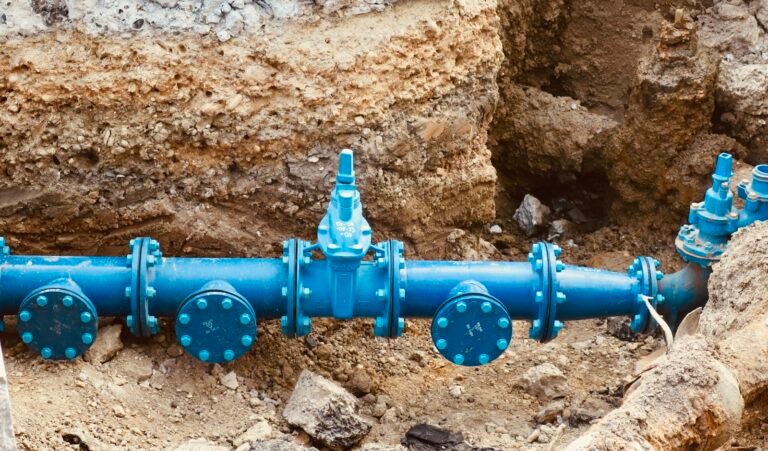
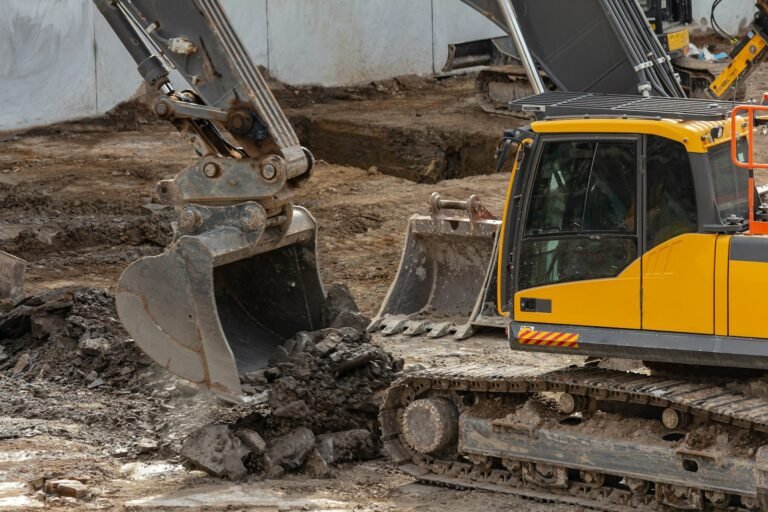
A soakaway lets rainwater from a roof, drive or patio soak back into the ground instead of overloading drains or flooding a garden. Soakaway installation is straightforward digging work, but it only works if the ground will actually accept water, so the job starts with a percolation test, not a digger. This guide covers testing, siting, the kit to hire, and how a field drain differs, with notes on the ground conditions we see across Devon and Cornwall.

In this guide
Will a soakaway work on your ground?
Ground conditions vary sharply across the four counties. Free-draining sandy and gravelly soils, and some weathered granite areas, take water well. Much of mid and north Devon around Okehampton, Holsworthy and Hatherleigh sits on Culm Measures clays and shales that drain slowly, and a soakaway dug into tight clay can simply become an underground pond. A percolation test tells you which you have.
Many building control bodies describe a method along these lines:
- Dig a trial hole to the depth the soakaway will work at, then dig a 300mm square pocket in the bottom.
- Fill the pocket with water and let it drain away, ideally overnight, to wet the surrounding soil.
- Refill to around 300mm and time how long the level takes to fall from 75% to 25% full.
- Repeat several times, ideally in more than one hole, and average the results.
- Avoid testing in very wet, frozen or drought conditions, which give misleading results.
Your local authority building control team or designer will use the result to size the soakaway. If water barely moves, a soakaway is probably the wrong answer and you will need another route for surface water.
Rules and siting for soakaway installation
Surface water drainage for new buildings and extensions falls under Part H of the Building Regulations. Approved Document H says soakaways should not be built within 5m of a building or a road, or in areas of unstable land. Many councils also ask for a distance from boundaries; check the current guidance with your building control body before you dig, especially if the work is part of a notifiable project.
A soakaway is for clean surface water only. Foul water from a septic tank or treatment plant goes to a drainage field, which is a different design and has its own Environment Agency rules.
Before digging, get utility plans through LinesearchbeforeUdig and scan the area with a cable locator. Soakaway positions often end up in the same corner of the garden as a buried water main or power cable to an outbuilding.
Choosing the digger for soakaway installation
A domestic soakaway pit and its feed trench are well within the reach of a mini excavator. As a guide:
| Job | Suggested machine | Why |
|---|---|---|
| Garden soakaway with tight access | Sunward SWE 18UF | Zero tail swing, works close to fences |
| Drainage and utility trenching | Sunward SWE 20F | Listed for drainage and utility work |
| Larger or deeper pit, crates for a big roof | Sunward SWE 25UF or SWE 35UF | More reach, depth and bucket capacity |
| Long field drain runs | Mak Brent MAK 60 tracked trencher | Fast, narrow 60cm trench on rough ground |
Ask us for the maximum dig depth of each machine and compare it with your design. All are on our construction equipment page.
Do not enter an unsupported excavation. Trench and pit sides can collapse at any depth, particularly in wet clay or loose fill, and the HSE guidance on excavations is clear that support or battering back is needed. We do not list trench support, so ask us and we will point you in the right direction. Keep spoil heaps and machines back from the edge.
Building the soakaway: crates or stone
For most modern domestic soakaway installation work, the choice is plastic geocellular crates wrapped in geotextile membrane, which hold far more water per cubic metre than a pit of stone. A stone-filled pit with clean, single-size aggregate also works for smaller roofs. Old-style rubble soakaways tend to silt up and are best avoided.
- Dig the pit to the designed size and depth, keeping the sides as clean as possible.
- Line with geotextile, leaving enough to wrap over the top.
- Place crates or clean stone, connecting the inlet pipe at the right level.
- Fit a silt trap or inspection chamber upstream so leaves and grit do not reach the soakaway.
- Wrap the membrane over, then backfill and compact in layers.
Lay the feed pipe to a steady fall, as set out by your designer, and bed and surround it in suitable granular material. Compact backfill around the pipe with a narrow-foot rammer such as the Weber MT SRV 300-II SF, then use a reversible plate like the CR 2 or the MC 85 trench roller over the upper layers. Keep heavy compaction away from crates and pipes until you have enough cover over them.
Field drains for wet lawns and paddocks
If the problem is a whole area that stays soggy rather than a downpipe needing an outlet, a field drain is often better. Perforated pipe in trenches backfilled with clean stone collects water and carries it to a ditch, watercourse or soakaway. A herringbone layout covers a lawn or paddock evenly.
On larger areas, a trencher is much quicker than a digger: the Mak Brent MAK 40 cuts 40cm deep, while the tracked MAK 60 reaches 60cm and handles rough ground. For sports turf, the Selvatici 1.2m vertical drainage aerator relieves surface compaction so water can reach the drains. Both are on our sports and landscaping page. If you plan to discharge into a watercourse, check with the Environment Agency or the lead local flood authority first.
Common soakaway mistakes
- Skipping the percolation test and assuming the ground drains because the topsoil looks dry.
- Siting the soakaway downhill and close to the house, so water finds its way back towards the foundations.
- Leaving out the silt trap, so the soakaway clogs within a few seasons.
- Connecting foul water or a sink waste to a surface water soakaway.
- Tracking a loaded dumper over newly installed crates before there is enough cover on top.
In the wetter months, plan around the weather. Clay subsoils across much of Devon become hard to dig cleanly once saturated, and an open pit can fill with groundwater overnight. A dry spell makes both the test and the dig far more reliable.
How a soakaway is sized
Sizing is a design job, and for anything that forms part of building work your building control body will want to see how it was done. BRE Digest 365 is the method most commonly used in the UK. It is worth understanding the inputs, because they explain why two soakaways for the same roof can be very different sizes.
- Area drained: the roof, drive or patio in square metres. Double the area and you roughly double the water.
- Design rainfall: a short, intense storm rather than average rainfall. The soakaway has to store water faster than the ground can take it.
- Infiltration rate: from your percolation test. Slow ground means a bigger store.
- Storage medium: geocellular crates are mostly empty space, whereas a stone-filled pit has only a fraction of its volume available for water, so the same storage needs a much bigger stone pit.
This is why a soakaway installation in free-draining ground on the edge of Dartmoor might need a modest pit, while the same roof on Culm clay near Holsworthy needs a far larger one, or a different solution altogether. Some building control bodies publish simple sizing notes for small areas; larger roofs and paved areas usually need a full design.
When a soakaway is the wrong answer
A soakaway only works if water can leave it. It should not be used where the water table reaches the base of the soakaway at any time of year, and wet winter conditions in the South West bring groundwater up much higher than a summer test hole suggests. If your trial hole fills with water from the sides or bottom, take that seriously.
Other situations where you should think again include sloping ground just above a building or a road cutting, made ground or fill, and anywhere close to old mine workings, which are found in parts of Cornwall and west Devon. Alternatives include connecting to a public surface water sewer (which needs the water company’s agreement), rainwater harvesting tanks, rain gardens and planted swales, or discharge to a ditch or watercourse, which can need consent from the lead local flood authority or the Environment Agency. Building control or a drainage designer can advise which suits your site.
A worked example: soakaway installation for a rear extension
Here is an illustrative sequence for a single-storey rear extension on a detached house near Tavistock, where building control has approved a crate soakaway sited more than 5m from the house and away from boundaries. The figures are typical, not a real project.
- Two weeks before: percolation test already done and accepted. Utility records obtained and the route scanned with a cable locator. Crates, membrane, pipe, silt trap and stone ordered for delivery the day before the dig.
- Day 1 morning: SWE 18UF and a tracked dumper delivered. Strip turf and stack it for reuse. Dig the feed trench from the downpipe position to the soakaway at the designed fall.
- Day 1 afternoon: excavate the soakaway pit to the design depth, keeping everyone out of the hole. Spoil goes by dumper to a stockpile or skip.
- Day 2 morning: line with geotextile, place crates from the edge without entering the pit, connect the inlet and fit the silt trap. Lay and bed the feed pipe.
- Day 2 afternoon: wrap the membrane, backfill and compact in layers with a rammer and plate, relay turf. Machines collected or off-hired.
Building control may want to inspect before backfilling, so check when they need notice and book the inspection into your plan. A digger sitting idle while you wait for an inspection is a cost you can avoid with a phone call a few days earlier.
Access, spoil and protecting the garden
Soakaways usually go at the far end of a garden, which means tracking machines across the lawn. A Sunward SWE 18UF on rubber tracks spreads its weight well, but repeated turning on wet grass still churns it. Lay ground protection on the route, and plan the dig so the machine reverses out over its own tracks rather than cutting new ones.
A soakaway pit and trench can easily produce several cubic metres of loose spoil. Clean topsoil is worth keeping for the garden; heavy clay subsoil is often better removed. If you are paying someone to take spoil away, check they are a registered waste carrier. Keep spoil heaps at least a metre back from the edge of the excavation so they do not add load to the sides or slide back in.
Keeping a soakaway working for years
Most soakaways that fail do so because silt, leaves and roots get in. A little maintenance adds years to the life of the system:
- Fit leaf guards to gutters and downpipes feeding the soakaway.
- Lift the silt trap or inspection chamber cover once or twice a year, particularly after autumn leaf fall, and scoop out debris.
- Keep trees and large shrubs away from the soakaway, as roots seek out the water.
- Do not drive or park over a soakaway unless it was designed for vehicle loads.
- After heavy rain, check whether water drains down within a reasonable time. Water still standing in the chamber a day later is a sign of trouble.
What affects the cost of the hire
We do not publish hire prices, but the main factors for a soakaway job are the size of excavator, the number of days, whether you need a trencher or tracked dumper as well, compaction kit, and delivery distance from our depot near Okehampton.
A design that lets you dig everything in one visit, with materials already on site, keeps the hire short. Insurance is not included automatically, so arrange cover before the hire starts. Contractors doing several drainage jobs a month may find Flex Hire simpler, with one flat monthly fee and the option to swap machines as each job changes.
Where field drains can discharge
A field drain needs a proper outfall: an existing ditch, a watercourse or a soakaway sized for the area drained. Set the outfall pipe slightly above normal water level in the ditch so it does not silt up, and protect the bank around it from erosion. Works that affect the flow of a watercourse can need consent from the lead local flood authority or the Environment Agency, so check before connecting. Never run surface water drains into a foul sewer, septic tank or treatment plant drainage field.
Drainage dig safety checklist
- Services traced with utility records and a cable locator before breaking ground.
- No one enters a trench or pit unless the sides are supported or battered back to a safe angle.
- Spoil, materials and machines kept back from the edge.
- The excavation fenced or covered at the end of each day, especially where children or animals could reach it.
- Seat belts worn in the excavator and dumper, and a banksman used when reversing in tight gardens.
- Hearing protection and gloves when using rammers and plates, and time on vibrating tools limited.
Glossary of drainage terms
- Percolation test: a timed test of how quickly water drains into the ground at the soakaway’s depth.
- Infiltration rate: the speed at which water soaks into the soil, worked out from the percolation test.
- Geocellular crates: plastic boxes that interlock to form an underground store with a high proportion of empty space for water.
- Geotextile: a permeable fabric that lets water through but keeps soil from washing into the soakaway or drain.
- Silt trap: a chamber upstream of the soakaway where grit and leaves settle out and can be removed.
- Fall: the slope of a pipe or surface, written as a ratio such as 1:80.
- Herringbone layout: field drain laterals joining a main carrier drain at an angle, like the bones of a fish.
- Battering back: cutting the sides of an excavation to a safe slope instead of supporting them.
Frequently asked questions
How far from the house should a soakaway be?
Approved Document H says not within 5m of a building or a road. Your building control body may also set boundary distances.
Do I need building regulations approval for a soakaway?
It depends on the project. Drainage forming part of an extension or new build is normally covered by building control; check with your local authority for standalone work.
What size digger do I need for a soakaway?
For most garden soakaways, a 1.8 to 2.5 tonne mini excavator. Larger crate systems or deeper pits may need the 3.5 tonne SWE 35UF.
Why has my old soakaway stopped working?
Usually silt, roots or ground that never drained well. Lifting the inspection cover after rain will tell you whether water is backing up.
Can a soakaway take water from a driveway?
Yes, if it is clean surface water and the soakaway is designed for that area. Many drives use permeable paving instead, which avoids collecting the water in the first place.
How deep is a typical domestic soakaway?
It depends on the design and the depth at which the ground drains best. Your percolation test should be carried out at the depth the soakaway will work at, so the design and the dig depth match.
Can I do a soakaway installation in winter?
You can, but wet ground makes digging messier and groundwater can fill the pit. Percolation tests in very wet conditions can also mislead, so many people test and dig in a drier spell.
Book your drainage kit
Send us your percolation results or design, site postcode, access details and dates, and we will match the right excavator, trencher and compaction kit for your soakaway installation. WhatsApp or call 07841 036064, or use our contact page for a written quote.