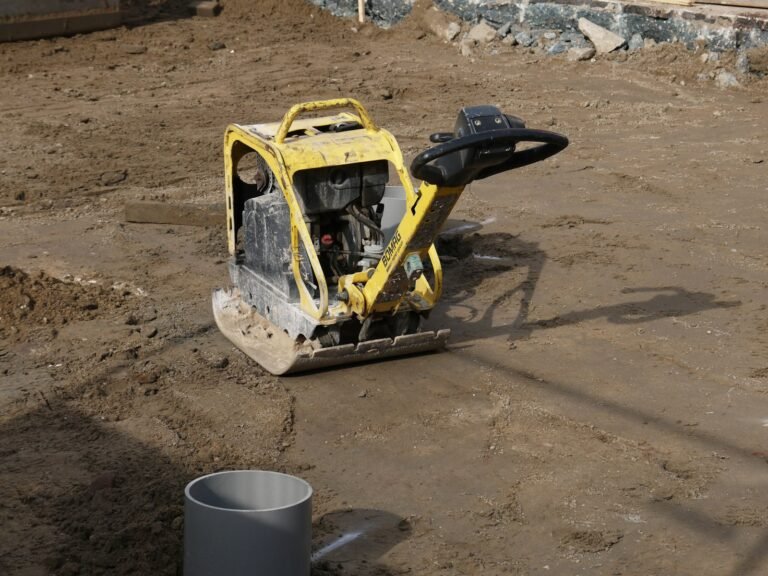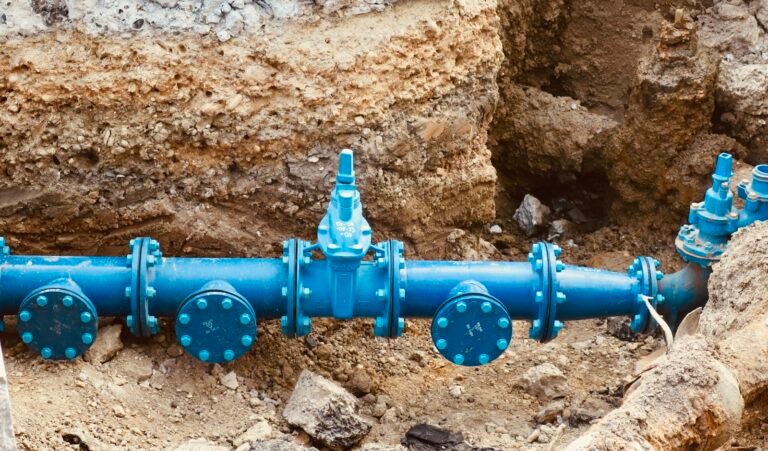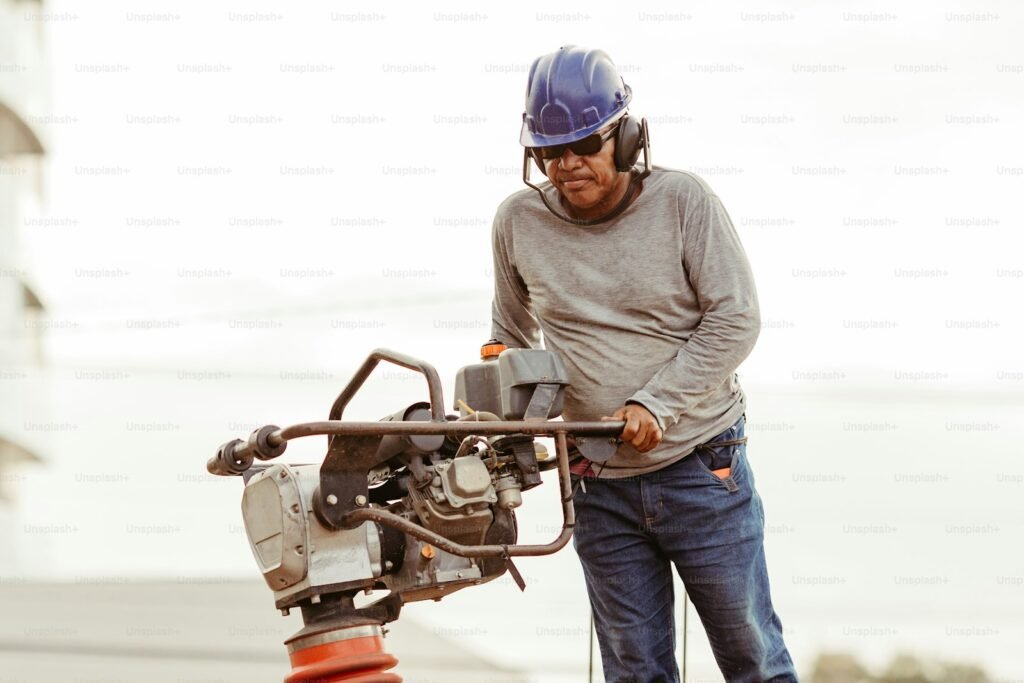
Trench rammer hire is essential whenever you backfill a narrow trench for a water main, cable duct, drain or service connection. A plate compactor is too wide to work in the bottom of a 300mm trench, and backfill that isn’t compacted in layers will settle and leave a dip in the road, drive or lawn.

In this guide
From our depot near Okehampton we hire two Weber MT rammers, the SRV 620-II and the slim-foot SRV 300-II SF, plus the Weber MT MC 85 trench roller for wider trenches. This guide explains how to choose between them, how to backfill in lifts, what the highway reinstatement rules say, and how to keep the trench itself safe while you work.
Trench rammer hire: rammers, rollers and plates compared
A vibrating rammer (often called a trench rammer, jumping jack or vibrotamper) has a small foot that hammers the ground at high frequency. The narrow foot fits into trenches and around pipes, chambers and posts. Rammers are particularly good on cohesive soils such as clay, where plates struggle.
A trench roller is a compact, usually remote or walk-behind double-drum roller narrow enough to drive along the trench itself. It compacts long trench runs faster than a rammer and gives a more even result.
A reversible plate suits wider excavations and the top layers of reinstatement, where there is room to manoeuvre.
| Machine | Type | Best for |
|---|---|---|
| Weber MT SRV 620-II | Vibrating rammer, high impact force, Honda engine | General trench backfill, clay and mixed soils, around chambers |
| Weber MT SRV 300-II SF | Vibrating rammer, slim foot | Narrow trenches, tight spots beside pipes and kerbs |
| Weber MT MC 85 | Trench roller | Longer, wider trench runs and confined trench compaction |
| Weber MT CR 2 / CR 3-III | Reversible plates | Wider backfill, sub-base and utility reinstatement layers |
The full Weber compaction range is listed on our construction hire page.
On domestic jobs, such as a new water supply to a garden building or an electric cable to a car charger, the slim-foot SRV 300 is often all you need. Contractors laying longer utility runs in rural Devon and Cornwall, where trenches cross farm tracks and verges, tend to combine a rammer for the edges with the trench roller for the main run.
Rammer, roller or both?
As a rule of thumb, short trenches, narrow trenches and anything with lots of obstructions such as pipes, chambers, posts and kerbs suit a rammer. Long, straight runs wide enough for the drum suit the trench roller, which covers ground faster and leaves a more even finish. Many utility jobs use both: the roller for the main run and the rammer for the ends, the edges and around fittings. If you only hire one machine for a mixed job, a rammer is the more versatile choice.
Why backfill in lifts
Compaction equipment only reaches so far into the ground. If you tip half a metre of spoil back into a trench and run a rammer over the top, the surface may feel firm but the material below stays loose. Weeks or months later it settles, and the reinstatement sinks or cracks.
The answer is to backfill in thin layers, known as lifts, and compact each one before placing the next. The right lift thickness depends on the material and the machine, but for rammers it is typically thin, often around 100mm compacted.
How thick should each lift be?
It depends on the machine, the material and where the trench is. In the highway, the SROH tables set the maximum compacted lift thickness and the minimum number of passes for each type of plant, and you must follow them. On private land there is no single legal figure, but the same logic applies: the lighter the machine and the stickier the material, the thinner the lift needs to be. If in doubt, go thinner. An extra lift costs a few minutes; a sunken trench across a new drive costs far more to put right.
A simple test is to watch the rammer. If it is still sinking in noticeably after several passes, the lift is either too thick or the material too wet.
Choosing and preparing backfill
The material going back into the trench matters as much as the machine compacting it. A few practical points:
- Granular fill compacts most reliably. Crushed stone and graded aggregates lock together under a rammer or roller and are less sensitive to weather.
- As-dug clay can be reused in many private situations, but only if it is at a workable moisture content and placed in thin lifts. Sticky, saturated clay won’t compact properly whatever you use.
- Remove rubbish and large stones. Bricks, roots, turf and boulders create voids that settle later, and sharp stones can damage pipes and ducts.
- Use the specified surround for pipes and ducts. Water, gas, electricity and drainage each have their own bedding requirements, so follow the utility’s or designer’s specification.
- Keep spoil tidy beside the trench so it can go back in the right order, topsoil last, and keep heaps back from the edge.
In the public highway, the SROH sets out which reinstatement materials are permitted. On private land, follow the specification for the service you are laying and use common sense: the better the backfill, the less it will settle.
Utility reinstatement in the highway
If your trench is in a public road, footway or verge, the reinstatement has to meet a national standard. In England that is the Specification for the Reinstatement of Openings in Highways (SROH), whose fourth edition came into force in 2021. It sets out permitted materials, layer thicknesses and the compaction needed for each type of plant.
For example, the SROH compaction table allows a vibrotamper of at least 50kg to compact lifts of up to 100mm with a minimum of four passes, or up to 150mm with eight passes in granular material, while 200mm lifts are not permitted with a vibrotamper. Lighter vibrotampers of 25 to 50kg are permitted only in restricted areas. Trench rollers are categorised by mass per metre of drum width, with their own minimum passes. Check the nominal mass of the machine you hire against the current SROH tables before you plan your lifts.
Work in the highway also needs the right permissions from the highway authority, such as Devon County Council or Cornwall Council. If you are not a utility company, that usually means applying for a street works licence (often called a section 50 licence) before you dig, and the work needs suitably qualified street works supervisors and operatives. This is general information, so check the current guidance and the authority’s requirements for your job.
Step-by-step: backfilling a service trench
- Locate services first. Before digging, check plans and use LinesearchbeforeUdig. Hand dig near known services.
- Bed and surround the pipe or duct with the specified material, and hand compact around it so you don’t damage the pipe.
- Lay warning tape at the specified depth above the service.
- Place backfill in thin lifts. Spread each layer evenly along the trench.
- Compact each lift with the rammer, overlapping each footprint and working systematically along the trench. Use the slim-foot SRV 300 along the trench sides and around chambers.
- Use the trench roller on longer runs where the width allows, then finish edges with the rammer.
- Bring up the sub-base and surface layers to the required specification, using a reversible plate where there’s room.
On lawns and verges, leave the final soil layer very slightly proud before replacing turf or seeding, as even well-compacted ground settles a little. On drives and paths, finish the sub-base flush and level so the surface course sits at the right height, and check with a straight edge across the trench line before you lay it.
Keeping the trench safe
Compaction work puts people in and beside trenches, which is where collapse risk is highest. HSE’s excavations guidance makes several points that apply directly to rammer and roller work:
- No ground can be relied on to stand unsupported in all conditions, so decide on support or battering before digging and have the equipment on site.
- Keep spoil heaps, materials and plant back from the edges, as extra loading makes collapse more likely.
- Excavations should be inspected by a competent person at the start of each shift and after anything that might affect their stability.
- Don’t run petrol or diesel engines in an excavation unless fumes are safely ducted away or forced ventilation is provided.
That last point matters for compaction plant. Most rammers and trench rollers have engines, so in a deep, narrow trench think carefully about fumes, work from the top where the method allows, and never leave anyone working in a trench with an engine running and poor airflow. Where people could fall in, use barriers and cover the trench when it is left open.
Getting the best from a rammer
- Run it at full throttle. Rammers are designed to work at full speed; part throttle makes them bounce and compact poorly.
- Let the machine do the work. Guide it rather than forcing it down.
- Watch the moisture. Very wet clay won’t compact properly, and very dry granular fill may need dampening.
- Use the fuel specified in the operator’s manual, and check the engine oil before starting.
- Keep the foot clean so it sits flat on each lift.
- Work systematically from one end of the trench to the other, overlapping each footprint, so no patch of the lift is missed.
- Lay the rammer down only as the manual describes when transporting it, so fuel and oil don’t leak.
- Don’t run it on hard surfaces such as concrete, which damages the machine.
- Take regular breaks and swap operators on long runs, which helps with both vibration exposure and concentration.
Two worked examples
These illustrate how the kit fits real jobs. They are planning aids, not specifications.
A water supply and power cable to a garden office
A homeowner in Exeter needs a 25m trench from the house to a garden office for a water pipe and an armoured cable duct. The trench is narrow, through lawn, with as-dug soil going back. A micro digger opens the trench, the services are bedded and surrounded as specified, warning tape is laid, and the slim-foot SRV 300-II SF compacts the backfill in thin layers. The turf goes back on top. One or two days of trench rammer hire usually covers it, alongside the digger.
A 60m duct across a farm track and field edge
A contractor in Cornwall is laying a power duct to a new farm building, crossing a stone track. Along the field edge, the MC 85 trench roller handles the long straight run quickly in granular backfill. At the track crossing and around a draw pit, the SRV 620-II compacts the backfill in lifts right up to the sub-base, which is then finished with a reversible plate so the track takes tractors without dipping. A weekly hire suits this kind of job.
Vibration, noise and safety with trench rammer hire
Rammers produce significant hand-arm vibration. The Control of Vibration at Work Regulations 2005 set a daily exposure action value of 2.5 m/s² A(8) and a limit value of 5 m/s² A(8), and require employers to assess and control exposure, so rotate operators, plan breaks and record use where needed. Wear hearing protection, safety boots and gloves.
For very small trenches, our Sunward SWE 08B micro digger pairs well with the slim-foot rammer. If you need breakers or other hand tools for breaking out the surface, check our hand tools range or ask what’s available.
Planning trench rammer hire: what to tell us
We can recommend the right machine quickly if your first message covers the basics. Send us these on WhatsApp:
- The trench width and depth, and roughly how long the run is.
- What is being laid: water, power, telecoms duct, drainage or gas.
- The backfill: as-dug clay, stony subsoil or imported granular material.
- Where the trench runs: lawn, private drive, farm track, verge or public road.
- Whether you also need a digger, a dumper or a plate for the surface layers.
- Your dates, and the site postcode for delivery.
From that we can tell you whether the slim-foot rammer alone will do, whether the SRV 620-II or the MC 85 trench roller will save you time, and what else to put on the same delivery.
Common mistakes on trench compaction
- Tipping all the spoil back at once and compacting the top. The surface feels firm, the bottom stays loose, and the trench sinks later.
- Running the rammer at part throttle. It bounces instead of compacting. Run it at full speed as designed.
- Compacting directly on pipes. Hand compact the surround and keep the rammer off the pipe or duct until there is enough cover.
- Using a plate in a narrow trench. It won’t reach the edges and may not fit. Use a rammer or trench roller.
- Ignoring the weather. Saturated clay backfill pumps and won’t compact. Cover spoil heaps in wet weather, or bring in granular fill.
- Forgetting the off-hire call. Charges run until you have an off-hire reference from us.
Hire periods, delivery and what affects the cost
A domestic service trench often needs no more than a day or two of trench rammer hire. Longer utility runs suit a weekly hire, our most popular period. We don’t publish prices, so WhatsApp us for a current quote. The cost depends on which machines you need, how long for, and delivery distance from our depot. A rammer is light enough to collect in a suitable vehicle during opening hours, while the trench roller is better delivered. Bundling compaction kit with a mini excavator or dumper usually means one delivery covers the lot.
Contractors doing regular utility work can look at Flex Hire: the Flex Hire page lists compaction plates in Tier 1 (£795 +VAT and delivery per month) and trench compactors in Tier 2 (£895), with swaps any time and servicing included. Insurance isn’t included automatically with any hire; we refer customers to insurance4plant.co.uk.
Frequently asked questions
What’s the difference between a trench rammer and a wacker plate?
A rammer has a small, narrow foot for trenches and cohesive soils. A plate compactor has a wide flat base for open areas and granular material.
How deep can a trench rammer compact?
It depends on the machine and material, but rammers work on thin layers. Backfill in lifts and compact each one; in the highway, follow the SROH limits.
Do I need a trench roller as well?
For short or very narrow trenches, a rammer is enough. For long runs of wider trench, a trench roller like the MC 85 saves time and gives a more even finish.
Can I use a trench rammer on clay?
Yes. Rammers are generally better than plates on cohesive soils, provided the clay is at a workable moisture content and placed in thin lifts. Very wet clay won’t compact properly.
Which rammer should I choose for a narrow cable trench?
The slim-foot SRV 300-II SF is designed for narrow trenches and tight spots beside pipes and kerbs. For wider trenches and general backfill, the SRV 620-II delivers more impact force.
Do I need a licence to dig a trench in the pavement?
Work in the public highway needs permission from the highway authority, usually a street works licence for non-utility work, and qualified operatives. Check with the council before you start.
Book trench rammer hire
Tell us the trench width, depth, length and backfill material, and we’ll recommend the right rammer or roller. WhatsApp or call 07841 036064 for a current quote, or use our contact page for written quotes and accounts.