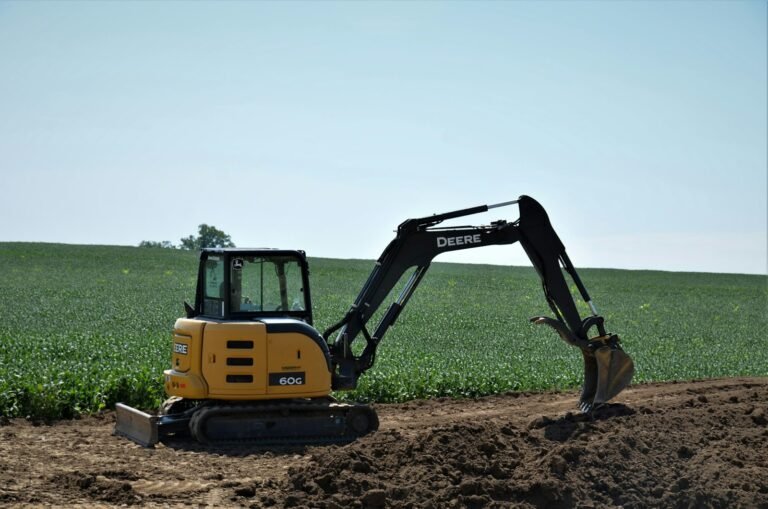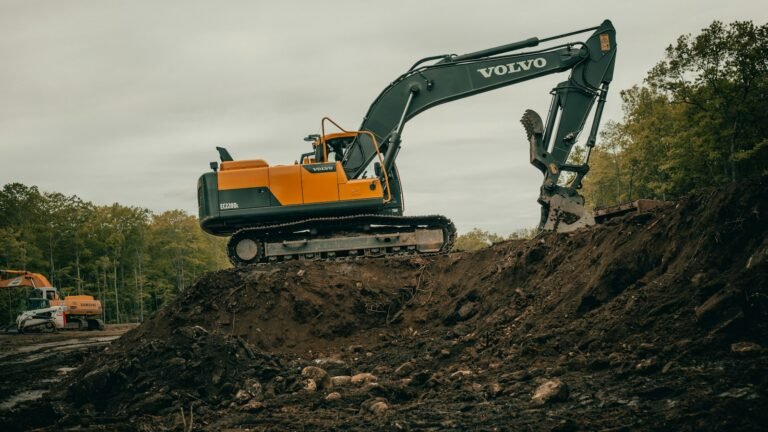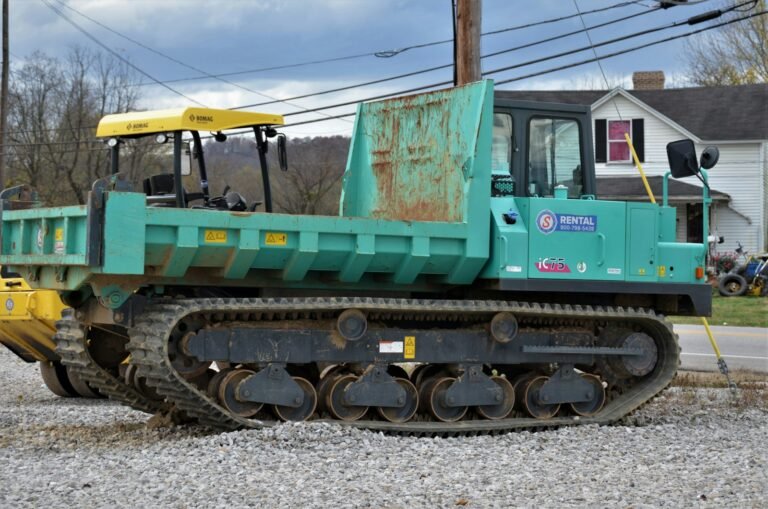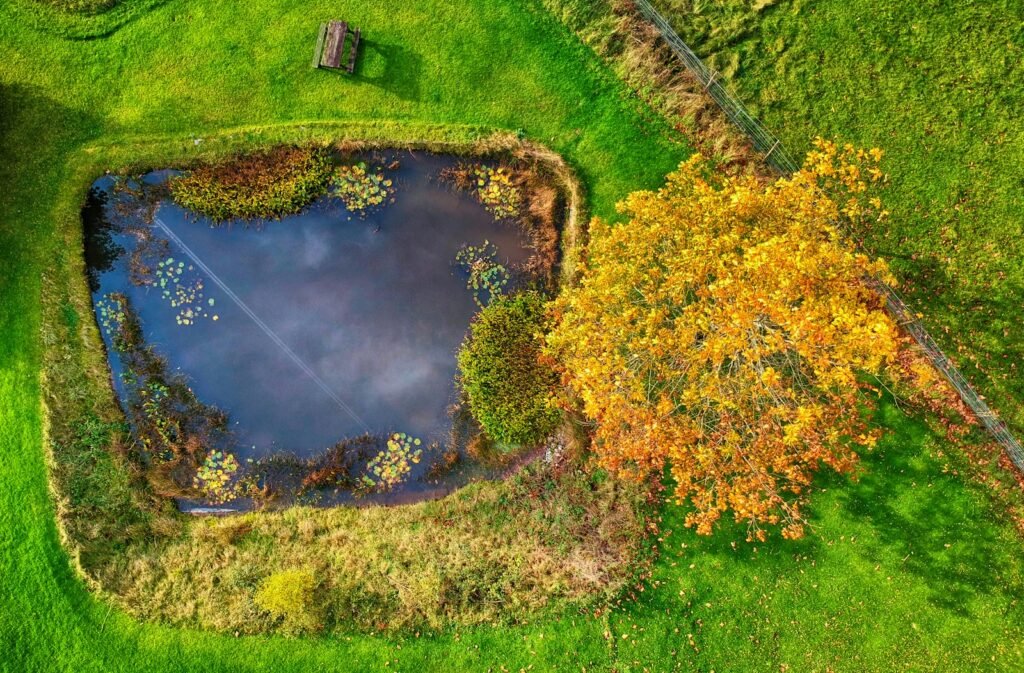
For pond digging, the excavator size follows the pond. A garden wildlife pond is a job for a 1.8 to 2.5 tonne mini digger, a decent farm or wildlife pond suits a 6 tonne machine, and a lake or large irrigation reservoir calls for a 9 tonne excavator with dumpers or tractors moving spoil. Before you hire anything, though, you need to know whether your ground will hold water, where the spoil is going, and whether any consents apply. This guide covers all three.

In this guide
Which excavator for which pond
| Pond type | Suggested machine | Why |
|---|---|---|
| Garden or wildlife pond in a back garden | Sunward SWE 18UF or SWE 25UF | Fits through garden access; zero tail swing for tight spots |
| Larger garden or paddock pond | Sunward SWE 35UF | More reach and dig depth, still compact to deliver |
| Farm, wildlife or fishing pond | Sunward SWE 60UF | Moves volume quickly; handles clay well |
| Lake or large irrigation reservoir | Sunward SWE 90UF | Bulk digging and shaping of banks and dams |
Reach matters as much as weight. A bigger machine can stand back from a soft edge and still reach the middle, and it can bank spoil further from the hole. On a wide pond, a 6 or 9 tonne excavator working from the margins often finishes in fewer days than a small machine constantly repositioning. All of these are on our construction equipment page, and our post on the Sunward SWE 18UF explains why that size suits garden pond digging so well.
Sizing the job: volume and hire time
Working out the volume of a pond gives you a realistic idea of how long you need the machines and how much spoil you will be handling. Multiply the length by the width by the average depth, not the deepest point. A pond 20m long and 10m wide with an average depth of 1.2m holds about 240 cubic metres. Once dug, that soil bulks up by a significant amount, so plan space for a heap noticeably bigger than the hole.
Hire time then depends on three things: the machine size, how far the spoil has to travel, and the ground. A 6 tonne excavator loading spoil straight onto a bank beside the hole works far faster than the same machine loading dumpers that have to run 200 metres across a wet field. Stony ground, roots and old field drains all slow progress. As a rule, small garden ponds take a day or two, while farm ponds and lakes are better hired by the week with the option to extend.
Illustrative example
Imagine a wildlife pond of roughly 25m by 15m on a farm near Crediton, on heavy clay, with spoil being spread on the same field. A Sunward SWE 60UF can dig, puddle and shape it while a tracked dumper moves spoil to the spreading area, and a tractor-mounted implement can then level and seed the spread spoil. The same pond on free-draining ground would need a liner or imported clay, adding a lining stage and different kit. This is an illustration to show the thinking, not a quote.
Will your ground hold water?
This is the most important question in pond digging, and the cheapest one to answer. Dig a trial hole or two with the excavator on day one, ideally in late autumn or winter when the water table is high. If water seeps in and stays, you have a good chance of a natural pond. If the hole stays dry or drains away quickly after rain, you will probably need a liner or imported clay.
Ground in the South West varies a lot. Much of mid and north Devon sits on heavy clay soils that can hold water well once worked properly. Granite areas on and around Dartmoor and Bodmin Moor tend to be thin, peaty or free-draining, and limestone and sandy ground in parts of Somerset and Dorset can be leaky. Squeeze a handful of subsoil: if it rolls into a smooth sausage that bends without cracking, it has a good clay content.
Clay, liner or bentonite: comparing your options
| Method | Best for | Watch out for |
|---|---|---|
| Natural clay, puddled in place | Clay sites with a good water table | Must be compacted in thin layers and kept wet |
| Imported clay | Leaky sites where suitable clay is available nearby | Haulage volume and wet-weather access |
| Bentonite clay products | Sealing slightly leaky ground | Needs careful spreading and mixing to the supplier’s method |
| Flexible liner with underlay | Garden ponds, free-draining ground, formal designs | Sharp stones and roots puncture liners; excavation must be smooth |
If you are using a liner, dig slightly oversize, rake out every stone and root, and lay a protective underlay or a layer of soft sand before the liner goes in. A toothless grading bucket on the excavator gives a smoother finish than a digging bucket. Keep the edge of the liner buried in a trench around the rim so it can’t slip.
Designing for wildlife, fishing or irrigation
Pond digging for different purposes needs different shapes, so decide what the pond is for before the machine starts.
- Wildlife ponds: wide, shallow margins and gently sloping sides matter more than depth. Irregular edges and shallow scrapes create more habitat than one deep bowl.
- Fishing ponds: anglers usually want some deeper areas, stable banks to fish from and safe access for maintenance. Talk to a fishery adviser about depth and stocking.
- Irrigation reservoirs: these hold large volumes and are usually engineered and lined. Larger schemes may need abstraction licensing and reservoir safety input, so get professional design advice early.
- Drainage and attenuation ponds: often required as part of a planning consent on developments. They follow an engineer’s design rather than a free-form layout.
How to dig a pond properly
- Mark out and strip topsoil: keep it separate from subsoil so you can dress the banks afterwards.
- Dig in benches: work down in steps rather than one deep hole. It is safer, and the shelves become planting margins later.
- Shape gentle slopes: shallow edges help wildlife get in and out and are less prone to slumping. Leave steeper sides only where you need depth.
- Puddle the clay: on clay ground, spread and compact the clay in thin layers across the base and sides, using the bucket and the weight of the machine. Keep it damp; dry, cracked clay will leak.
- Build the overflow: every pond needs a planned, protected spillway so heavy rain does not cut through the bank.
- Finish and seed: dress the banks with topsoil and seed quickly to stop erosion before winter.
Dealing with the spoil
Spoil takes up more space once it is dug, so the heap is always bigger than the hole looks. Decide before you start whether it will be spread over nearby land, shaped into a bank or bund, or taken away. Spoil leaving the site is generally treated as waste, so it needs a proper destination.
For moving spoil over soft ground, the Mechbadger tracked dumper copes with rough terrain, and the Sunward SWL 2830 tracked skid-steer loader is useful for spreading and grading the heaps. On farms, tractors with trailers can do the long-distance haul. Our agricultural range includes the John Deere 6155R and the Bailey 10-ton low loader for moving machinery between fields.
Pond digging and the rules: consents to check
Most small ponds dug into the ground and fed by rainwater need little in the way of consents, but larger schemes can trigger several. Treat this as general information and check the current guidance for your site.
- Abstraction: taking more than 20 cubic metres of water a day from a river, stream or groundwater usually needs an Environment Agency licence. See GOV.UK: check if you need a licence to abstract water.
- Impounding: building, altering or removing a dam, weir or other structure in inland waters, such as damming a stream to form a lake, generally needs an impounding licence before work starts. Some low-impact work may be covered by an Environment Agency regulatory position statement. See GOV.UK: check if you need a licence to impound water.
- Work near watercourses: work in, under or near a main river may need a flood risk activity permit from the Environment Agency, and changes to smaller ordinary watercourses may need consent from the lead local flood authority, usually the county or unitary council.
- Large raised reservoirs: a reservoir holding 25,000 cubic metres or more above natural ground level falls under reservoir safety law in England, with registration and engineer supervision.
- Planning: a large pond or lake can count as an engineering operation needing planning permission. Ask your local planning authority; in the Dartmoor and Exmoor National Parks, that is the National Park Authority.
- Wildlife and heritage: if there are existing ponds or wetland nearby, consider whether protected species could be present, and avoid known archaeological features.
Common pond digging mistakes
- Skipping the trial hole. An hour digging a test pit can save a week of work on a pond that will never hold water.
- Mixing topsoil and subsoil. Topsoil in the base or banks makes them soft and leaky, and you lose the good soil you need to dress the finished banks.
- Building steep sides everywhere. Steep banks slump, are dangerous and offer little habitat.
- No overflow. A pond without a protected spillway can wash out its own bank in the first big storm.
- Damming a stream without checking. On-line ponds on watercourses raise licensing, flood and fish passage questions. Get advice first.
- Leaving clay to dry. Puddled clay that dries and cracks in a hot spell may never seal properly again. Fill or cover it promptly.
- Underestimating spoil. Spoil always takes more room and more time to move than expected.
Working safely around a new pond
Freshly dug banks and wet clay are unstable. Keep the excavator tracks well back from the edge of a deep cut, especially after rain, and never let anyone stand in the hole while the machine is working above them. Plan where the machine will track in and out so it is never forced to work on a slumping bank. Once the pond starts to fill, deep water and steep, slippery sides are a drowning risk for children, livestock and dogs, so fence the area temporarily until the margins have settled and planted up.
Questions to answer before you hire
Running through these before you contact us means we can recommend the right machines first time, and you avoid paying for a digger that sits waiting for a decision.
- What is the pond for, and roughly how long, wide and deep will it be?
- Have you dug a trial hole, and did it hold water?
- Is the site on or near a stream, spring, ditch or field drain?
- Where will the topsoil and subsoil go, and how far is that from the hole?
- What is the access like from the road: gateway widths, slopes, soft ground, overhead lines?
- Is the site in a National Park, near a listed building or on land with known archaeology?
- Who will operate the machines, and do they have the right training and experience?
- Do you have insurance in place for hired-in plant? It is not included in our hire, and we refer customers to our partner insurance4plant for cover.
After the dig: settling and planting
A new pond rarely looks finished on the day the digger leaves. Banks settle, clay margins can crack if exposed, and bare soil washes into the water with the first heavy rain. Seeding the spread spoil and banks straight away, ideally in early autumn while the soil is still warm, helps bind it together before winter.
Let the pond fill naturally from rainfall where you can. Filling from a mains supply brings in nutrients that can feed algae, and filling from a stream or borehole may raise the abstraction questions covered above. Many people choose to let wildlife ponds colonise naturally from nearby water, adding a few native plants from a reputable source if needed.
Plan for maintenance from the start. Leave space for a machine to reach the pond in future to clear silt or cut back vegetation, and keep the overflow and spillway clear of debris. If you have fenced the pond for safety, make sure the fence line still allows access for that work.
Timing and delivery
Late summer and early autumn are usually the best time for pond digging in the South West. Ground is at its driest for tracking machines about, and the winter rain then fills the pond naturally. Digging in mid-winter on clay can turn the site into a quagmire.
Wildlife timing matters too. If reaching the dig means widening a gateway or cutting through a hedge, remember that nesting birds are protected and that hedge cutting on farmland is restricted through spring and summer, so check the current rules before you plan the access. If you are enlarging or reshaping an existing pond, think about what already lives in it.
Great crested newts are found in parts of the South West and are protected, so disturbing an existing pond where they may be present needs proper advice before any digging. Creating a brand new pond on dry ground is usually far simpler, and a well-designed one is likely to be colonised by wildlife within a season or two.
We deliver from Okehampton across Devon, Cornwall, Somerset and Dorset. Tell us the access to the dig site, including gateways, soft ground and any slopes, so we can plan where the delivery vehicle unloads.
Frequently asked questions
How long does it take to dig a pond?
A small garden pond is often a day or two with a mini digger. Farm ponds and lakes depend on volume, ground and spoil distance, so tell us the size and we’ll suggest a hire period.
Can I line a pond with clay instead of a liner?
Yes, if you have enough good clay on site or can import it. It must be compacted in layers and kept wet; if the pond dries out and cracks, it may leak.
Do I need planning permission to dig a pond?
Small garden ponds usually do not, but larger ponds and lakes may. Check with your local planning authority before you start.
Can you supply an operator?
Our hire is self-drive unless agreed otherwise, and operators must be competent. Ask us if you need help finding someone.
How deep should a wildlife pond be?
Depth matters less than shape. Most of the value for wildlife is in the shallow margins, with a deeper area in the middle to keep some water through dry summers. Gentle slopes on at least one side let animals get in and out.
Can I dig a pond where the field is already wet?
Often that is the best place, because a wet spot suggests a high water table or spring. Check first that it is not a field drain, a watercourse or a valuable existing wetland, as those raise different issues.
What other machines do I need besides the excavator?
Usually something to move spoil, such as a tracked dumper or skid-steer loader, and on larger sites a tractor and implements to spread and level it. Our hire FAQs cover delivery, fuel and off-hire for multi-machine jobs.
Get your pond digging kit booked
Send us the rough pond size, site postcode, access details and preferred dates, and we’ll recommend the right excavator and spoil-moving kit. WhatsApp or call 07841 036064, or use our contact form for a written quote.