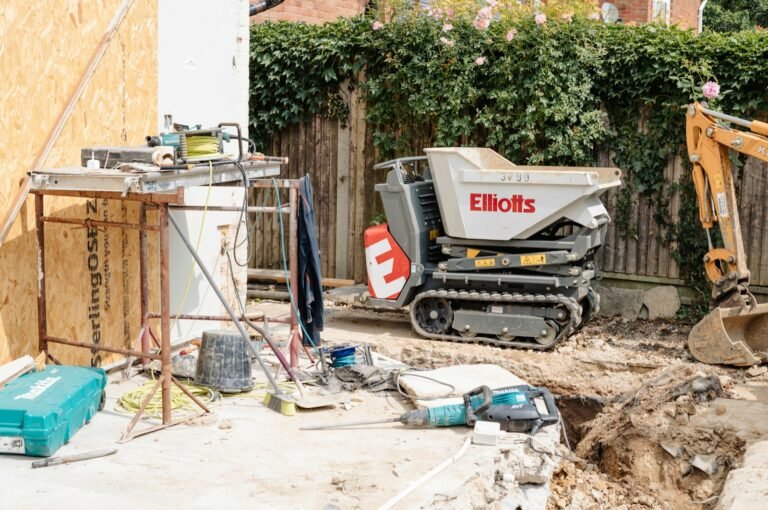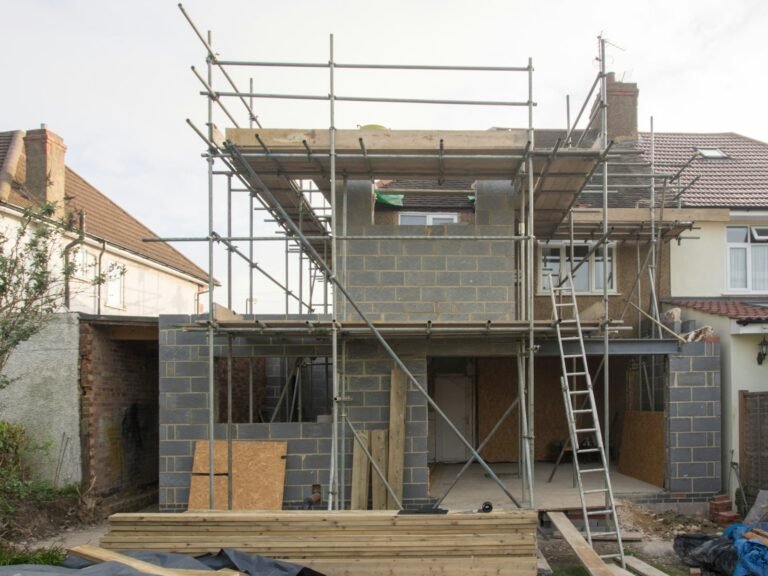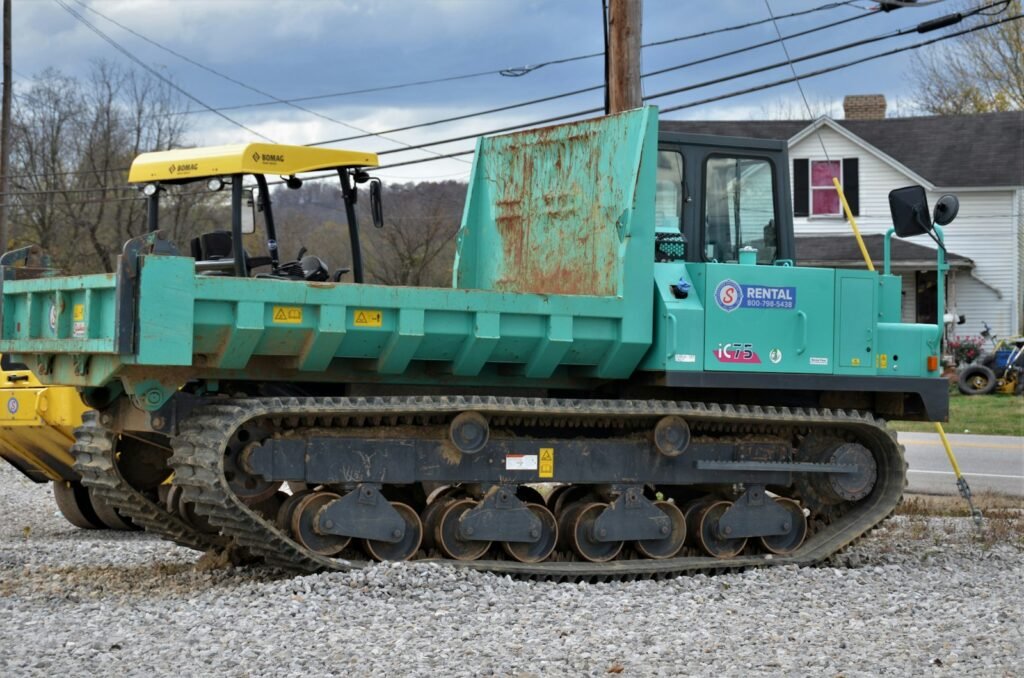
Tracked dumper hire is the answer when you need to move muck, stone or concrete across ground that would bog down a wheelbarrow or a wheeled dumper: wet lawns, soft clay, slopes and narrow side passages. We hire two tracked dumpers from our depot near Okehampton, the Mechbadger tracked dumper and the Hyundai 500kg tracked dumper, plus the electric HG 1000 wheeled dumper for firmer sites. This guide explains which to choose, how to work out how many loads your job involves, how to get the machine onto an awkward site and how to use it safely.

In this guide
Why tracks beat wheels on difficult ground
Rubber tracks spread the machine’s weight over a much larger area than tyres. Lower ground pressure means less sinking and rutting, better grip on slopes and loose material, and less damage to lawns you’ll have to put back afterwards. Tracks also keep moving on mud that would leave a wheeled dumper spinning.
The trade-off is speed. Tracked dumpers are slower over long distances on hard surfaces, and continual turning on tarmac or block paving can scuff the surface. On a firm yard with long runs, wheels win. On a soft garden, tracks win.
The HG 1000 is worth a mention for the other end of the scale. It is electric, so it is quiet and produces no exhaust at the point of use, and its 1000kg payload suits yards, farm buildings and hard-surfaced sites. If most of your route is concrete or tarmac and only the last few metres are soft, ask us whether a wheeled dumper and some ground mats would do the job.
Our dumpers compared
| Machine | Type | Best for | Less suited to |
|---|---|---|---|
| Hyundai 500kg tracked dumper | Tracked, 500kg payload | Narrow access, garden and landscaping jobs | Long runs on hard surfaces |
| Mechbadger tracked dumper | Tracked, compact | Rough terrain, manoeuvring on mixed ground | Very narrow passages (check width) |
| HG 1000 wheeled dumper | Electric, wheeled, 1000kg payload | Firm sites, yards and longer flat runs | Soft lawns and wet clay |
All three are listed on our construction equipment hire page. If you’re not sure which suits your site, send us a photo of the route and we’ll recommend one.
Tracked dumper hire for gardens and narrow access
A lot of our tracked dumper hire goes to garden and extension projects where everything has to come out through a side passage or a rear gate. Think terraced streets in Plymouth or Exeter with a back lane, or a cottage garden on a slope in a Cornish village. A compact tracked dumper turns hours of barrowing into a short shuttle.
Before booking, measure:
- The narrowest point on the route, including gateposts, downpipes and utility boxes.
- Any steps or kerbs. Tracked dumpers handle small level changes better than barrows, but steps need a ramp.
- The steepest slope on the route, especially if it slopes sideways.
- Where the dumper will tip: skip, grab lorry, spoil heap or a mixer.
Send those measurements and a couple of photos on WhatsApp and we’ll confirm whether the Hyundai or the Mechbadger will fit.
Farms, smallholdings and rural sites
Tracked dumpers aren’t only for gardens. On farms and smallholdings they are handy for jobs where a tractor and trailer is too big or too heavy for the ground: carrying stone to repair a gateway, moving muck out of an old stable block with a low doorway, taking materials across a wet field to a fencing line or a new water trough, or shuttling spoil from a hand-dug drainage trench.
On a steep Cornish or north Devon holding, tracks also give far more confidence on banks than a wheeled machine. Keep loads modest on slopes, travel straight up and down, and keep well away from the edges of ditches, ponds and slurry stores.
Tracked dumpers also suit renovation work on older rural properties, where outbuildings, cob walls and cobbled yards leave little room and you don’t want to crack fragile surfaces with heavy wheels.
How many loads? Working out your volumes
Payload is quoted in kilograms, but most jobs are described in cubic metres or square metres. Converting between the two stops you overloading the dumper and helps you plan how long the job will take. Three things to remember:
- Soil bulks up when dug. Loose spoil takes up noticeably more space than it did in the ground, often a quarter more or so, depending on the material.
- Weight varies a lot by material. Wet clay and stone are heavy; dry topsoil and bark are much lighter. As a rough guide, a cubic metre of damp soil or clay can weigh well over a tonne and a half.
- The payload is the limit, not the skip size. With heavy material, a 500kg dumper may be full by weight long before the skip looks full.
An illustrative example
Take a 20 square metre patio dig-out to 200mm deep in a back garden. That’s 4 cubic metres of ground. At a typical weight for damp soil and clay, that could be in the region of 7 tonnes of spoil. With a 500kg tracked dumper, you’re looking at something like 14 or 15 trips, plus the same again in reverse if sub-base is coming in. Knowing that in advance tells you whether a day is realistic, whether you need a bigger skip or grab lorry, and whether a 1000kg machine would halve the trips on a firm route.
Preparing the site before the dumper arrives
A tracked dumper is quick to learn, but the route it runs on decides how productive it is. A little preparation the day before pays back many times over:
- Walk the route from the work area to the tipping point and back. Look for hidden drain covers, soft spots, tree roots and overhanging branches at head height.
- Build ramps for any kerbs, steps or thresholds, using scaffold boards or timber strong enough for the loaded machine.
- Protect what matters. Boards over lawns, sheets over new paving and padding on gateposts or door frames that the skip might clip.
- Set up the tipping point. A skip with a ramp, a marked spoil heap with a stop block, or a clear spot for a grab lorry to reach.
- Agree who does what. One person digging or loading, one running the dumper, and nobody else on the route while it is moving.
- Check where services run. Tracks won’t hurt buried pipes, but stakes for ramps and stop blocks might. Check plans before hammering anything in.
Soft ground, slopes and wet weather
Devon, Cornwall and Somerset have more than their share of soft ground. Clay soils across mid and north Devon hold water for months, and parts of the Somerset Levels are peat that won’t carry much weight at all. A tracked dumper copes far better than wheels, but it isn’t unstoppable:
- Lay boards or ground protection mats over lawns you want to keep, especially on repeated runs.
- Avoid running the same line until it turns to slurry. Vary the route or put down stone.
- Travel up and down slopes, not across them. A loaded skip raises the centre of gravity.
- Tip on level ground, well back from trench and excavation edges.
If you have a choice of dates, garden and landscaping jobs on clay are far kinder to lawns in late spring and summer. In winter, plan for ground protection from the start rather than waiting for the first ruts.
Safe use of site dumpers
HSE’s guidance on dumpers notes that over 60% of dumper deaths involve the driver being crushed when the machine overturns, and stresses keeping pedestrians and dumpers apart. Small tracked dumpers are often pedestrian-operated, but the same principles apply:
- Make sure whoever operates it is trained and competent on that type of dumper.
- Do a daily check: tracks, controls, tipping mechanism, leaks and the emergency stop.
- Keep loads level and don’t fill above the top edge of the skip.
- Make sure the load doesn’t block your view of the route.
- Use stop blocks or a marked tipping point near excavations.
- Keep people clear of the route and the tipping area, particularly children and pets in domestic gardens.
Near trenches, remember that a loaded dumper adds weight close to the edge, which makes collapse more likely. HSE’s excavations guidance advises keeping plant and vehicles away from the sides.
Hire is self-drive, so the hirer is responsible for operator competence. Insurance isn’t included automatically. Many customers arrange cover through insurance4plant.co.uk.
Pairing a dumper with the right machines
A dumper is only as productive as whatever loads it. With a mini excavator, size the dumper so the digger fills it in a few buckets. Our Sunward SWE 08B micro excavator and a 500kg tracked dumper make a natural pair for narrow garden access. For loading by hand, the 500kg Hyundai is easier to keep moving than a bigger machine sitting half empty. For mixing concrete in the garden, combine a tracked dumper with a cement mixer such as the Altrad Belle Mini Mix 150 from our hand tools range.
Using a tracked dumper for concrete and sub-base
For small concrete pours where a ready-mix lorry can’t reach the back of the house, a tracked dumper can shuttle concrete from a mixer at the front to the formwork at the back. Load it to well within the payload, as concrete is heavy and sloshes on slopes, and keep the route short and level. Wash the skip out promptly after the last load, before the concrete sets. The same approach works for bringing in sub-base stone, sand for block paving or bags of aggregate.
Loading safely with an excavator
Position the dumper so the excavator loads it from the side or rear with a short slew, never swinging the bucket over a person. If the dumper is pedestrian-operated, the operator should step well clear while it is loaded. Agree simple signals between the excavator driver and the dumper operator, and keep the loading point on firm, level ground.
Step by step: a day on a garden dig-out
Here is how a typical one-day tracked dumper hire might run on a back-garden patio or extension dig, with a micro excavator doing the digging. It is an illustration to help you plan, not a promise of what any particular job will take.
- Early morning: dumper and excavator delivered to the front of the house. Handover and daily checks done, ramps and boards laid along the side passage.
- First hour: turf and topsoil lifted and taken to a separate heap or bags if you want to reuse them.
- Mid-morning to mid-afternoon: subsoil dug and shuttled to the skip or grab-lorry heap. The dumper operator keeps an eye on the route, adding boards where the ground starts to soften.
- Late afternoon: if sub-base is going in the same day, the dumper reverses the process, carrying stone from the drop point to the dig for spreading and compacting.
- End of day: tracks and skip scraped clean, machine parked where the collection vehicle can reach it, and off-hire booked.
If the volumes say it won’t fit in a day, book a weekly hire from the start. It is usually better value than extending day by day, and it takes the pressure off when the weather turns.
Delivery, handover and collection
Our driver unloads the dumper as close to the work as is safe, then runs through controls, tipping, fuel and the daily checks. Have someone on site to sign the delivery note and look over the machine. Diesel machines arrive with a full tank and should go back full, and our terms require white diesel only.
At the end of the job, give the skip and tracks a scrape so the machine comes back reasonably clean, then call or WhatsApp us to off-hire. Hire charges run until you have an off-hire reference, so don’t rely on telling the driver.
Common mistakes on dumper hires
Overloading with wet material. A skip heaped with saturated clay can weigh far more than the same skip of dry topsoil. Overloading strains the tracks and makes the machine unstable on slopes. Fill to the payload, not to the brim.
Forgetting the tipping point. If spoil is going into a skip, check that the dumper can actually tip into it. A high-sided skip may need a ramp or a different tipping arrangement, or you may be better with a grab lorry collecting from a heap.
Not allowing for the return trip. A route that works going downhill empty may be a struggle coming back uphill loaded, particularly on wet grass. Walk the route both ways before you start.
Leaving it unsecured overnight. On domestic jobs, park the dumper somewhere secure, remove the key and make sure children can’t climb on it.
Tracked dumper or tracked carrier?
If noise, fumes or ground damage are the main concern, for example inside a building, on a golf course or in a residential close early in the morning, look at our electric tracked carriers. The Tracspider Elektro Joe is a quiet, zero-emission tracked transporter with a tipping body that works indoors and out, and the Tracspider 1000kg bed carrier is on our construction range. For general muck shifting on a building site, a tracked dumper is usually the better fit.
Hire periods and what affects the cost
A small garden clearance may only need a day, while extensions and landscaping usually suit a weekly hire, our most popular period. WhatsApp us for a current quote. What you pay depends on the hire period, delivery distance from our depot, and whether the dumper is part of a bigger order with an excavator or compactor, which can share a delivery.
Contractors who need a dumper on and off through the year can look at Flex Hire, where the electric wheeled dumper appears in Tier 2 (£895 +VAT and delivery per month). Ask us which tier covers the tracked models.
Frequently asked questions
Will a tracked dumper fit through a garden gate?
Compact models are designed for narrow access, but widths vary. Measure the narrowest point and send it to us so we can confirm before delivery.
How much does a 500kg dumper carry compared with a wheelbarrow?
Far more than a single barrow load, and without the strain. Check the payload in kilograms rather than volume, as wet clay and stone are heavy.
Can I drive a tracked dumper on block paving?
Yes with care. Avoid sharp turns on the spot, which can scuff or shift blocks, and protect new paving with boards.
How long should I hire for?
A small garden clearance may only need a day. Extensions and landscaping usually suit a weekly hire, which is our most popular period.
Can a tracked dumper climb steps?
No. Small level changes are fine, but steps need a properly built ramp that can take the loaded weight. Never try to drive a dumper up or down steps.
Is a tracked dumper hire worth it for one day?
Often, yes. Compared with barrowing several tonnes of spoil through a side passage, a single day of tracked dumper hire can save a lot of time and backache.
Do I need a ticket to use a tracked dumper?
On commercial sites a recognised training card is often expected. At home there may be no card check, but whoever uses the machine must be shown how it works and be competent before working alone. We cover the controls at handover.
Book tracked dumper hire
Tell us the site postcode, dates, the narrowest access width and what you’re moving. WhatsApp or call 07841 036064 for a current quote, or use our contact page for written quotes and accounts.