French drain installation is one of the most useful jobs you can do on wet ground. A French drain is a gravel-filled trench with a perforated pipe in the bottom that collects water from the soil and carries it, on a steady fall, to somewhere it can safely go. Done properly it will dry out a soggy lawn, take the pressure off a retaining wall or stop water sitting against a house wall for decades.
In this guide
This guide covers planning the run, where the water can go, trench sizes, the machines that make the digging quick and how to lay the pipe so it does not silt up. It is based on the kit we hire across Devon, Cornwall, Somerset and Dorset from our depot near Okehampton.
What a French drain does and when you need one
A French drain works because water always takes the easiest path. Soil, especially clay, holds water tightly. A trench full of clean stone is far more open, so groundwater moves sideways into it, drops to the pipe and flows away.
Typical uses:
- Waterlogged lawns where water lies for days after rain and the grass turns to moss.
- Behind retaining walls, where trapped water builds up pressure and can push a wall over.
- Around house perimeters on sloping sites where water runs towards the building from higher ground.
- At the foot of a bank or slope, to intercept water before it reaches a patio, drive or garden room.
- Along a farm track or gateway that turns to mud every winter.
A French drain is not the answer to everything. Roof water belongs in a proper rainwater drain, and a site in a hollow with no lower point may need a different solution altogether.
Where the water goes: outfall options and the rules
The outfall is the most important decision in any French drain installation. A beautifully built drain that ends in a dead end is just an underground pond. You need a lower point that can accept the water, every day of the year, including in the wettest week of a South West winter.
Soakaway
A soakaway is a stone- or crate-filled pit that lets water soak into the ground. It only works where the subsoil drains reasonably well. On heavy clay a soakaway can fill and stay full, so a percolation test (digging a test hole, filling it with water and timing how fast it drops) is sensible first.
For surface water from buildings, Approved Document H of the Building Regulations sets out the order of preference for where rainwater should go, with infiltration first where the ground allows, then a watercourse, then a sewer. It also covers how far soakaways should sit from buildings.
Ditch, stream or other watercourse
Running a drain into an existing ditch is common in rural Devon and Cornwall. Be careful, though. Work in or alongside a watercourse can need permission. GOV.UK’s guidance on owning a watercourse explains that the Environment Agency is the authority for main rivers, while the lead local flood authority (your county or unitary council) or an internal drainage board controls work on other watercourses. Building a new outlet through a bank, or changing a ditch, may need their consent, so check before you dig.
Existing surface water drain
Connecting to an existing private surface water drain can work if it has capacity. Never connect groundwater to a foul drain or septic tank. A connection to a public sewer will need the agreement of the sewerage company. If you are not sure what a drain carries, lift the covers and trace it before you plan around it.
This is general information, not legal advice. Rules change and every site is different, so check the current guidance or speak to your council’s building control or drainage team for anything beyond a simple garden drain.
Planning a French drain installation: falls, depth and route
Walk the site after heavy rain and note where water lies, where it comes from and where the lowest point is. Mark the route from the outfall back uphill, keeping it as straight as you can.
Getting the fall right
A fall of around 1:100 is a common guide for a French drain, which is 10mm of drop for every metre of run. A 30m drain would therefore fall about 300mm from top to bottom. Steeper is fine if the ground allows, but avoid flat spots or dips where silt will settle. Set a string line or use a laser level and check the trench bottom as you go, not just at the end.
Trench width and depth
For most garden and landscaping drains, a trench of roughly 300mm wide and 450mm to 900mm deep is typical. Shallower trenches suit lawn drainage, where you are catching water in the topsoil. Deeper trenches suit house perimeters and retaining walls, where you want to intercept water lower down.
| Situation | Typical depth | Typical width | Notes |
|---|---|---|---|
| Waterlogged lawn | 450mm to 600mm | 150mm to 300mm | Herringbone laterals feeding a main run work well on big lawns |
| Behind a retaining wall | Base of the wall | 300mm or more | Pipe at the foot of the wall with clean stone up the back |
| House perimeter | Usually below floor level | 300mm | Stay clear of foundations; take advice if digging near footings |
| Farm track or gateway | 600mm to 900mm | 300mm to 450mm | Uphill side of the track, outfall to a ditch |
Never undermine foundations. If your trench will run close to and below the level of a footing, get advice from a structural engineer or building control first. Old boundary walls and outbuildings often have very shallow footings.
Choosing the right kit to dig the trench
Digging by hand is fine for a few metres. Beyond that, a machine saves days. The choice comes down to length, depth, access and ground conditions.
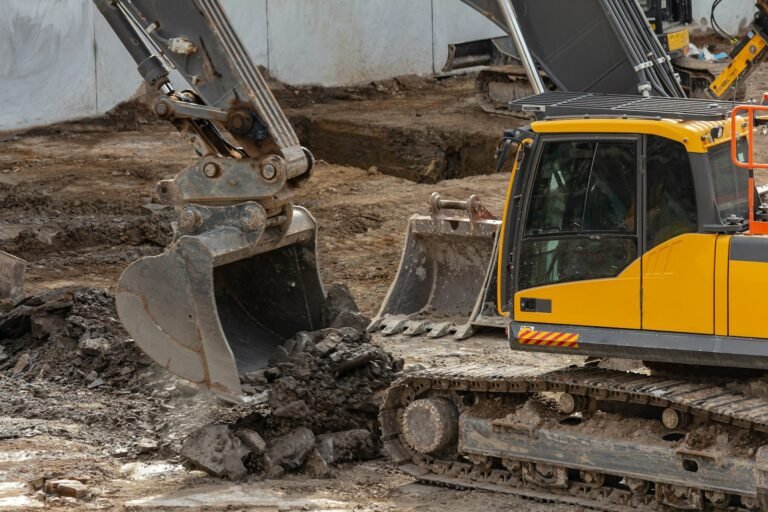
Mini digger with a narrow bucket
A mini digger is the most flexible option. The Sunward SWE 08B micro digger is about 0.8 tonnes and fits through many side gates, which makes it popular for back gardens. For longer or deeper runs, the Sunward SWE 18UF zero tail and SWE 20F suit drainage work well. Bucket choice matters: a narrow digging bucket gives a tidy trench, and a wider ditching bucket is useful for trimming the trench bottom and spreading stone. Tell us the trench width you want and we will confirm which buckets come with the machine.
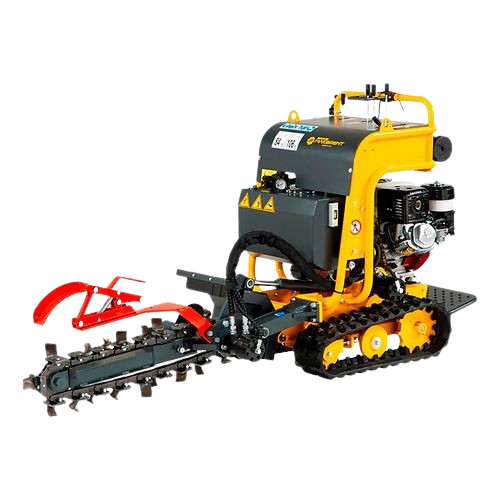
Trencher for long, straight runs
For long lawn or field drains, a dedicated trencher is often quicker than a digger. On our sports and landscaping hire page you will find the Mak Brent MAK 40 wheeled trencher, which digs to 40cm, and the MAK 60 tracked trencher, which digs to 60cm and copes better with rough ground. A trencher cuts a consistent, narrow slot with less mess, which suits sports pitches, paddocks and big lawns. It is less suited to stony ground, heavy tree roots or deep perimeter drains, where a digger is the better tool.
Moving stone and spoil
A 30m drain needs a surprising amount of stone, and the dug soil has to go somewhere. Wheelbarrows across a lawn are slow and wreck the grass. On our construction equipment page you will find the Hyundai 500kg tracked dumper and Mechbadger tracked dumper for narrow access, the HG 1000 electric wheeled dumper for firmer ground, and the Tracspider 1000kg electric tracked carrier for soft or sloping sites. If your stone arrives in bulk bags, the Dragon LT1000 dumpy bag lifter makes handling them far easier.
Equipment table
| Task | Kit we hire | Best for |
|---|---|---|
| Digging in tight gardens | Sunward SWE 08B (0.8t) | Side gate access, short to medium runs |
| Longer or deeper drains | Sunward SWE 18UF or SWE 20F | Perimeter drains, tracks, retaining walls |
| Long shallow lawn drains | Mak Brent MAK 40 wheeled trencher | Lawns and pitches, up to 40cm deep |
| Deeper or rougher runs | Mak Brent MAK 60 tracked trencher | Field drains and rough ground, up to 60cm deep |
| Moving stone and spoil | Hyundai 500kg or Mechbadger tracked dumper, HG 1000, Tracspider | Narrow access, soft ground, slopes |
| Bulk bags of stone | Dragon LT1000 dumpy bag lifter | Lifting and placing 1,000kg bags |
| Consolidating backfill above the stone | Weber MT CR 2 reversible plate or MC 85 trench roller | Trenches under paths or drives |
Shovels, rakes and hand tools are worth having on site too. Our hand tools range is growing, so ask us what is available when you book.
Step-by-step French drain installation
Here is the method we would follow on a typical garden or landscaping job. Adjust depths and widths to suit your site.
- Check for underground services. Use a cable avoidance tool and request records through LinesearchbeforeUdig before breaking ground. Garden pipes and cables are often unrecorded.
- Mark the route and the outfall. Peg the line and note the depth needed at each end to achieve your fall.
- Strip the turf. Cut and roll turf to one side if you want to relay it.
- Dig from the outfall uphill. Starting at the low end means any water that seeps in drains away rather than flooding the trench.
- Check the fall. Use a string line or laser every few metres. Trim high spots by hand and fill low spots with stone, not loose soil.
- Line the trench with geotextile. Lay a non-woven geotextile membrane along the trench with enough spare to fold over the top later.
- Add a bed of clean stone. Around 50mm of clean, washed stone (often 20mm to 40mm) goes in the bottom.
- Lay the perforated pipe. Use perforated land drain pipe, commonly 100mm diameter for domestic jobs. Lay it on the stone with a consistent fall and join lengths with proper connectors.
- Surround and cover with stone. Fill with clean stone to within about 150mm of ground level for a lawn drain, or higher behind a wall.
- Wrap the geotextile. Fold the membrane over the top of the stone so soil cannot wash down into it.
- Finish the surface. Topsoil and turf over a lawn drain, or carry the stone to the surface where you want it to catch surface water as well.
- Build the outfall. Protect the end of the pipe where it enters a ditch or soakaway, and fit a rodding or inspection point at the top end and at changes of direction on longer runs.
Do not run a plate compactor directly on top of the pipe. Light hand tamping is enough over a lawn drain. Where a drain crosses under a path or drive, consolidate the layers above the stone carefully with a trench roller or reversible plate, keeping the heavy work well above the pipe.
Geotextile, pipe and stone: getting the materials right
The materials decide how long the drain lasts. The commonest cause of failure is silt. Fine soil particles wash into the stone, fill the gaps and slowly choke the pipe. A good geotextile wrap is the main defence.
- Geotextile: use a non-woven filter membrane rather than weed control fabric. It lets water through but holds back fine soil.
- Pipe: perforated twin-wall or flexible land drain pipe. Some come pre-wrapped in a filter sock, which helps in silty ground but is not a substitute for a membrane-wrapped trench in clay.
- Stone: clean, washed, angular stone. Avoid scalpings or anything with fines, as those fines will block the drain.
- Fittings: connectors, end caps, and a rodding eye or inspection chamber so the drain can be flushed later.
As a rough planning guide, a trench 300mm wide and 600mm deep holds about 0.18 cubic metres per metre of run. Most of that will be stone, so a 30m drain can easily need several tonnes. Ask your supplier to work out quantities from your trench sizes.
Devon clay and South West ground conditions
Much of mid and north Devon, including the country around Okehampton, Holsworthy and Torrington, sits on the Culm Measures. These give heavy, slow-draining clay soils that stay wet through the winter. French drains work well in this ground because they give water an easy path out, but soakaways often struggle. Plan for a ditch or other outfall wherever possible.
The red soils around Exeter and Crediton generally drain better, though they can still hold water where there is compacted subsoil from old building work. On and around Dartmoor and Bodmin Moor you may find granite, peaty topsoil and boulders, which slow trenchers and favour a digger. Parts of Somerset, including the Levels, have very high water tables, and drainage there is often managed by internal drainage boards.
Clay also smears. If you dig wet clay with a bucket, the sides of the trench can glaze over and stop water getting in. Dig when the ground is workable, avoid tracking up and down on the trench edge, and rough up any glazed faces before lining.
Working safely in drainage trenches
Trenches can collapse without warning, even shallow ones in wet ground. HSE guidance on excavation safety explains that sides need support or battering back where there is a risk of collapse, and that spoil and machines should be kept back from the edge.
- Keep spoil heaps back from the edge so they do not add load or fall back in.
- Do not climb into a deep trench to level the bottom. Use the bucket, or batter the sides back first.
- Keep children, pets and visitors away while the trench is open, and fence or cover it overnight.
- Only operate a digger or trencher if you are competent to do so. Hire is self-drive unless otherwise agreed, so you must have suitable training.
Insurance is not included automatically with our hire. If you need cover for the machine, we refer customers to our partner insurance4plant.co.uk.
A worked example: draining a wet back lawn in mid Devon
Here is an illustrative scenario. A semi-detached house near Okehampton has a back lawn of around 12m by 15m. Water lies at the bottom end for days after rain. There is a ditch along the bottom boundary, about 1m below the lawn level, and a side gate about 900mm wide.
A sensible plan would be a main French drain running down the length of the lawn, with two or three short laterals feeding it in a herringbone pattern, all falling to the ditch. With a 1:100 fall, the 15m main run needs only about 150mm of drop, which the site easily allows. After confirming the ditch is a suitable outfall, the owner hires a Sunward SWE 08B for its narrow access and a small tracked dumper for the spoil and stone.
Day one: turf stripped, services checked, main run and laterals dug. Day two: geotextile, stone and pipe laid, topsoil and turf replaced, spoil taken off site or spread on beds. The real time saver is having the stone tipped close to the gate and moved in by dumper rather than barrow.
Common French drain mistakes to avoid
- No proper outfall. The drain fills and has nowhere to go.
- Flat spots and dips. Silt collects in low points and blocks the pipe.
- Dirty stone. Fines in the stone clog the drain from day one.
- No geotextile. Soil migrates into the stone over a few winters.
- Digging too close to footings. Risks undermining walls and foundations.
- No access for cleaning. Without a rodding point, a blocked drain means digging it up.
- Compacting hard over the pipe. Heavy plates can crush or displace it.
Planning your hire and delivery
Most domestic French drain installation jobs fit into a two or three day hire. A typical sequence:
- Measure the run and decide the outfall.
- WhatsApp us the job, postcode, dates and gate width for a recommendation and quote.
- Order stone, pipe and membrane to arrive by the first morning.
- We deliver, often same day across much of Devon and Cornwall, and collect when you are done.
Contractors with a steady flow of drainage work may find Flex Hire useful. It is one flat monthly fee with the option to swap kit as jobs change, from Tier 1 at £795 +VAT and delivery a month for compact kit, up to Tier 2 at £895 which adds excavators.
Frequently asked questions
How deep should a French drain be?
For lawns, 450mm to 600mm is typical. For house perimeters and retaining walls, the pipe usually sits lower, near the base of the wall or below floor level. Depth depends on where the water is and on the fall you need to reach your outfall.
Do I need planning permission for a French drain?
A simple garden drain usually does not need planning permission, but outfalls to watercourses, connections to sewers and drainage serving buildings can involve other consents or Building Regulations. Check with your council or the relevant authority before you start.
Can I use a trencher instead of a mini digger?
Yes, for long, straight runs in reasonably clear ground. The MAK 40 digs to 40cm and the MAK 60 to 60cm. For deeper trenches, stony ground, heavy roots or tight corners, a mini digger is usually better.
What fall does a French drain need?
Around 1:100, or 10mm per metre, is a common guide. A steady, even fall matters more than a steep one. Check it as you dig rather than relying on the surface, which is rarely as level as it looks.
How long does French drain installation take?
A 15m to 30m domestic drain is often a two or three day job with a mini digger and dumper, including turfing. Ground conditions, access and how far you have to move stone and spoil make the biggest difference.
Will a French drain work on clay?
Yes, and clay is where French drains are most useful. The key is a reliable outfall, because water collected from clay cannot soak away easily. Wrap the stone in geotextile and avoid smearing the trench sides.
Hire your drainage kit from 4Counties
Tell us about your French drain installation and we will match the right digger, trencher and dumper to your site. WhatsApp or call 07841 036064 (Mon to Fri, 7:30am to 5:30pm) with the job, site postcode, dates and access details, or use our contact page for written quotes and accounts.