

Garden clearance goes much faster with the right equipment. An overgrown garden that would take weeks with secateurs and a borrowed mower can often be cleared in a weekend with a strimmer, a wood chipper, a small digger for stumps and a dumper or trailer to move the waste. The trick is doing the jobs in the right order and knowing where the waste will go before you start.
In this guide
This guide is for homeowners, landlords and small landscapers taking on a neglected garden, a rental property between tenants or a plot that has been left for years. It covers the survey, the legal points to check, the kit we hire from our depot near Okehampton and a staged plan you can follow.
Start with a survey, not a strimmer
Walk the whole garden before anything is cut. Overgrowth hides things, and finding them with a blade is expensive. Take photos, make a rough sketch and note:
- Hidden hazards: old glass, wire, buried metal, broken slabs, manholes, ponds and steps.
- Things to keep: mature trees, shrubs, paving or edging worth saving.
- Services: outside taps, cables to sheds and garden lights, gas meters and drain covers.
- Old structures: sheds, greenhouses and garages, including any roofing or panels that might contain asbestos.
- Access: gate widths, steps, slopes and where a skip, trailer or chipper could sit.
- Wildlife: active birds’ nests, hedgehogs and other animals in long grass and brash piles.
- Problem plants: Japanese knotweed, brambles, and anything with sap that irritates skin.
Measure the narrowest point between the road and the garden. That one measurement decides which machines can get in. A 900mm side gate, for example, rules out a lot of kit but still lets a micro digger, a narrow tracked dumper or a tracked chipper through.
Garden clearance and the law: birds, knotweed and asbestos
Nesting birds
All wild birds are protected. GOV.UK’s guidance on wild bird protection confirms it is an offence to intentionally take, damage or destroy a wild bird’s nest while it is being used or built. The main nesting season runs roughly from spring through late summer, but birds can nest outside that window. Check hedges, shrubs, ivy and brash piles carefully before cutting, and leave anything with an active nest until the birds have gone.
Japanese knotweed
Knotweed has hollow, bamboo-like canes, shield-shaped leaves and dies back to brown canes in winter. GOV.UK guidance on stopping Japanese knotweed from spreading says you do not legally have to remove it unless it causes a nuisance, but you can be prosecuted for causing it to spread into the wild. Tiny fragments of root can regrow, and waste containing it may count as controlled waste that needs a registered carrier and a suitable disposal site. Do not strim it, dig it, chip it or put it in your green bin. Get a specialist in.
Asbestos in old sheds and garages
Older garages, sheds and outbuildings sometimes have asbestos cement roof sheets, panels or downpipes. Do not break, cut or drill anything you suspect until it has been checked. If in doubt, leave it alone and get it tested before demolition.
This is general information, not legal advice. Rules can change, so check the current guidance for your situation.
Garden clearance equipment: what to hire and why
Most of the kit for clearing an overgrown garden is on our sports and landscaping hire page, with diggers and dumpers on the construction page and trailers on our trailer hire page.
| Job | Kit we hire | Notes |
|---|---|---|
| Cutting long grass, nettles and weeds | CRAMER battery strimmer | Quiet and light; good near neighbours |
| Mowing once the rough is down | CRAMER electric walk-behind mower | Various widths; ask for current sizes |
| Large rough areas and paddocks | Captain 26HP compact tractor with Conagri MEGA 1.45m flail mower | For bigger plots with good access, not small gardens |
| Chipping branches and brash | GL&D 5.5″ tracked chipper or 6.5″ towable chipper | Tracked unit for gardens, towable for open sites |
| Removing stumps, roots and old features | Sunward SWE 08B micro digger or SWE 18UF | 08B fits many side gates |
| Moving soil, rubble and waste | Hyundai 500kg or Mechbadger tracked dumper, Tracspider carrier | Narrow access and soft lawns |
| Taking waste away | Ifor Williams, Brian James or Indespension trailers | Check your towing entitlement |
| Splitting logs from felled timber | Ifor Williams trailed log splitter | Turns waste wood into firewood |
| Cleaning paths and patios afterwards | Brendon 35KPE power washer | Lifts moss and algae from slabs |
| Leaves and debris | CRAMER backpack or handheld leaf blower | Battery powered, low noise |
Strimmers and cutting tools
The CRAMER battery strimmer handles long grass, nettles and light weeds without the noise and fumes of a petrol machine, which matters in a terraced street or on an early start. For thick, woody bramble you will also want loppers and a pruning saw. Ask us what cutting heads and hand tools are available when you book.
Flail mowers for big plots
If the “garden” is really a paddock, orchard or half-acre of rough grass, a flail mower behind a compact tractor will clear it far faster than any handheld tool. The Captain 26HP compact tractor and Conagri MEGA 1.45m flail mower suit larger plots with good access. For a typical town garden, a strimmer followed by a mower is the better choice.
Wood chippers for brash
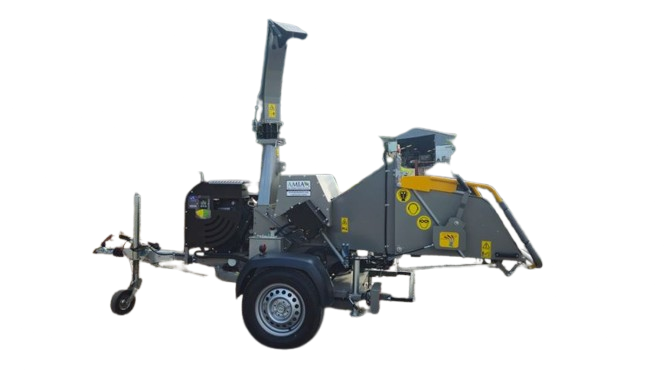
Brash is bulky. A pile of cut branches the size of a car might chip down to a few bags of chip. The GL&D 5.5″ tracked chipper is self-propelled and can drive through gates and over lawns, so you chip at the pile rather than dragging branches through the house. The GL&D 6.5″ towable chipper suits open sites and roadside work. Both reduce the trips to the tip, and the chip makes useful mulch or path surfacing.
Micro diggers for stumps and old features
Old shrub stumps, concrete post bases, crumbling raised beds and buried rubble are slow, back-breaking work by hand. The Sunward SWE 08B micro digger weighs around 0.8 tonnes and fits through many side gates. It will lever out small stumps, dig out old paths and level ground ready for turf. Larger stumps from mature trees may need grinding instead, so ask us and we will point you in the right direction.
Dumpers and carriers
Moving waste is often the slowest part of a garden clearance. A tracked dumper carries far more than a wheelbarrow, and tracks spread the weight on a soft lawn. The Hyundai 500kg tracked dumper suits narrow access. On steep or soft ground, the Tracspider Elektro Joe electric tracked transporter is quiet, low ground pressure and works indoors and out.
A staged garden clearance plan for a weekend
Order matters. Cutting first exposes the ground, chipping keeps the site clear, and digging comes last so you can see what you are working with. Here is an illustrative plan for a medium-sized overgrown back garden.
Before the weekend
- Complete the survey and check for nests and knotweed.
- Decide where waste is going and book any collection, skip or tip visits.
- Tell the neighbours, especially if you will be chipping.
- Book the kit. WhatsApp us the job, postcode, dates and gate width.
Saturday morning: cut back
- Pick up visible rubbish, glass and metal by hand.
- Strim long grass and weeds down to a few inches, working from the edges in.
- Cut back overgrown shrubs and low branches, stacking brash in one pile near the chipper’s working spot.
- Rake up and bag the grass cuttings.
Saturday afternoon: chip
- Set the chipper on firm, level ground and feed brash butt-end first.
- Blow chip into bags, a trailer or a pile for reuse as mulch.
- Keep the work area clear and children and pets well away.
Sunday: dig, move and tidy
- Remove stumps, old post bases and broken features with the micro digger.
- Move soil, rubble and roots out with the dumper.
- Level and rake the ground ready for turf or seed.
- Pressure wash paths and patios, then load the trailer or skip.
A bigger or more neglected plot may take a week. Weekly hire is our most popular hire period, and it often works out better value than trying to cram everything into one weekend.
A worked example: a rental garden between tenants
Here is an illustrative scenario. A landlord has a terraced house in Exeter with a back garden of roughly 6m by 20m that has not been touched for three years. There is waist-high grass, a bramble thicket along one fence, two overgrown shrubs, an old rotten shed and a crumbling concrete path. Access is through a 1m side passage with one step.
The survey turns up no knotweed and no active nests, as it is November. The shed roof is felt over timber, not cement sheet, so it can be taken down by hand. The landlord books a skip on the road for the shed timber and rubble, and plans to chip all the green waste and spread it on the borders.
A sensible kit list would be a CRAMER strimmer, the GL&D 5.5″ tracked chipper, a Sunward SWE 08B micro digger and a Hyundai 500kg tracked dumper, all of which suit a narrow side passage. Day one is strimming, cutting back and chipping. Day two is lifting the old path and shrub stumps with the digger and running the rubble out to the skip by dumper. A third day for levelling, seeding and pressure washing leaves the garden ready for viewings.
Delivery, handover and collection
When you book, tell us exactly where the kit can be dropped. A driveway or a level spot near the gate is ideal. If the street is narrow, or parking is tight, say so, because it affects which delivery vehicle we send and when. Same-day delivery is possible across much of Devon and Cornwall.
On delivery we walk you through the controls, daily checks and safe operation of each machine. Check fuel or battery charge, look over the kit for damage and ask anything you are unsure of before the driver leaves. If something goes wrong during the hire, call or WhatsApp us and we will assess it and arrange a repair or replacement quickly.
At the end of the hire, clean off the worst of the mud, leave the kit somewhere accessible and let us know it is ready. If the job has grown and you need an extra day, message us before the hire ends.
Getting rid of the waste legally
Garden clearance produces a lot of waste, and where it ends up is your responsibility. GOV.UK’s page on how to dispose of household waste says you must check that anyone taking your waste away is on the register of waste carriers, and that you could be fined if you hand waste to someone who is not allowed to take it. A cheap “man with a van” whose load ends up fly-tipped down a lane can lead back to you.
Your options usually include:
- Reuse on site: chip for mulch and paths, logs for firewood, clean soil for levelling.
- Home composting: soft green waste and grass clippings.
- Council garden waste collection: fine for small amounts over a few weeks.
- Household waste recycling centre: take it yourself in a car or trailer. Check your council’s rules on trailers, vans and rubble before you go.
- Skip: the skip company arranges any permit needed if it sits on the road.
- Registered waste carrier: check their registration and get a receipt.
A note on bonfires
There is no general ban on garden bonfires, but smoke and smell must not be a nuisance to neighbours, and councils can act on complaints. Burning plastics, treated timber or general rubbish is not acceptable. Chipping is usually the better route: no smoke, no waiting for a dry day, and the chip has a use.
Moving waste with trailers
If you are taking waste to the tip yourself, a trailer saves multiple car trips. Our trailer range includes the Brian James 9ft plant trailer (2,700kg GVW), the Indespension 10ft plant trailer with ramps, and Ifor Williams 18ft flat bed and tilt bed trailers. Check the weight you are allowed to tow on your licence and that your vehicle can legally tow the loaded trailer. Sheet or net every load so nothing blows off on the road.
If you are clearing a garden before building work and need somewhere secure for tools, furniture or salvaged materials, our Hiway Storage BV126 mobile storage trailer can be sited on your drive. It is lockable and weatherproof, and we move it, so you do not need a towbar.
Safety during garden clearance
- PPE: gloves, eye protection, ear defenders, long sleeves and sturdy boots. Add a visor for strimming.
- Chipper safety: no loose clothing or gloves with cuffs that can catch. Never reach into the feed. Read the operating instructions we give you on delivery.
- Machines: hire is self-drive unless otherwise agreed, and you must be competent to use the kit. Ask for a run-through on delivery.
- Hidden objects: strim slowly into unknown long grass and watch for wire and glass.
- Slopes: take care with dumpers and diggers on banks, and travel up and down a slope rather than across it.
- Underground services: before digging out stumps or footings, check for pipes and cables.
Insurance is not automatically included with our hire. We refer customers to our partner insurance4plant.co.uk for plant hire cover.
Seasonal advice for South West gardens
Late autumn and winter are often the easiest times for a big clearance. Growth has died back, you can see the ground and nesting is far less likely. The downside in Devon and Cornwall is wet, soft ground, especially on clay. Tracked dumpers and the tracked chipper cope better than wheeled kit, and laying boards or ground protection over the lawn helps.
Spring clearances need more care because of nesting birds and fast regrowth. Summer is dry and pleasant to work in, but cutting hedges and shrubs then needs the most careful checking for nests. Whatever the season, avoid parking heavy kit on a sodden lawn overnight.
Common garden clearance mistakes
- Strimming before checking for nests, wire and hidden objects.
- Hiring a chipper without planning where the chip will go.
- Under-estimating how much waste there will be, then running out of hire days.
- Handing waste to an unregistered carrier.
- Digging out stumps without checking for pipes and cables.
- Choosing a machine that will not fit through the gate.
- Disturbing knotweed and spreading it around the garden.
What affects the cost of a garden clearance hire
We do not publish hire prices because they depend on the job, so WhatsApp us for a current quote. The main factors are:
- Which machines you need and for how long.
- Daily, weekly or longer hire periods.
- Delivery distance from our depot near Okehampton.
- Access, including whether we can drop kit close to where it is needed.
- Whether you need trailers or storage as well.
Landscapers and property managers clearing gardens regularly may prefer Flex Hire, a flat monthly fee from £795 +VAT and delivery a month for Tier 1 compact kit, with the freedom to swap equipment as jobs change.
Frequently asked questions
Can I clear a garden during the bird nesting season?
You can, but you must not intentionally damage or destroy an active nest. Check hedges, shrubs and brash piles carefully before cutting, and leave anything with a nest in use until the birds have finished.
What size chipper do I need for a garden?
For most gardens, the GL&D 5.5″ tracked chipper is the better fit because it can drive to where the brash is. The 6.5″ towable chipper suits open sites with road or yard access.
Will a micro digger fit through my side gate?
The Sunward SWE 08B fits through many standard side gates. Measure the narrowest point, including gate posts and steps, and send us the figure so we can confirm before delivery.
Can I burn garden waste instead of chipping it?
Small bonfires of dry garden waste are not banned, but they must not cause a nuisance to neighbours. Chipping is quicker, smoke free and gives you mulch.
Do I need to remove Japanese knotweed?
You do not legally have to remove it unless it causes a nuisance, but you must not let it spread. Do not cut or dig it yourself. Use a specialist and follow GOV.UK guidance on disposal.
How long does a garden clearance take?
A medium-sized overgrown garden is often a weekend’s work with the right kit. Large plots, lots of stumps or a big volume of waste can stretch it to a week.
Book your garden clearance kit
Tell us about the garden and we will suggest the right mix of strimmer, chipper, digger, dumper and trailer. WhatsApp or call 07841 036064 (Mon to Fri, 7:30am to 5:30pm) with the job, site postcode, dates and gate width, or use our contact page for written quotes.


