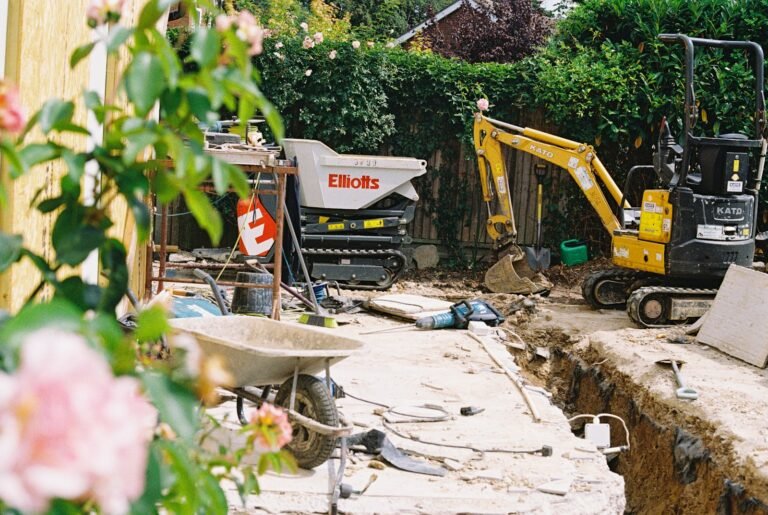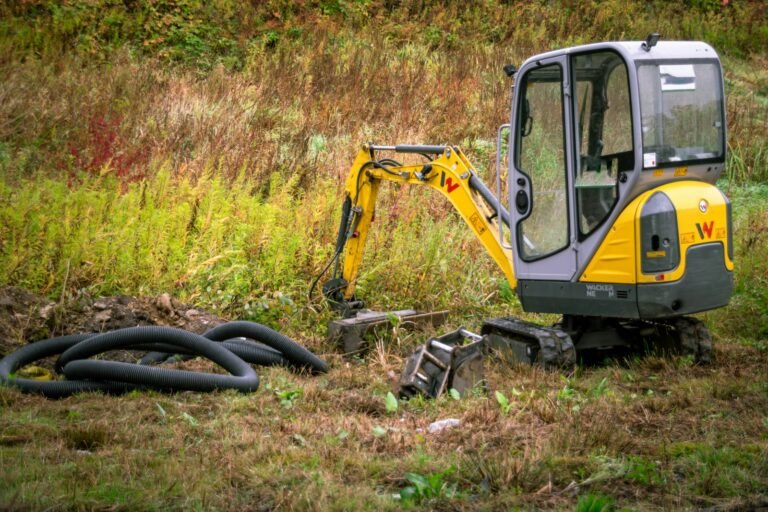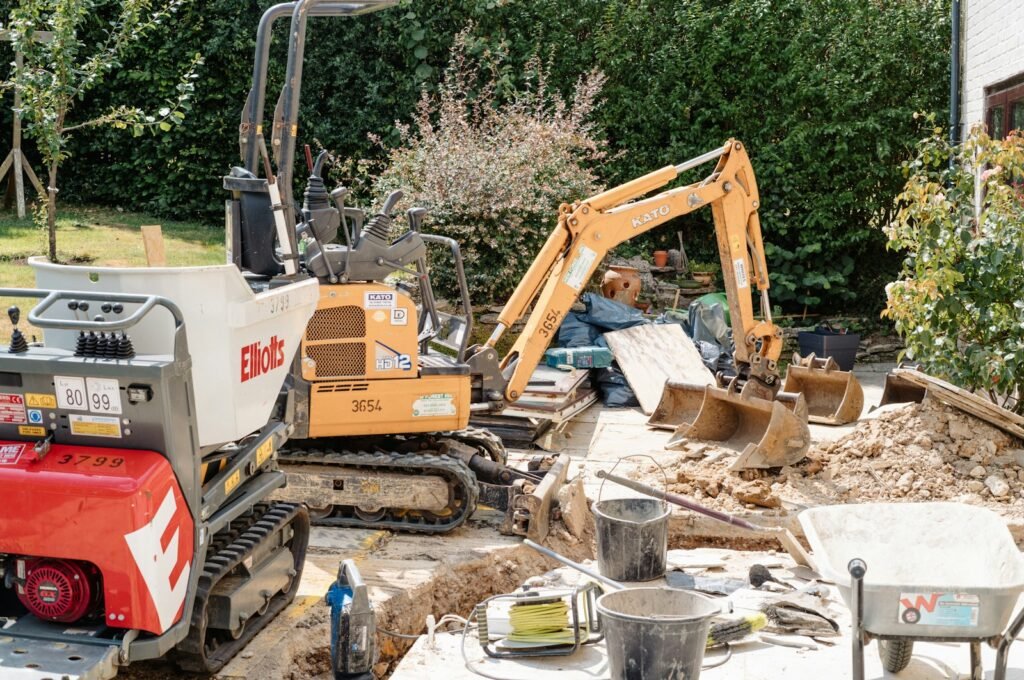
A zero tail swing excavator keeps its counterweight inside the width of its tracks as it slews, so the back end never overhangs. That makes it the safer choice beside walls, fences, roads and traffic. A conventional excavator lets the counterweight swing out past the tracks, which gives it more stability and lifting performance for its weight.

In this guide
Which to hire depends on the space around the machine, not just the size of the hole. This guide explains the terms, the trade-offs, how to measure your site, and how to choose, using the Sunward range we hire from our depot near Okehampton as the example.
What “tail swing” actually means
Every excavator carries a counterweight at the rear of its upper structure to balance the boom, arm and bucket. When the operator slews, that counterweight travels in an arc. On a conventional machine the arc extends beyond the tracks, sometimes by a fair distance. Anything standing in that arc, whether a wall, a parked car or a person, can be struck.
A zero tail swing design tucks the counterweight in so the rear stays within the track width through a full rotation. Some machines are described as “reduced” or “short” tail swing, where the overhang is smaller but not zero. Always check the spec for the exact machine you are hiring, because the labels are used loosely in the industry.
Key terms in plain English
Hire desks and spec sheets use a handful of terms that are worth knowing before you choose:
- Slew: rotating the upper structure (cab, boom and counterweight) on the tracks.
- Rear swing radius: the distance from the centre of rotation to the furthest point of the counterweight. On a zero tail machine it is no more than half the track width.
- Front swing radius: the smallest circle the boom, arm and bucket sweep when tucked in. Even zero tail machines have one, and it is often the bigger of the two.
- Boom swing or offset: on many minis the boom can pivot left or right at its base, letting the machine dig alongside a wall without the tracks being parallel to it. Ask whether the model you’re hiring has it.
- Over-side and over-front stability: excavators are generally most stable working over the front or rear, with the blade down, and least stable working over the side.
- Dozer blade: the blade on the front of the tracks, used for backfilling and levelling, and for extra stability when lowered.
Zero tail swing excavator vs conventional: side by side
| Factor | Zero tail swing | Conventional tail |
|---|---|---|
| Working beside walls and fences | Rear stays within tracks, can work close in | Needs clearance for the counterweight |
| Roadside and highway work | Less risk of slewing into a live lane | Larger exclusion zone needed |
| Over-side stability | Good, but weight is more concentrated | Usually better for its weight class |
| Lifting at reach | Check duty charts carefully | Generally higher capacity at reach |
| Operator awareness | Easier to watch the bucket, not the back | Must monitor the rear constantly |
| Cab and access | Compact, can feel tighter | Often roomier engine access |
| Exclusion zone to fence off | Smaller, easier to manage | Larger, needs more space |
When to choose zero tail swing
Pick a zero tail machine whenever there is something solid or someone working close to the sides or rear of the excavator. Typical examples across our area:
- Terraced streets and back gardens in Plymouth, Exeter and Torbay, where the machine works between a house wall and a boundary fence.
- Roadside drainage and utility trenches, where a counterweight swinging into the carriageway is a serious risk.
- Devon lanes and hedge banks, where a narrow working width leaves no space for overhang.
- Inside farm buildings and yards, around steel stanchions, gates and parked machinery.
- Next to scaffolding on extension and renovation projects.
- Sites with people on foot nearby, where a smaller slew zone is easier to fence off and manage.
When a conventional tail is the better choice
On open ground with plenty of room, a conventional machine gives you more stability for the same weight. That helps with heavy lifting at reach, deep excavation with a full bucket held far out, and breaking work where the machine is pushed hard. Bulk digging in an open field or a large pond dig are good examples.
In our fleet the Sunward SWE 20F (2.0 tonne) is a conventional mini excavator well suited to drainage and utility work, and the SWE 90UF (9 tonne) is listed as our full-size machine for bulk dig and heavy demolition. Ask us about the tail swing of a specific machine before you book if clearance is critical.
How to measure your site for tail clearance
You don’t need a spec sheet to get a good first answer. Five minutes with a tape measure and a phone camera will do:
- Mark where the machine will sit for each stage of the dig, not just the first position.
- Measure from that centre line to the nearest obstruction on each side and behind: walls, fences, scaffold, parked vehicles, trees, the kerb line.
- Note the height of anything overhead: eaves, branches, cables and phone lines. Zero tail swing doesn’t help with a raised boom.
- Measure the narrowest point on the route in. A machine that fits the dig must also get there.
- Photograph the area from the access point and from where the machine will work.
If the space beside and behind the machine is less than its rear slewing radius plus a safe margin, you need a zero tail model. If the obstruction is a public road, a footpath or a working area where people pass, lean towards zero tail even when the numbers say a conventional machine would just fit. Send the measurements and photos on WhatsApp and we’ll give you a straight answer.
Our zero tail swing excavators
Most of the Sunward range on our construction hire page is zero tail swing, which means you can usually choose the right digging power without giving up the clearance advantage.
| Model | Weight class | Good for |
|---|---|---|
| SWE 08B | 0.8t micro, zero tail swing option | Through-house access, small gardens, hand-dig replacement |
| SWE 18UF | 1.8t zero tail | Footings, drainage and landscaping in tight gardens |
| SWE 25UF | 2.5t zero tail | Extensions, longer service trenches, driveway digs |
| SWE 35UF | 3.5t zero tail | Larger groundworks, deeper drainage, small plots |
| SWE 60UF | 6t zero tail | House plots, farm yards, medium groundworks |
For more detail on two of the most popular sizes, read our Sunward SWE 18UF overview and the Sunward SWE 08B guide.
Choosing the size within the zero tail range
Once you know you need zero tail swing, the next question is size. Three things decide it. First, access: the machine has to get to the dig, so the narrowest gate or passage sets the upper limit. Second, depth and reach: deeper foundations, soakaways and drains need a longer arm, and loading over the side of a dumper or skip needs enough height. Third, volume: a micro digger is brilliant for a few cubic metres behind a terrace, but on a 50m drainage run a 2.5 or 3.5-tonne machine will finish in a fraction of the time.
As a rough guide, through-house and very narrow side access points to the SWE 08B, typical garden gates suit the 1.8 to 2.5-tonne class, and driveway or field-gate access opens up the 3.5 and 6-tonne machines. If you sit on the boundary between two sizes, the larger machine usually pays for itself if it fits, provided the ground can take it.
Four illustrative scenarios
These examples are typical of the enquiries we get. They are illustrations, not real customer jobs.
A drainage run along a terraced house wall
A 12m foul drain runs parallel to a house wall in a narrow Plymouth back garden, with a boundary fence about 2m away. The machine has to sit between the two and slew to load a dumper. A zero tail machine in the 1.8 to 2.5 tonne class is the obvious choice. A conventional machine would clip the wall or the fence as it slewed.
A ditch along a quiet Devon lane
Re-cutting a roadside ditch with traffic passing. Even a quiet lane gets the odd tractor or delivery van. A zero tail machine keeps its rear out of the carriageway, which makes traffic management simpler, though you still need signs and cones and any permission the highway authority requires.
A pond in an open paddock
Plenty of room, nothing nearby, and lots of material to shift. Here tail swing barely matters. Choose by digging capacity, reach and ground conditions, which often points to a larger conventional machine.
Cleaning out and re-levelling a cattle shed
Working inside a portal-frame building between steel stanchions, with feed barriers along one side and a low eaves height at the edges. A zero tail machine lets the operator slew without catching a stanchion, but the bigger limit is often the roof. Check the clear height with the boom raised, keep away from roof sheets and lights, and make sure the building is well ventilated if the machine is diesel.
Stability trade-offs and safe working
Zero tail swing doesn’t remove the need for care. Because the counterweight sits closer to the centre of rotation, these machines can feel lighter on the tracks when slewing a full bucket over the side, especially on a slope. Good practice includes:
- Work with the tracks square to the dig where possible, and keep the dozer blade down on the digging side for extra support.
- Keep the bucket low when slewing and travelling.
- Avoid slewing across a slope with a loaded bucket held out at full reach.
- Never lift loads unless the machine is set up for lifting. HSE’s guidance on lifting equipment and LOLER applies whenever an excavator is used to lift.
- Remember the front still swings: the boom and bucket sweep well beyond the tracks, so the exclusion zone isn’t zero.
- Check for buried services before digging, using LinesearchbeforeUdig and utility plans.
- Look up as well as down. HSE’s guidance on overhead power lines (GS6) explains safe working near lines, which cross a lot of rural Devon and Cornwall.
Delivery, access and ground protection in tight sites
The places where a zero tail swing excavator earns its keep are usually the places that are hardest to deliver to. A few things help the day go smoothly:
- Clear the route. Move bins, planters, bikes and garden furniture from the path between the delivery point and the dig.
- Protect surfaces. Rubber tracks are kind to most surfaces, but lawns, block paving and fresh concrete benefit from boards or ground protection mats, especially where the machine turns.
- Think about level changes. Steps, kerbs and garden retaining walls need a safe ramp. Never track a machine down steps.
- Tell the neighbours. On a terrace with shared access, a quick word about delivery times and parking saves a lot of friction.
- Plan the spoil exit. In a back garden, every bucketful has to leave somehow. A tracked dumper sized to the same access width keeps things moving.
Our micro and mini zero tail machines are delivered on a suitable vehicle and unloaded as close to the access as is safe. Send us photos of the frontage and route and we’ll tell you what to expect. Across most of Devon and Cornwall we can often deliver the same or next day, subject to availability, though booking 24 to 48 hours ahead is safer for a specific date.
Common mistakes when choosing
The most common mistake is choosing by weight alone. A customer asks for a 3-tonne digger, but the job is a trench along a garden wall, so the type of tail matters more than the exact tonnage. The second is forgetting the delivery route. A compact zero tail excavator still needs to get through the gate, so measure the narrowest point before you book. The third is assuming a zero tail machine can be used right up against a building without a banksman. Operators still need someone watching where visibility is poor.
A fourth is forgetting the front swing. In a tight garden, it is often the boom and bucket, not the counterweight, that hit the fence when slewing to a dumper. Plan where the dumper or spoil heap sits so the operator can load with a short slew, and use the boom offset where the machine has one.
What to tell us before you hire
To recommend the right size and tail type, we need to picture the site. The more of this you can send in your first WhatsApp, the faster and more accurate the answer:
- The job: trench, footings, soakaway, levelling, pond, and the rough depth and length.
- The narrowest width and lowest height on the route in.
- The clear space beside and behind where the machine will sit.
- Anything overhead, and any services you already know about.
- Where spoil will go: skip, grab lorry, heap on site or a dumper.
- Your dates, and whether you have a trained operator.
With that, we can usually tell you within the hour whether a zero tail swing excavator is essential, helpful or unnecessary for your job, and which size to book.
Hire periods and Flex Hire
Most zero tail hires for domestic and small commercial jobs run from a day to a week, and weekly hire is our most popular period. Contractors who need different sizes across the month can look at Flex Hire, where one flat monthly fee covers a tier of kit with swaps whenever the job changes. The Flex Hire page lists 1-tonne excavators in Tier 1 (£795 +VAT and delivery per month), 1.8 to 2-tonne machines in Tier 2 (£895), 2.5-tonne in Tier 3 (£995) and 6 and 9-tonne in Tier 4 (£1,495). Servicing is included and there’s no long-term contract.
Frequently asked questions
Is a zero tail swing excavator less stable?
Not unsafe, but generally a little less stable over the side than a conventional machine of the same weight. Within its working limits it is perfectly stable.
Are zero tail machines more expensive to hire?
Not necessarily. Hire cost depends on the model and period. WhatsApp us for a current quote on the machine you need.
Can I use a zero tail excavator next to a road?
It reduces the risk of the rear entering live traffic, which is why it’s often preferred for roadside work. You still need appropriate traffic management and any permits the highway authority requires.
Do I need a ticket to operate one?
Operators must be trained and competent, and most sites ask for a CPCS or NPORS card. See our hire FAQs for more on training and responsibilities.
Is reduced tail swing the same as zero tail swing?
No. A reduced or short tail machine still overhangs the tracks a little. If you need the rear to stay inside the tracks, ask specifically for zero tail swing.
Can a zero tail swing excavator dig right up against a wall?
It can work close, but digging alongside a wall also needs care with the foundations. Don’t undermine footings, and get advice before digging below the base of any wall.
Does zero tail swing make the machine slower?
Not in any way you would notice on a typical job. Productivity depends far more on the operator, the bucket size and how quickly spoil is taken away.
Get help choosing your excavator
Tell us about the space around your dig, the depth and the access route, and we’ll recommend a zero tail or conventional machine. WhatsApp or call 07841 036064, or use our contact form for written quotes.