If you want to know how to install artificial grass so it stays flat, drains and lasts, the answer is mostly in the groundwork. Rolling out the turf takes an afternoon. Removing the old lawn, digging to the right depth, fixing a solid edge and compacting a proper sub-base is where the job is won or lost. This guide walks through each stage, the machines that save your back, and the mistakes we see on Devon and Cornwall gardens, especially on heavy clay.

In this guide
This is general guidance. Always follow the installation instructions from your turf supplier, as pile heights, infill rates and warranty conditions vary between products.
How to install artificial grass: the job at a glance
Every good installation follows the same order. Skipping a stage, or doing two of them badly, is what causes the dips, puddles and lifting edges that make a fake lawn look fake.
- Plan and measure the area, the roll direction and where the joins will fall.
- Check for services such as cables, pipes and drains before you dig.
- Remove the existing turf and roots.
- Dig out to depth, usually about 75 to 100mm below finished level.
- Fix the edging (timber, sleepers, steel or a concrete-haunched kerb).
- Lay and compact the sub-base of Type 1 or crushed granite.
- Lay and compact the laying course of granite dust or sharp sand, then screed it level.
- Put down a weed membrane.
- Roll out the turf and let it settle.
- Make the joins with joining tape and adhesive.
- Trim and fix the perimeter.
- Spread the infill (if your product needs it) and brush the pile up.
Learning how to install artificial grass properly is mostly learning this order. On a typical back garden, the groundwork is two to three days and the turf itself is the last day, so plan your hire around that.
Planning: measure, roll direction and timing
Artificial grass usually comes in rolls 2m or 4m wide. Measure the area at its longest and widest points, sketch it on paper and work out how the rolls fit with the fewest joins. Add a margin of 100 to 150mm on each edge for trimming.
Decide which way the pile will lean. Most installers point the pile towards the house or the main viewpoint, because the grass looks fuller from that side. Every roll must run in the same direction, or the joins will show as a change in colour.
Timing matters more in the South West than many people expect. Clay soils across much of mid and north Devon, and the culm measures around Okehampton and Holsworthy, turn sticky and smeared when wet. A dry spell in late spring or late summer is ideal. If you dig out in a wet week, you can end up compacting mud rather than stone.
Check for services before you dig
Even a 100mm dig can reach shallow cables for garden lighting, outside sockets or a shed supply, and older properties sometimes have shallow drains or water pipes. Find out what runs under the lawn before you start. For utility assets, you can submit a free enquiry through LinesearchbeforeUdig, which shows which member asset owners have pipes or cables near your site. For your own private cables and pipes, check with whoever installed them.
Removing the old lawn
There are two practical ways to strip turf. The first is a turf cutter, a walk-behind machine that slices the grass off in neat strips at a set depth. We don’t list turf cutters in our fleet, so ask us and we’ll tell you what’s available or point you in the right direction.
The second, usually quicker for a full dig-out, is a small excavator with a wide, flat-edged bucket, which strips the turf and digs the formation in one pass. Ask us about bucket options when you book.
For most gardens, the Sunward SWE 08B 0.8 tonne mini excavator is the natural choice. It is the smallest excavator in our fleet and suits side passages and gardens where a larger machine would cause damage. Tell us the narrowest point of your access when you enquire, so we can confirm it fits.
Dealing with the spoil
Spoil bulks up when dug, so the loose volume is larger than the hole. Plan where it goes before you start. Options include reusing it to build up raised beds or low areas elsewhere, or removing it from site. For disposal, ask us and we’ll point you in the right direction.
Digging to the right depth
The finished surface of the artificial grass normally sits level with, or just below, the surrounding patio or path. Work backwards from that level. A common build-up for domestic lawns is:
| Layer | Typical compacted depth | Purpose |
|---|---|---|
| Artificial grass (backing only) | Pile sits above finished level | The visible surface |
| Weed membrane | Negligible | Stops weeds growing up through the base |
| Laying course (granite dust or sharp sand) | About 15 to 25mm | Fine, smooth bed the backing sits on |
| Sub-base (Type 1 or crushed granite) | About 50 to 75mm | Load-bearing, free-draining layer |
| Formation (dug ground) | Firm, trimmed to falls | Supports everything above |
That gives a total dig of about 75 to 100mm. On soft or heavy clay ground, many installers go deeper, adding more sub-base so the surface spreads load and drains better. If the ground is spongy when you walk on it after digging, that is a sign you need more depth or a different approach.
Trim the formation to follow the falls you want. Artificial grass drains through holes in its backing, but on a dead-flat clay base the water has nowhere to go. A gentle fall away from the house, towards a border or drain, helps a lot.
Edging: what holds the lawn in place
The edge is what you fix the turf to and what stops the sub-base spreading. It is worth getting right, because a weak edge is the most common cause of the grass lifting or creeping over time.
- Treated timber boards on pegs: cheap and easy to nail the turf to, but it rots eventually in wet ground.
- Sleepers: good for raised lawns or where the lawn meets a bed.
- Steel or aluminium edging: neat, hard-wearing and good for curves. Usually staked into the ground.
- Existing paths or patios: a solid edge already. You can butt the turf up to the paving and fix it with adhesive.
- Kerb or edging blocks haunched in concrete: very durable. A small mixer such as the Altrad Belle Mini Mix 150 on our hand tools page handles the small batches of concrete for haunching.
Set the top of the edge at the level of the finished laying course, so the turf backing sits flush with it. Check the level along the whole length with a string line before the sub-base goes in.
Sub-base and compaction
The sub-base is the most important layer. It carries the load, resists dips and drains water away. The two common materials are MOT Type 1 crushed stone and crushed granite. Type 1 compacts very hard. Some installers prefer a more open, free-draining stone on clay so water can move through the layer rather than sitting on top of it. Ask your supplier what they recommend for your ground.
Spread the stone in layers and compact each one. A thick layer compacted in one go stays loose at the bottom, settles later and shows as dips.
Choosing a plate compactor
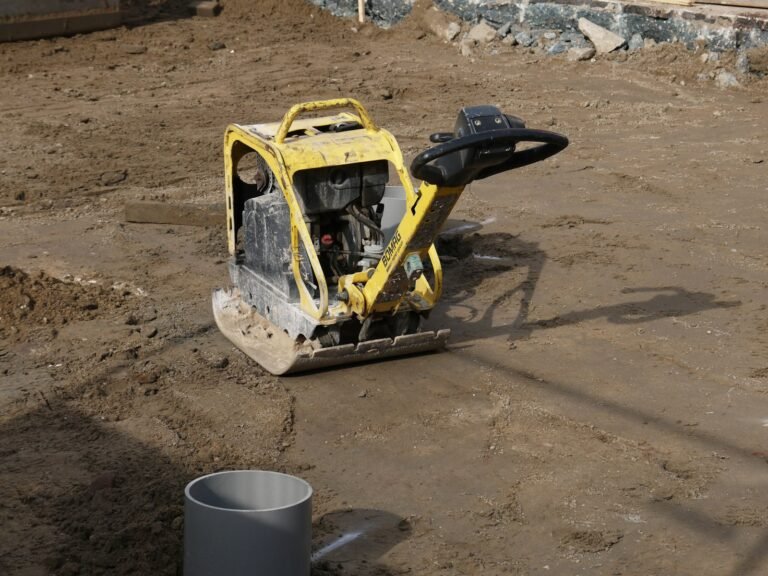
A forward plate compactor is the right tool for a domestic lawn base. On our construction equipment page you’ll find three Weber MT forward plates:
| Weber MT plate | Listed as | Best for |
|---|---|---|
| CF 1-III Hd | Light duty forward plate | Laying course and small, awkward areas |
| CF 2-II Hd | Mid-range, path and driveway work | Most garden lawn sub-bases |
| CF 3-II Hd | Heavy duty, sub-base compaction | Larger lawns, deeper sub-bases |
Make several overlapping passes over each layer. Slightly damp stone compacts better than bone-dry stone, so a light spray from a hose helps in hot weather.
Vibrating plates expose the operator to hand-arm vibration, so take regular breaks and share the work if you can. HSE explains the duties around hand-arm vibration at work if you’re employing people or working as a contractor.
Laying course and membrane
On top of the compacted sub-base goes a thinner laying course, usually granite dust (often sold as grano dust) or sharp sand. Granite dust is popular because it compacts firmly, holds its shape and gives a very smooth bed. Sharp sand is easier to find but can move about more under foot.
Spread the laying course, screed it with a straight board run along the edging, then plate it. Fill low spots and plate again until it is smooth and firm, because any lump left here shows through the turf.
Where the weed membrane goes
Some installers lay the membrane on the dug formation, under the sub-base. Most lay it on top of the laying course, just under the grass, where it blocks weeds that germinate in the dust. Overlap sheets by about 100mm. Don’t lay membrane where it would stop water draining on a clay base without checking with your supplier.
Laying, joining and finishing the turf
Roll the turf out and leave it a few hours, ideally in the sun, so the backing relaxes and creases drop out.
- Position the rolls with the pile running the same way on every piece.
- Cut the factory edges along the seams. Most installers trim off the outer two or three rows of stitches so the joins line up neatly.
- Lay joining tape shiny side down under the seam, then apply adhesive to the tape.
- Fold the turf edges down onto the adhesive, leaving a tiny gap so the fibres don’t get trapped. Press the seam down firmly and weight it while the glue sets.
- Trim the perimeter with a sharp knife, cutting from the back where you can.
- Fix the edges with galvanised nails or pins into timber edging, or with adhesive against paving.
Infill and brushing
Many products are designed for an infill of kiln-dried silica sand, which weighs the turf down, supports the fibres and helps protect the backing. Others are designed to be used without infill. Follow your supplier’s instructions on the type and rate.
Spread infill a little at a time, then brush it in with a stiff broom against the direction of the pile. This lifts the fibres and works the sand down to the backing. A power brush makes this quicker on larger lawns. Ask us if you need one and we’ll tell you what’s available.
Moving materials around the garden
Spoil comes out, stone and dust go in, and much of it travels through a side passage. Doing it all by wheelbarrow is slow, hard work.
- Hyundai 500kg tracked dumper: built for narrow access sites, and tracks spread the load on lawns and soft ground.
- HG 1000 electric wheeled dumper: a 1000kg payload, electric, so quiet near neighbours. Better on firm, level routes.
- Tracspider 1000kg electric tracked carrier: low ground pressure and zero emissions. The Tracspider Elektro Joe tipping transporter works indoors and out, so it can even go through a garage.
- Dragon LT1000 dumpy bag lifter: lifts bulk bags of stone or dust up to 1000kg, useful when a merchant drops bags on the drive. You’ll find it on our sports and landscaping page.
Lay boards over paving you’re keeping, and check the route has no steps or steep ramps before the dumper arrives.
Worked example: a 50m² back lawn on clay
To show how the quantities add up, take an illustrative back garden near Exeter with a 10m x 5m lawn, a 1m wide side passage and heavy clay soil.
- Dig-out: 50m² at 100mm deep is 5m³ of soil in the ground. Once dug and bulked up, expect noticeably more than that in loose spoil.
- Sub-base: at 75mm compacted, roughly 3.75m³ of stone. Stone is sold by the tonne, so ask your merchant how many tonnes that is for the material you choose.
- Laying course: about 20mm, so roughly 1m³ of granite dust before compaction.
- Turf: two 4m-wide rolls cut to about 10.3m, giving one long join down the middle.
A sensible kit for that job would be the Sunward SWE 08B to strip and dig, a Hyundai 500kg tracked dumper for the side passage, and a Weber MT CF 2-II Hd plate. On clay, add a gentle fall towards a border and extra sub-base in the lowest corner.
Drainage on Devon and Cornwall clay
Clay is the main reason fake lawns fail in the South West, and any plan for how to install artificial grass here has to deal with it. If the base sits in a dish, rain collects and the lawn feels soft and smells stale. A few steps help:
- Build in a fall so water runs towards a border, gravel strip or existing drain.
- Use a free-draining sub-base and consider increasing its depth at the low end.
- Check how water behaves after rain before you start. If the lawn already floods, artificial grass alone won’t fix it.
- Where ponding is severe, a land drain or soakaway may be needed. Our landscaping range includes the Mak Brent MAK 40 wheeled trencher for narrow drainage runs, and a mini digger handles larger trenches.
Granite-based soils on Dartmoor’s edges and in parts of Cornwall drain better, but bring stone close to the surface, so the digging is slower.
Artificial grass for dogs and pets
If dogs will use the lawn, plan for it at the groundwork stage. The base needs to drain quickly so urine washes through rather than sitting. Many installers prefer granite dust over sharp sand in the laying course for pet lawns, as sand can hold odours.
Some turf products are made for pets, with high-drainage backings or no sand infill. Check with your supplier, and plan to rinse the lawn regularly with a hose.
Common mistakes when learning how to install artificial grass
- Laying on soil or on old turf: it will sink, ripple and grow weeds.
- Compacting the sub-base in one thick layer: the bottom stays loose and settles later.
- A bumpy laying course: every lump shows through the turf.
- Mixing pile directions: the joins look like two different shades of green.
- Skimping on adhesive at joins: seams open up within a season.
- Weak edges: the lawn creeps and the edges lift.
- Ignoring drainage on clay: puddles and smells.
Equipment and materials checklist
Before the first machine arrives, make sure you have the materials ordered and the kit booked in the right sequence.
- Mini digger (or turf cutter), plus a dumper or carrier for spoil and stone
- Forward plate compactor
- Edging materials, pegs, galvanised nails or screws
- Type 1 or crushed granite sub-base
- Granite dust or sharp sand laying course
- Weed membrane
- Artificial grass rolls with trimming margin
- Joining tape and adhesive, a sharp knife and spare blades
- Kiln-dried sand infill (if required) and a stiff broom
- String line, level, rake, boards, gloves, boots, eye and hearing protection
Most hirers keep the digger and dumper for the first few days and the plate for the whole job. Hire is self-drive unless otherwise agreed, so make sure whoever operates the machines is competent to do so. Insurance isn’t automatically included; we refer customers to our partner insurance4plant.co.uk for plant hire cover.
Frequently asked questions
How deep should I dig for artificial grass?
For a domestic lawn, about 75 to 100mm below finished level is common. That allows roughly 50 to 75mm of compacted sub-base plus a 15 to 25mm laying course. On soft clay ground, digging deeper and adding more sub-base gives a firmer, better-draining result.
Can I lay artificial grass straight onto soil?
You can, but it rarely lasts. Soil moves, settles and holds water, so the lawn develops dips and weeds come through. A compacted stone base is what makes the surface flat and free-draining.
Do I need a plate compactor or can I use a roller?
A vibrating plate compactor is the standard tool. A garden roller won’t consolidate stone properly. A forward plate such as the Weber MT CF 2-II Hd suits most garden sub-bases, and you can use it again on the laying course.
Should I use sharp sand or granite dust?
Both work as a laying course. Granite dust compacts firmer and holds its shape better, and many installers prefer it for pet lawns. Sharp sand is widely available and easier to rake. Follow your turf supplier’s recommendation.
How long does it take to install artificial grass?
An average back garden lawn often takes two to four days for one or two people. Most of that time is groundwork. Access, ground conditions and how much spoil needs to leave site make the biggest difference.
What size digger do I need to remove a lawn?
For most gardens, a micro excavator around 0.8 tonnes is enough, and it suits narrow side access. Larger lawns with good access can use a bigger machine. Tell us the narrowest point on your route and the area and we’ll suggest the right size.
When is the best time of year to lay artificial grass in Devon?
A settled dry spell is best, which often means late spring or late summer. Wet clay smears and won’t compact, so avoid digging out in a run of rain if you can.
Book your groundwork kit
Now you know how to install artificial grass the right way, the next step is booking the machines that make the groundwork quick. We don’t take online bookings. WhatsApp or call us on 07841 036064 (Monday to Friday, 7:30am to 5:30pm) with the machines you need, your site postcode, the dates and details of your access, including the narrowest point. We aim to reply to WhatsApp within the hour in business hours.
For written quotes or several machines, use our contact page. We deliver from our depot near Okehampton across Devon, Cornwall, Somerset and Dorset, with Day 1 delivery available.