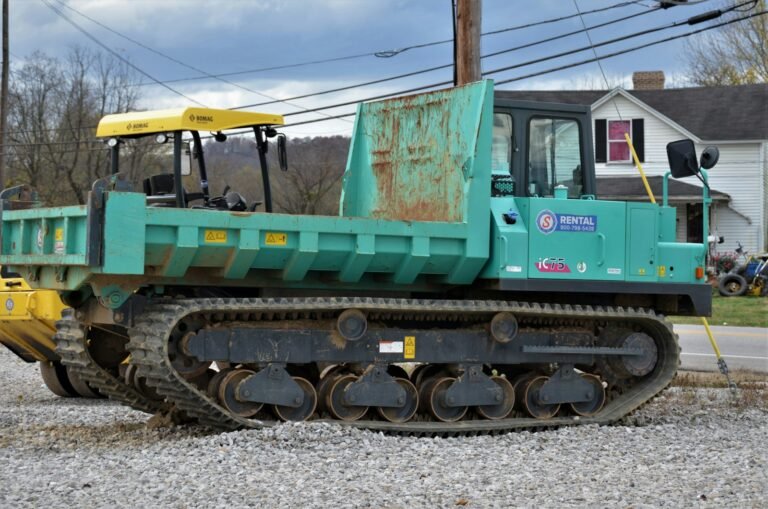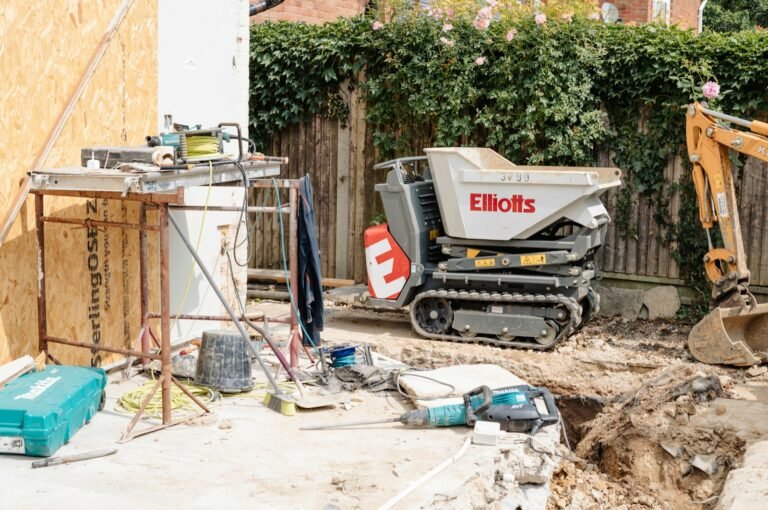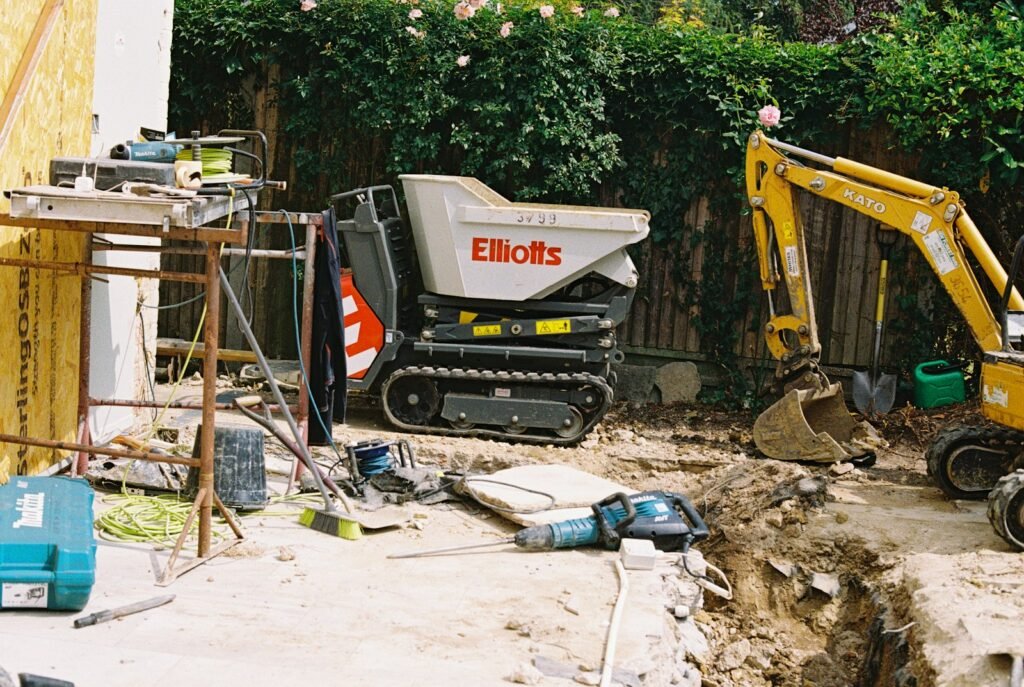
Mini dumper hire makes sense on any job where a wheelbarrow would take days: digging out a back garden, moving soil and stone through a side passage, or clearing rubble from behind a house. The right machine depends on your access, the ground and how much you’re moving. This guide compares our tracked, wheeled and electric mini dumpers, plus a tracked carrier alternative, and explains how to pick one for garden and back-of-house work in Devon, Cornwall, Somerset and Dorset.

In this guide
It is aimed at homeowners, landscapers and small builders who need to shift material in tight spaces, rather than large sites with open haul roads.
What counts as a mini dumper?
A mini dumper is a compact, usually pedestrian-operated machine with a skip or tipping body on tracks or wheels. You walk behind or alongside it and control it with levers on a handle, rather than sitting in a cab.
They are built for narrow access: garden gates, passages between houses, paths and doorways. Payloads are measured in hundreds of kilograms rather than tonnes, but a mini dumper moves many barrow loads in one trip, without the strain on your back.
Larger site dumpers, with a seat and a front skip, are a different class of machine for open sites. If you need one of those, ask us and we’ll tell you what’s available or point you in the right direction.
Our mini dumpers compared
We hire three dumpers and two electric tracked carriers that suit garden and back-of-house jobs. All are listed on our construction equipment page.
| Machine | Drive | Power | Payload | Best for |
|---|---|---|---|---|
| Hyundai 500kg tracked dumper | Tracks | Engine | 500kg | Narrow gardens, side passages, soft lawns |
| Mechbadger tracked dumper | Tracks | Engine | Ask us | Rough ground, slopes, longer runs |
| HG 1000 wheeled dumper | Wheels | Electric | 1,000kg | Firm surfaces, yards, paved routes, quiet or indoor work |
| Tracspider 1,000kg bed carrier | Tracks | Electric | 1,000kg | Soft ground, slopes, sensitive surfaces |
| Tracspider Elektro Joe | Tracks | Electric | Ask us | Lawns, estates, events, indoor use |
We don’t list exact widths here because they change with configuration. Before you book, ask us for the overall width of the machine you’re considering and compare it with your measured access.
Hyundai 500kg tracked
The smallest of our dumpers and the one most people need for a back garden. Its compact size suits side passages and garden gates, and the tracks keep it moving on soft lawns and soil. At 500kg per trip, it carries roughly what eight to ten heavy barrow loads would, depending on the material.
Mechbadger tracked
A tough, manoeuvrable tracked dumper for rough terrain. It suits sloping gardens, farmyards, paddocks and longer runs where you want grip and a bit more capability than the smallest machine.
HG 1000 electric wheeled
A 1,000kg electric dumper for firm surfaces. It’s ideal for yards, paved drives, warehouse floors and building sites with hard standing. With no fumes and low noise, it suits early starts and indoor work.
Tracspider carriers
Not dumpers in the strict sense, but electric tracked carriers that do a similar job with very low ground pressure. They’re the choice for golf courses, fine lawns, estates and events where ground damage matters.
Mini dumper hire: tracked, wheeled or electric?
The choice comes down to three questions: what is the ground like, what’s the route, and does noise or fumes matter?
Tracked
Tracks spread the weight and grip on mud, grass, gravel and slopes. On a typical South West garden with clay soil after rain, tracks keep working where wheels would spin and rut. The Hyundai 500kg is the compact choice for narrow access, and the Mechbadger suits rougher ground.
The trade-off is speed. Tracked dumpers are slower on firm, long runs, and steel or rubber tracks can mark soft surfaces if you turn sharply on them.
In the South West, wet ground is the norm from late autumn to spring. Clay soils in much of Devon and the Culm country of north Devon and north-east Cornwall stay soft for weeks after heavy rain. If your job falls in that window, tracks are usually the safer choice even on a short route.
Wheeled
Wheels are quicker and smoother on firm, level ground: concrete, tarmac, block paving and compacted paths. The HG 1000 carries up to 1,000kg, double the Hyundai’s payload, so fewer trips on a long, firm route.
On wet grass or soft soil, wheels lose grip and can sink. If the route crosses a lawn, board it or choose tracks.
Electric
Electric machines produce no exhaust fumes and run quietly. That opens up work indoors, in garages, under cover, inside barns and stables, and in residential streets where noise causes complaints. The HG 1000 dumper and both Tracspider carriers are electric.
Plan charging. Ask us about run time for your job and make sure you have a suitable power supply where the machine will be kept overnight.
Measure your access first
The most common problem with any mini dumper hire is a machine that won’t fit. Measure before you book, and send us the numbers and photos.
- Narrowest width: gates, gateposts, passages, doorways, bins and downpipes that stick out. Measure at the tightest point.
- Height: arches, carports, low branches and overhead obstructions.
- Steps and kerbs: count them and measure their height. You’ll need ramps.
- Turns: a tight corner can be harder than a narrow straight. Note any 90-degree turns.
- Slopes: note any steep sections along the route, particularly across a slope.
- Surface: grass, gravel, paving, decking or soft soil.
- Distance: how far from the dig to the skip or tipping point.
Leave some clearance either side. A machine that fits with a few millimetres to spare is slow and stressful to drive and easy to scrape against walls.
Tipping: skips, bodies and what to ask
Mini dumpers differ in how they tip. Some tip forwards at ground level, some raise the skip before tipping (often called high-tip), and carriers may have a tipping bed. That matters for where the load goes.
- Tipping onto the ground: for a spoil heap or spreading material across a garden, a ground-level tip is fine.
- Tipping into a skip: you need to lift the load over the skip side. A high-tip dumper, a ramp up to the skip or a digger to transfer the spoil are the usual options.
- Spreading: for topsoil or gravel, a dumper that tips cleanly and progressively helps.
Tip features vary by model and configuration, so ask us which of our machines suits your tipping point. Tell us if you’ll be tipping into a skip and how high its side is.
Loading from a mini digger
Most garden jobs pair a mini dumper with a mini digger. The Sunward SWE 08B fits narrow access and pairs well with the Hyundai 500kg. The SWE 18UF, with zero tail swing, suits slightly wider gardens. Read about the Sunward SWE 08B for tight jobs.
- Park the dumper on firm, level ground within easy reach of the digger arm.
- Keep the dumper operator clear of the skip and the slew area while loading.
- Load evenly and keep the load below the skip’s top edge.
- Avoid dropping heavy stone from height, which can damage the skip and unbalance the dumper.
- Agree hand signals between the digger and dumper operators.
Matching the bucket size to the skip keeps the cycle quick. Two or three buckets to fill a 500kg dumper is a good rhythm.
Ramps, slopes and kerbs
Steps and slopes cause more problems than any other part of the route. A loaded dumper is top-heavy and can tip if it goes over a kerb at an angle or crosses a slope.
- Ramps: use strong, wide ramps rated for the loaded weight, secured so they can’t slip. Keep them as gentle as possible.
- Go straight: drive up and down slopes, not across them.
- Load direction: follow the manufacturer’s guidance on which way to face on a slope with a loaded skip.
- Kerbs: approach square on. Don’t try to climb a kerb or step diagonally.
- Wet surfaces: wet boards, paving and grass reduce grip. Slow down.
HSE’s guidance on dumpers says to plan work so dumpers only operate on gradients within their safe working capacity, and to check those limits with the manufacturer.
Indoor and quiet work with electric
An electric mini dumper or carrier is often the only sensible choice for indoor work. With no exhaust fumes, it can work in barns, stables, garages, glasshouses and under covered areas.
It also helps on jobs where noise matters: terraced streets, early starts, schools and care homes, or events. The Tracspider Elektro Joe is a quiet electric tracked transporter with a tipping body, built for indoor and outdoor use with low ground pressure.
Check floor loading, doorway widths and any ramps for indoor jobs. Make sure floors can take the weight of a loaded machine.
Mini dumper hire safety
HSE reports that over 60% of dumper deaths involve the driver being crushed when the machine overturns, and most other deaths involve pedestrians struck by moving dumpers. Pedestrian mini dumpers carry different risks, but the same principles apply.
- Make sure the operator is trained and competent on that type of dumper. Read the operator’s manual before starting.
- Do a daily check: tracks or tyres, controls, brakes, tipping mechanism, leaks and the emergency stop.
- Distribute loads evenly, don’t overfill and keep your view clear.
- Keep pedestrians, especially children and pets, away from the route and the tipping area.
- Use stop blocks at a safe distance from the edge of excavations when tipping.
- Never carry passengers.
- Switch off and secure the machine when you’re not using it.
Hire is self-drive unless agreed otherwise, so the hirer is responsible for safe use. Insurance isn’t included automatically. Many customers arrange cover through insurance4plant.co.uk.
Planning the route and the tip point
A little planning before the machine arrives makes the job much quicker.
- Choose the tip point: a skip, a grab lorry or a spoil heap. Check skip or road permission if it’s on the highway.
- Protect surfaces: lay boards over lawns and paving. Tracks can mark block paving if you turn on it.
- Clear the route: move bins, plants and garden furniture, and tie back branches.
- Plan the order: dig and remove spoil from the far end first, so you’re not driving over freshly dug or finished ground.
- Bring materials in: the same dumper can bring in stone, sand and Type 1 for the next stage.
When you message us about mini dumper hire, include the job, the narrowest access width, any steps or slopes, the ground surface, where you’ll tip and your dates. Photos of the route from start to finish are the quickest way for us to recommend the right machine.
Think about bulking too. Dug soil takes up more space than it did in the ground, often by a quarter or more. Plan skip sizes and trips accordingly.
Worked example: a back garden dig-out
This is an illustrative scenario, not a customer story. A semi-detached house has a 15m back garden being dug out for a patio and lawn re-level. Access is a 1m side passage with two steps down to the garden.
- The owner measures the passage at 1m at its narrowest and sends photos.
- We recommend a Hyundai 500kg tracked dumper and an SWE 08B mini digger, with ramps for the steps.
- A skip is booked on the drive at the front, with the route boarded over the lawn.
- The digger loads the dumper at the back, and the dumper runs up the passage, over the ramps to the skip.
- Once the dig-out is done, the dumper brings in Type 1 for the patio sub-base.
A job like this often suits a weekly hire, giving time for the dig-out and the start of the sub-base without rushing.
A second scenario: rubble out of a terraced house
Again illustrative. A terraced house is having a kitchen and old outhouse stripped out, with brick, plaster and concrete to clear through the house to a skip at the front. There’s no side access, and the route crosses a hallway floor.
An electric HG 1000 dumper on boarded floors, or a Tracspider carrier where the route is softer, moves the rubble without fumes inside the house. The skip is placed on the road with permission from the highway authority. The floors are protected with boards and the dumper’s load is kept low so it doesn’t hit door frames. Heavy concrete is broken into manageable pieces before loading.
Hire periods and Flex Hire
Most mini dumper hire is daily or weekly. A small clear-out may only need a day. A full garden rebuild usually takes a week or more.
Landscapers who use a dumper every week may save with Flex Hire. It’s one flat monthly fee, with swaps any time. Tier 1, covering compact kit and everyday tools, is £795 +VAT & delivery per month, with servicing, collection and redelivery included, a 10% rebate and no long-term contract.
Delivery and collection
We deliver from our depot near Okehampton across Devon, Cornwall, Somerset and Dorset, with same-day delivery often possible in Devon and Cornwall. Send the machine, site postcode, dates and access details.
On delivery we’ll run through the controls and daily checks. Before each day’s work, check:
- Tracks or tyres for damage and correct tension or pressure.
- Fuel or charge level, plus oil and hydraulic fluid on engine models.
- Controls, brakes and the emergency stop work correctly.
- The skip or bed tips and locks properly.
- No leaks, loose parts or damaged guards.
If anything looks wrong, stop and call or WhatsApp us. We’ll assess the problem and arrange repair or replacement as quickly as we can.
Make sure someone is on site, the machine can be unloaded safely and there’s somewhere secure to keep it. At collection, have the machine clean, accessible and parked where the vehicle can load it.
Common mistakes with mini dumpers
- Not measuring access, so the dumper doesn’t fit.
- Choosing wheels for a wet lawn route.
- Overfilling the skip, so the dumper becomes unstable and spills.
- Crossing slopes instead of driving straight up or down.
- Using weak or short ramps over steps.
- Forgetting skip permission on the highway.
- Not planning charging for an electric machine.
Frequently asked questions
How wide is a mini dumper?
Widths vary by model and configuration. Ask us for the width of the machine you’re considering and compare it with your narrowest access point.
Can I use a mini dumper on grass?
Yes. A tracked dumper or tracked carrier is best on grass, particularly when wet. Lay boards on a regular route to protect the lawn.
Do I need training to use a mini dumper?
Operators should be trained and competent. We’ll show you the controls on delivery, but read the manual and practise before working near people or excavations.
Can a mini dumper tip into a skip?
It depends on the machine and the skip height. Some dumpers have a high-tip feature, or you can use a ramp or a digger. Ask us which suits your job.
Is mini dumper hire available for one day?
Yes. The minimum hire is usually one day. WhatsApp us for a current quote.
Can I use an electric dumper indoors?
Yes. Electric machines produce no exhaust fumes, so they suit barns, garages and other covered spaces. Check floor loading and access first.
Book mini dumper hire
Send us the job, site postcode, dates and access measurements on WhatsApp or call 07841 036064, Monday to Friday, 7:30am to 5:30pm. We aim to reply within the hour during business hours. For written quotes or accounts, use our contact page.