We provide plant hire Honiton and East Devon contractors, estates and homeowners use for groundworks, drainage, fencing, land management and landscaping. Mini diggers, tracked dumpers, compaction kit, tractors and turf equipment can be delivered to Honiton, Axminster, Ottery St Mary, Sidmouth and the Blackdown Hills villages. WhatsApp us the machine, your postcode and dates and we will confirm what is available and how we will get it to you.

In this guide
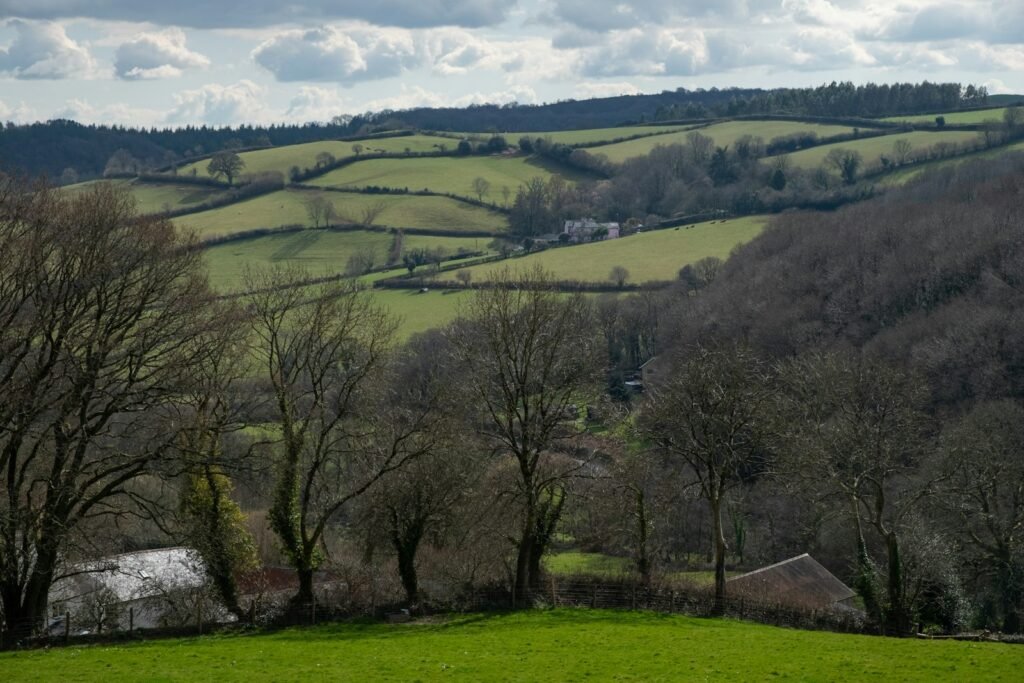
East Devon has its own challenges: flinty clay on the hilltops, wet spring lines on the slopes, steep lanes and protected landscapes all around. This guide covers what to expect and which machines cope best.
Plant hire Honiton: where we deliver and how
The A30 runs from our side of Dartmoor straight past Exeter to Honiton, which makes the town one of the more direct deliveries we do. From Honiton, the A35 takes us east to Axminster and on towards the Dorset border, the A375 heads south to Sidmouth, and the A303 climbs north-east over the Blackdowns towards Ilminster.
The main roads are the easy part. Many farms and houses in the Blackdown Hills are reached by narrow lanes with high banks, tight bends and steep gradients. If your site is like that, tell us when you book. A 1.8 tonne machine on a compact plant trailer will get in where a lorry carrying a 6 tonne excavator will not, and we would rather plan for that than turn back at the bottom of your lane.
We cover the coast as well: Sidmouth, Seaton, Beer and Budleigh Salterton all fall within our East Devon area. Coastal jobs tend to be garden landscaping, driveways and drainage on sloping plots, where a zero tail swing excavator and a narrow tracked dumper are the usual pairing. Parking for a delivery lorry is often the tightest constraint in the older streets, so let us know if there are restrictions outside.
Flint, clay and spring lines in the Blackdown Hills
The geology around Honiton is different from the red soils of Mid Devon, and it affects which machine you pick and how the job goes.
Clay-with-flints on the plateau
The flat tops of the Blackdown Hills are capped with a sticky clay full of hard flints. Flints are tough on bucket teeth and edges and can make trench sides ragged. Expect slower progress than in clean soil, and allow for a toothed digging bucket rather than a smooth grading bucket for the first cut.
Greensand slopes and springs
Below the clay cap is sandier greensand, and where the two meet water often comes out as springs. It is why so many Blackdown fields are wet halfway down the slope even in a dry spell. Drainage runs, soakaways and field drains are common jobs here, and a trench can start running with water the moment you cut into the spring line.
Valley floors
The Otter, Axe and Yarty valleys carry softer, wetter alluvium. Tracked kit with low ground pressure, such as a Mechbadger tracked dumper or the Tracspider electric carrier, causes far less damage than wheeled machines on these meadows.
Working in a protected landscape
Much of the land north of Honiton lies in the Blackdown Hills National Landscape, and the coast to the south is in the East Devon National Landscape. These designations (formerly Areas of Outstanding Natural Beauty) can affect planning decisions, so check with the local planning authority before starting anything that needs permission.
From a hire point of view, the practical side is about leaving a light footprint:
- Choose tracked machines on soft ground to reduce rutting on grass and verges.
- Use battery-powered kit where noise matters. The CRAMER electric mowers, strimmers and blowers, and the Tracspider electric carrier, are quiet enough for early starts near houses.
- Lay out a route for dumpers before you start, so you are not cutting a new track across a field every trip.
- Strip and store topsoil and turf separately, then reinstate as you go.
- Before digging anywhere, check for buried services. LinesearchbeforeUdig is a free service for checking many utility networks, alongside plans from your local providers.
Estate, parkland and equestrian work
East Devon has many rural estates, larger gardens and equestrian yards, and a lot of our plant hire Honiton work supports ongoing land management rather than building. Common jobs and kit include:
| Job | Machine |
|---|---|
| Topping paddocks and rough grass | Captain 26HP compact tractor with Conagri MEGA 1.45m flail mower |
| Larger fields and verges | John Deere 6155R with SaMASZ Mammut 2.8m flail topper |
| Fence lines and gateposts | Hyundai pedestrian post hole borer, Sunward SWE 08B for larger posts |
| Clearing scrub and fallen timber | GL&D 5.5″ tracked or 6.5″ towable chipper, Ifor Williams log splitter |
| Arena and yard drainage | Mak Brent MAK 60 tracked trencher, Sunward SWE 25UF excavator |
| Moving feed, bags and bales | Venieri 1.63D pivot loader or Dragon LT1000 dumpy bag lifter |
The turf, mowing and chipping kit is on our sports and landscaping equipment hire page, and the bigger tractors and toppers are under agricultural machinery hire.
A typical job: draining a wet Blackdown field
A spring-fed wet patch halfway down a field is one of the most common problems we get asked about in this area. Every site is different, and larger schemes may need a drainage specialist, but a straightforward herringbone drain usually runs like this:
- Walk the field after rain and mark where water appears and where it can be taken to an existing ditch or watercourse.
- Check for services and any consent needed for discharging into a watercourse.
- Cut the main carrier trench with a 2.5 or 3.5 tonne excavator, working uphill from the outfall.
- Cut lateral runs into the wet area with the tracked trencher, which is quicker and neater for long narrow trenches.
- Lay pipe on a stone bed, backfill with clean stone and cap with topsoil.
- Move stone with a tracked dumper along a single route to avoid churning the field.
The excavators, dumpers and compaction kit for this are on our construction equipment hire page.
Worked example: a terraced garden on a Sidmouth slope
This is an illustrative scenario, not a real job, but it reflects the kind of coastal project we are often asked about. Imagine a house on one of the steep roads above Sidmouth with a sloping back garden, and the owner wants two level terraces, a retaining wall, a patio and a land drain to stop water pooling against the house.
- Access first. The only way in is a side passage just over a metre wide, so a Sunward SWE 08B micro excavator and a Hyundai 500kg tracked dumper are the realistic choice. Both can travel on a small plant trailer.
- Dig from the top down. Working from the highest terrace down keeps the machine on solid ground and lets spoil travel downhill to wherever it is leaving the site.
- Retaining wall footings. A retaining wall of any real height needs proper design. Get an engineer’s or builder’s specification before digging, and keep the trench open for as short a time as possible.
- Land drain. A perforated pipe in clean stone along the back of the wall and the house, falling to a suitable outlet, takes spring water away from both.
- Patio sub-base. Compact the stone in layers with a Weber MT CF 2-II Hd plate. If the patio is block paving, finish with the VPR 450 roller.
A job like this usually suits a week of hire for the digger and dumper, with the plate kept on for a few extra days while the paving goes down. Tell us how much spoil is leaving the site, because on a steep street skip or grab lorry access is often the real bottleneck.
Digging close to neighbours: the Party Wall Act
Many East Devon homes, from Honiton’s High Street terraces to the Victorian villas in Sidmouth, sit close to their neighbours. If you are digging foundations or a deep trench near next door’s house, garage or wall, the Party Wall etc. Act 1996 may apply.
Broadly, the GOV.UK Party Wall Act explanatory booklet explains that notice is needed when you excavate within 3 metres of a neighbouring building or structure and go deeper than its foundations, or within 6 metres where the dig would cut a line drawn down at 45 degrees from the bottom of their foundations. Notice must be served at least one month before the work starts. This is general information, so check the booklet or take professional advice for your own project.
From a hire point of view, the lesson is simple: sort out the paperwork before you book the digger, not after it has arrived.
Plant hire Honiton through the seasons
East Devon’s weather is milder than the moors, but the Blackdown clay holds water well into spring. Matching the job to the season makes plant hire Honiton jobs quicker and cleaner.
| Season | Ground and weather | Jobs that suit |
|---|---|---|
| Late winter | Plateau clay saturated, springs running | Find and mark wet areas, plan drainage, yard and hardstanding work |
| Spring | Drying slowly, busy hire period | Garden landscaping, footings on drier sites, fencing |
| Summer | Clay firm, flints hard on buckets | Field drains, bulk dig, arena bases, tracks |
| Autumn | Rain returns, leaf fall on lanes | Hedge and verge work from September, scrub clearance, chipping, paddock topping |
On farmland, remember that hedges covered by the hedgerow management rules in England cannot be cut or trimmed between 1 March and 31 August, apart from specific exemptions. Plan any hedge work for an access route outside that window.
Getting the most from a short hire
Many East Devon customers book a machine for a weekend project or a few days. Short hires reward good preparation, because every hour waiting for materials or permission is an hour paid for. Before the machine arrives:
- Have stone, pipe, sand and cement on site, or a confirmed delivery for the first morning.
- Mark out the job with paint and pegs so digging can start straight away.
- Clear the access route of cars, garden furniture and low branches.
- Decide where spoil goes and book the skip or grab lorry for the right day.
- Make sure the operator has watched the machine walk-round and knows the controls before the driver leaves.
- Keep a spare day in mind. If rain stops play, ask us early about extending.
The reverse also applies. If an estate or equestrian yard has a list of small jobs, such as a fence line, a gateway, a drain and some topping, it is often cheaper to group them into one week with one delivery than to hire for each separately over the year. Write the list down, put the jobs in a sensible order and send it to us. We can then suggest which machines to bring together and which to swap in partway through.
What to tell us when you book
The fastest way to a sensible quote for plant hire Honiton way is to send everything in one WhatsApp message. We need:
- The job in a sentence, such as “60m field drain across a sloping paddock” or “footings for a single-storey extension”.
- The site postcode, and a what3words location for a field gateway if the postcode covers a large area.
- The access: lane width, gate width, weight limits, any steep or tight bends, and where a lorry could stop.
- Your start date and how long you think the job will take.
- Who will operate the machine and whether they hold training for it.
- Photos of the site and the route in, which often answer more questions than a phone call.
We will come back with a recommendation, availability and a delivery plan. For estates with recurring work, ask about a long-term or Flex Hire arrangement as well.
Common mistakes on East Devon sites
- Underestimating flints. Progress in clay-with-flints is slower than in clean soil. Allow extra time and do not plan the hire to the hour.
- Cutting across a spring line without a plan. Water appears quickly. Have pipe, stone and somewhere for the water to go before you open the trench.
- Using the wrong vehicle on a Blackdown lane. A lorry that cannot get round the last bend wastes a morning for everyone. Tell us about the lane honestly.
- Rutting a wet meadow. In the Otter and Axe valleys, wheeled kit on wet grass leaves scars for a season. Use tracked machines and a single route.
- Leaving mud on the road. Clean the lane at the gateway before you leave each evening.
A short glossary of ground and hire terms
Some of the words we use on the phone mean more in East Devon than they do elsewhere. A quick guide:
- Clay-with-flints: the sticky, flint-rich clay capping the Blackdown plateau. Slow digging and hard on bucket teeth.
- Greensand: the sandy layer beneath the clay on the Blackdown slopes. It holds water, which emerges where it meets the clay.
- Spring line: the level on a hillside where groundwater comes out. Expect wet ground and running trenches here.
- Alluvium: soft river-laid silt and clay on the valley floors of the Otter, Axe, Yarty and Sid.
- Zero tail swing: an excavator whose body stays within the width of its tracks as it turns, so it can work close to walls and fences.
- Ground pressure: a machine’s weight spread over its contact area. Lower ground pressure means less rutting on soft grass.
- Sub-base: the compacted stone layer under a patio, drive or yard. It does most of the structural work.
- Batter: sloping the sides of an excavation back to a safe angle instead of cutting them vertical.
- Herringbone drain: a main carrier drain with lateral drains feeding into it at an angle, used to dry out wet fields.
- Off-hire: formally ending the hire with us. Charges stop when the off-hire is confirmed, not when you stop using the machine.
- Self-drive: the machine comes without an operator, so you supply a suitably trained person to use it.
If we use a term you do not recognise when we talk through your job, just ask. Getting the details right before the machine leaves the yard is the whole point of the conversation.
Frequently asked questions
Can you get a digger up a narrow Blackdown Hills lane?
Usually, yes, with the right machine and vehicle. Give us the postcode and a description of the lane, including any tight bends or weight limits, and we will plan the delivery.
Do you deliver to Sidmouth and Seaton?
Yes. We cover the whole East Devon coast as well as Honiton, Axminster and Ottery St Mary.
Will flints damage the hired machine?
Flints cause normal wear on buckets and tracks, which is expected. Avoid tracking over sharp flint piles on hard ground where you can, and report any damage promptly.
Can I hire a tractor and topper together?
Yes. We can supply the John Deere 6155R with the Del Moriano or SaMASZ toppers, or the Captain compact tractor with a MEGA flail mower for smaller paddocks.
Do you deliver to Axminster and the Dorset border?
Yes. Axminster, Kilmington and the villages towards Lyme Regis are reached along the A35, and we also cover Dorset more widely.
Can I hire a chipper for a day to clear a fallen tree?
Yes. The GL&D chippers are commonly hired by the day. Chipping needs proper PPE and training, and any chainsaw work to cut the tree down should be done by someone trained and certified.
Do I need permission to dig in the Blackdown Hills National Landscape?
The designation does not stop ordinary work, but it can affect planning decisions for new buildings, tracks and changes to the landscape. Check with East Devon District Council before starting anything that may need planning permission.
Book plant hire in Honiton and East Devon
Send us the machine, postcode, dates and access details. WhatsApp or call 07841 036064 (Mon–Fri 7:30am–5:30pm), or use our contact form for estates and contractors needing several machines or a longer arrangement.