
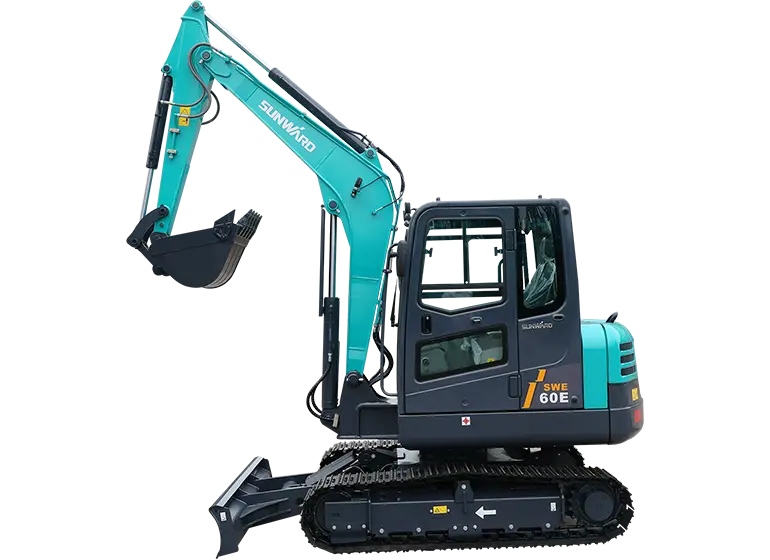
Knowing the main excavator bucket types saves time, fuel and frustration on site. The same digger can be quick or painfully slow depending on what is on the end of the arm. A narrow trenching bucket cuts a neat drainage trench, a wide ditching bucket profiles a bank or levels a pad, and a riddle bucket sorts stone from soil without a separate screener.
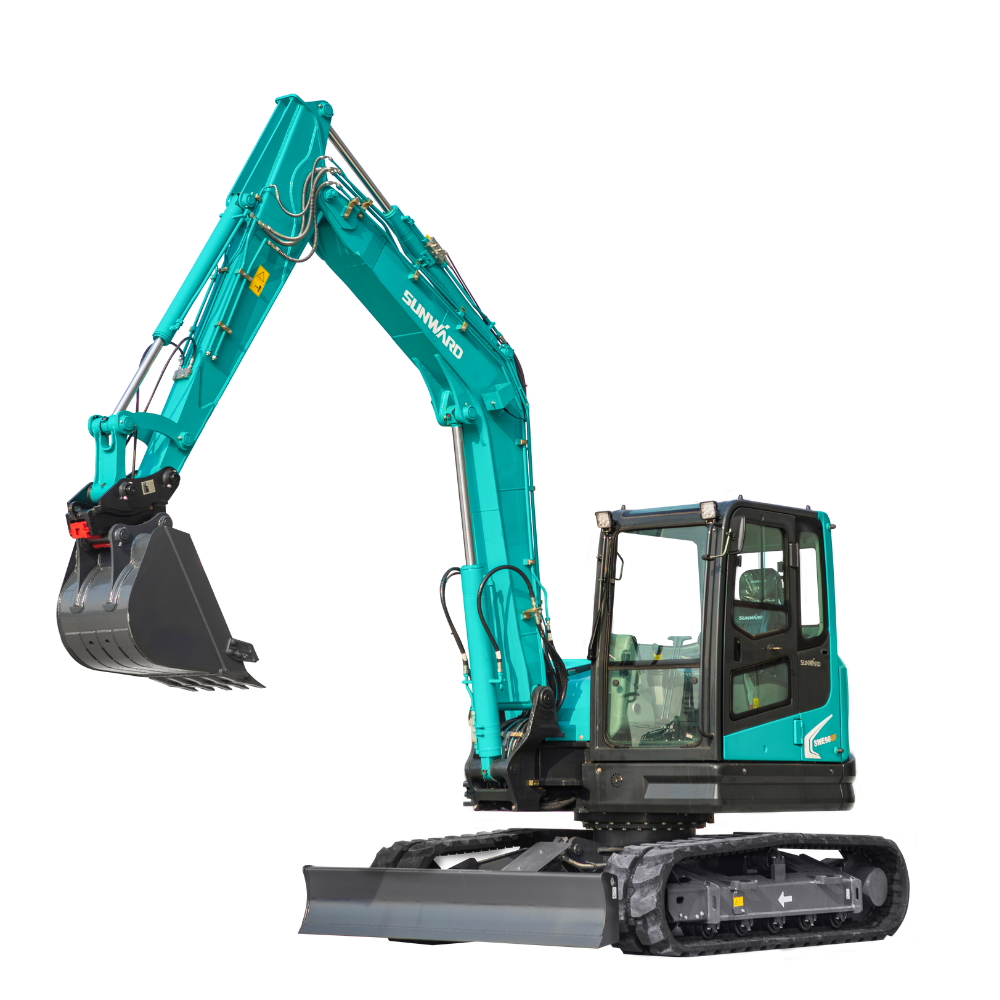
In this guide
This guide explains the common buckets and attachments, which jobs they suit, how to match bucket width to trench and pipe size, and how to change buckets safely. It is based on the Sunward excavators we hire from our depot near Okehampton, from the 0.8 tonne SWE 08B up to the 9 tonne SWE 90UF.
Why the bucket matters as much as the machine
Most people choose a digger by weight and access, which is right. But once the machine is on site, the bucket decides how much work it gets done. Too wide a bucket in hard ground and the machine struggles to fill it. Too narrow on bulk digging and you make three passes where one would do. The wrong bucket for a trench means extra backfill, extra stone and extra cost.
A good rule: the bucket should suit the job you will spend the most time doing. If a job has two distinct phases, such as digging a trench and then grading the ground, it is often worth having two buckets on site rather than making do with one.
The main excavator bucket types explained
Here are the excavator bucket types you are most likely to meet on a mini or midi digger, and what each one is for.
Digging or general purpose buckets
The everyday bucket. It has teeth on the cutting edge to break into the ground and a curved shape that holds spoil well. On mini diggers, digging buckets are commonly available in a range of widths. Wider buckets suit bulk digging and loading, while narrow ones suit trenches and footings. Most hires come with at least one digging bucket.
Trenching buckets
A narrow digging bucket, sometimes called a trenching or drainage bucket. It is used for pipe and cable runs, land drains and narrow footings. A narrow bucket removes less material, which means less spoil to move and less stone or backfill to buy. The trade-off is that it fills slowly on bulk work.
Ditching or grading buckets
A wide, shallow bucket with a flat cutting edge and no teeth. Many have drain holes so water runs out. Ditching buckets are used for cleaning out ditches, profiling banks, levelling ground, spreading topsoil and trimming the base of an excavation. They are the bucket of choice for finishing work, because the smooth edge leaves a clean surface.
Tilt buckets
A ditching bucket that can tilt left and right, usually through a hydraulic ram. Tilting lets you cut a slope or camber without moving the machine, which is very useful for ditches, embankments, pond edges and landscaping. Tilt buckets need hydraulic connections and add weight to the arm, so they are more common on larger machines.
Riddle or skeleton buckets
A bucket made from bars or a grid rather than solid plate. You scoop and shake: soil falls through and stones, roots and rubble stay in the bucket. Riddle buckets are useful for clearing stone from topsoil, sorting demolition rubble and separating roots during site clearance. For larger volumes, a dedicated screener is faster, such as the Flexiever towable screener on our sports and landscaping range.
Rock buckets
A heavy-duty bucket with thicker plate, reinforced wear strips and longer, stronger teeth. It is designed for rocky ground, shale and compacted hardcore where a standard bucket would wear quickly. Rock buckets are often V-shaped or narrower so the machine can concentrate force on a smaller edge.
Attachments beyond buckets
Excavators can run a range of attachments other than buckets. The common ones:
- Hydraulic breakers: for breaking concrete, tarmac and rock. They need a machine with suitable auxiliary hydraulics.
- Augers: for drilling holes for fence posts, piles and tree planting.
- Rippers: a single tooth for breaking up compacted or rocky ground before digging.
- Grabs and selector grabs: for handling logs, rubble and demolition material.
- Compaction plates: excavator-mounted plates for compacting trench backfill.
We do not list specific attachments as standard. Tell us the job and we will confirm which buckets come with the machine and whether an attachment is available, or point you in the right direction. For post holes, our Hyundai pedestrian post hole borer is an alternative to an auger, and for concrete recycling our Dragon crushers deal with the broken material once it is out.
Excavator bucket types compared: which bucket for which job
| Bucket or attachment | Best jobs | Less suited to | Typical machine class |
|---|---|---|---|
| Digging (general purpose) | Bulk digging, loading dumpers, footings | Fine finishing, very narrow trenches | All, 0.8t to 9t |
| Trenching (narrow) | Drains, cables, water pipes, narrow footings | Bulk digging | 0.8t to 3.5t mostly |
| Ditching or grading | Ditches, levelling, topsoil, trimming | Hard or stony ground | 1.8t upwards |
| Tilt ditching | Banks, camber, pond edges, landscaping | Tight access, light machines | 2.5t upwards |
| Riddle or skeleton | Removing stone and roots from soil, sorting rubble | Wet clay, which clogs the bars | 1.8t upwards |
| Rock | Shale, rock, compacted hardcore | Finishing and soft soils | 3.5t upwards |
| Breaker | Concrete, tarmac, rock | Digging | Depends on machine hydraulics |
| Auger | Post and pile holes | Stony ground with boulders | Depends on machine hydraulics |
The machine class column is a general guide, not a rule. Ask us about your job and we will tell you what fits each machine.
Matching bucket width to trench and pipe size
For trench work, start with the pipe or duct size and the working space you need either side. For example, a 100mm land drain needs room for stone around it, so a trench of around 300mm wide is typical. A water service pipe or cable duct in a narrow trench can often be laid with a smaller bucket.
- Too narrow: no room to bed and surround the pipe properly, and no room for a trench rammer or compaction.
- Too wide: more spoil, more backfill and more stone, plus wider reinstatement of lawns or paving.
- Just right: enough room for bedding, surround and compaction, and no more.
If you need to compact backfill in a narrow trench, check the width of your compaction kit too. The Weber MT SRV 300-II SF slim foot rammer and the MC 85 trench roller from our construction equipment range are designed for confined trenches. Tell us your trench width and we will make sure the bucket and the compaction kit suit each other.
Pin sizes, hitches and machine class
Buckets are not universal. Each one is built to fit a particular machine size, with pin diameters and pin centres that must match the arm. A bucket from a different make or class may look similar but will not fit safely. Fitting a bucket that is too large for a machine can also make it unstable and overload the hydraulics.
Our Sunward range by class
- Micro (0.8t): the Sunward SWE 08B, for gardens, indoor work and tight access.
- Mini (1.8t to 2.5t): the Sunward SWE 18UF, SWE 20F and SWE 25UF, for drainage, footings and landscaping.
- Midi (3.5t to 6t): the SWE 35UF and SWE 60UF zero tail machines, for larger groundworks.
- Larger (9t): the SWE 90UF, for bulk digging and heavier work.
As a general rule, bucket options widen as the machine grows. Micro diggers are mostly about digging and trenching buckets. From around 2.5 tonnes upwards, ditching and tilt buckets become more practical, and bigger machines can carry heavier rock buckets and attachments.
Changing buckets safely: quick hitch checks
Most modern excavators use a quick hitch so buckets can be changed in minutes. Hitches range from manual pin-on systems to semi-automatic and fully automatic types. They are a huge time saver, but a bucket that falls off the arm can kill.
HSE guidance on quick hitches highlights that a hitch can keep working for some time without its retaining pin, then suddenly release the bucket. Its recommendations include:
- Check the safety pin or locking device is in place before starting work and every time you change attachment.
- Use only the pin specified by the manufacturer. Never substitute bolts, wire or other improvised pins.
- If you cannot see the hitch clearly from the cab, get out and check it visually from the ground.
- Keep people out of the area beneath and around the bucket, especially in trenches.
- Make sure you are trained in the specific hitch fitted to the machine.
A simple way to check the bucket is locked is to curl it in, press it against the ground and watch for any movement at the hitch. On delivery, we will show you how the hitch on your hire machine works and how to check it. If anything seems wrong, stop and call us.
If you plan to lift loads with the excavator, tell us before you hire. Lifting operations are covered by the Lifting Operations and Lifting Equipment Regulations, and HSE notes that quick hitches are subject to thorough examination under them.
Bucket capacity and productivity
Bucket capacity is usually quoted in litres or cubic metres, either struck (level with the top) or heaped. A bigger bucket does not always mean faster work. Productivity depends on:
- Ground conditions: in hard or stony ground, a smaller bucket fills fully and digs faster than a big one that only half fills.
- Breakout force: the machine’s power determines how easily the bucket can cut in.
- Cycle time: dig, swing, dump and return. Short swings to a dumper save more time than a bigger bucket.
- Dumper match: aim for a dumper the bucket fills in a few passes. A tiny dumper behind a big bucket wastes time and spills spoil.
- Operator skill: a smooth, experienced operator will out-dig a bigger bucket every time.
For moving spoil away from the machine, our dumpers include the Hyundai 500kg tracked dumper, the Mechbadger tracked dumper and the HG 1000 electric wheeled dumper with a 1,000kg payload.
Worked examples: choosing the bucket for the job
A garden drainage run
An illustrative job: a 20m land drain across a back lawn in mid Devon, through a narrow side gate. A Sunward SWE 08B with a narrow trenching bucket keeps the trench tidy and limits the stone needed. A small tracked dumper takes the spoil away.
A farm ditch
A silted farm ditch needs cleaning and reprofiling. A 3.5t or 6t machine with a wide ditching bucket clears the silt and leaves a smooth bank. A tilt bucket, where available, helps shape the sides without repositioning. Remember that work on watercourses can need consent from the relevant authority.
Clearing a stony paddock
Ground with lots of loose stone and rubble in the topsoil could be worked with a riddle bucket on a 2.5t or larger machine, sorting stone from soil in one pass. For large areas, a screener is faster.
Foundations on a building plot
Strip footings for an extension need a digging bucket matched to the footing width shown on the drawings. A 1.8t to 3.5t machine is common. A ditching bucket can then trim and level the base before concrete.
South West ground conditions and excavator bucket types
Ground in the four counties varies a lot, and it changes which excavator bucket types work best. Much of mid and north Devon, around Okehampton, Holsworthy and Torrington, is heavy clay over shale. Clay sticks in buckets, so a smooth ditching bucket sheds it better than a toothed one when you are trimming, and riddle buckets clog quickly when it is wet.
On and around Dartmoor and Bodmin Moor you meet granite, boulders and peaty topsoil, where a toothed digging bucket or a rock bucket earns its keep and a ripper tooth can help break the ground first. Cornwall‘s killas (slate) and parts of Somerset and Dorset with limestone or chalk can be hard and abrasive, wearing teeth and cutting edges faster. The softer, wetter ground of the Somerset Levels suits wide ditching work, where low ground pressure and a clean finish matter more than breakout force.
In winter, wet ground slows everything. A slightly narrower bucket that fills cleanly is often quicker than a wide one dragging through sticky clay.
What to ask before you hire
Running through the job with us at booking stage avoids the classic problem of the right machine arriving with the wrong bucket. Have these answers ready:
- What is the main job? Trenching, bulk digging, ditching, levelling or sorting stone.
- What widths do you need? Trench widths, footing widths from drawings, or pipe sizes.
- How deep are you going? This affects machine size as much as bucket choice.
- What is the ground like? Topsoil, clay, shale, rock, made ground or old hardcore.
- What is the access? Gate widths, slopes and overhead obstructions.
- Will you need attachments? A breaker, auger or grab, and whether you plan to lift anything.
- Where is the spoil going? A dumper, a trailer or a heap on site.
With those answers we can match the machine and the excavator bucket types to the work, and tell you plainly if something is not available so you can plan around it.
Glossary of bucket terms
- Cutting edge: the leading edge of the bucket that bites into the ground.
- Teeth: replaceable points fitted to a digging bucket’s edge.
- Pin centres: the distance between the two pins that attach the bucket or hitch to the arm.
- Quick hitch: a coupler that lets you swap buckets without knocking pins in and out.
- Struck capacity: bucket volume level with the top edge.
- Heaped capacity: bucket volume with material piled above the edge.
- Breakout force: the force the bucket can apply to tear into the ground.
Safety checks and common mistakes
Before you dig
Whatever the bucket, check for buried services before you break ground. Request utility records through LinesearchbeforeUdig, use a cable avoidance tool and dig by hand near known services. Keep spoil back from trench edges and support or batter back the sides of deep excavations.
Hire is self-drive unless otherwise agreed, and you must hold appropriate training. Insurance is not included automatically, so we refer customers to our partner insurance4plant.co.uk for plant hire cover.
Common bucket mistakes
- Using a toothed digging bucket for finishing work and leaving a ragged surface.
- Digging a trench far wider than the pipe needs.
- Using a riddle bucket in wet clay, which clogs the bars.
- Skipping the hitch check after changing buckets.
- Fitting a bucket from another machine that does not match the pins.
- Choosing the biggest bucket and leaving the machine struggling to fill it.
Frequently asked questions
What buckets come with a hired mini digger?
It varies by machine and availability. Tell us the job when you book and we will confirm which buckets come with it and whether others are available.
What is the difference between a ditching bucket and a digging bucket?
A digging bucket has teeth and a deeper shape for breaking into the ground. A ditching bucket is wider, shallower and has a smooth edge for finishing, levelling and cleaning ditches.
Can I use any bucket on any excavator?
No. Buckets must match the machine’s pin sizes, pin centres and hitch, and be the right size and weight for its class.
What width bucket do I need for a drainage trench?
Allow for the pipe and the stone or bedding around it. For a 100mm land drain, a trench of around 300mm wide is typical. Ask us and we will match the bucket to your trench.
Is a tilt bucket worth it?
For ditches, banks, ponds and landscaping, yes, because it shapes slopes without moving the machine. For simple trenching and digging, it is not needed.
How often should I check the quick hitch?
Before starting work and every time you change attachment, as HSE guidance recommends. If you cannot see it from the cab, check it from the ground.
Talk to us about the right machine and bucket
Tell us what you are digging and we will match the excavator and buckets to the job. WhatsApp or call 07841 036064 (Mon to Fri, 7:30am to 5:30pm) with the job, site postcode, dates and access details, or use our contact page for written quotes. For regular work, ask about long-term rental with on-site servicing included.