
If you want to know how to remove a tree stump properly, the answer depends on three things: the size of the stump, what is near it, and what you want to do with the ground afterwards. Small stumps can be dug and levered out by hand. Medium and large stumps are usually quickest with a micro or mini digger that digs round the root plate and lifts it clear. Grinding and chemical rotting are the other options. This guide walks through each method, the checks to make first, and the kit that makes the job manageable.
In this guide
Four ways to remove a tree stump
There is no single best answer to how to remove a tree stump. Each one leaves the ground in a different state, and that matters if you plan to lay a patio, build an extension or simply reseed a lawn.
- Dig and lever out by hand. Spade, mattock, root saw and a long digging bar. Fine for small stumps and shallow-rooted shrubs, hard going for anything larger.
- Dig out with a digger. A micro or mini excavator exposes the roots, you cut them, and the bucket rocks and lifts the stump out. Removes the root plate completely.
- Grind it down. A stump grinder chews the stump into chippings below ground level. Main roots stay in the ground and rot slowly.
- Let it rot. Drill, treat or simply leave the stump to decay. Cheap and quiet, but it takes years rather than days.
If the ground is going to be built on, paved or dug for foundations or drainage, you generally want the whole root plate out, which points to digging. If you only need a level lawn and the stump is in an awkward spot, grinding can be the neater answer.
Checks before you start
Removing a stump is usually straightforward, but a few checks save trouble later. Do them before you book any machine.
Tree Preservation Orders and conservation areas
If the tree is still standing, check whether it is protected before anyone touches it. Work on a tree covered by a Tree Preservation Order normally needs the council’s written consent, and in a conservation area you usually have to give the council six weeks’ notice before cutting down an unprotected tree. There are exceptions, including for dead and dangerous trees, but they come with their own notice rules.
The government guidance on Tree Preservation Orders and trees in conservation areas sets this out. If a tree was felled with consent, check whether that consent came with a condition to plant a replacement, as that affects what you do with the hole. When in doubt, ask your local planning authority, and check the current guidance as rules can change.
Underground services
Roots grow round pipes and cables, and old stumps often sit right next to a water supply, a drain run or a buried electricity cable to a garden building. Before you dig, find out what is underground. The free LinesearchbeforeUdig service covers many utility networks, and your own drawings or a cable locator help with private services. Hand dig to expose anything you suspect is there.
Wildlife
Stumps, log piles and the scrub around them can hold nesting birds, hedgehogs and other wildlife. Look carefully before you start, especially in spring and summer. Active bird nests are protected by law, so if you find one, leave that area until the young have gone.
Structures and boundaries
Note how close the stump is to the house, garage, walls, fences and your neighbour’s boundary. Large stumps near buildings need extra thought, which we cover below. If the stump straddles a boundary, agree the work with your neighbour first.
Which method suits which stump
Use this table as a starting point. Trunk diameter is measured at ground level. Soil type changes things a lot: a stump in sandy soil comes out far more easily than the same size in heavy clay or the shaly shillet found across much of Devon and Cornwall.
| Stump size (diameter) | Typical example | Best method | Machine to consider |
|---|---|---|---|
| Under 15cm | Conifer hedge plants, shrubs, small fruit trees | Dig and lever by hand | Hand tools; a micro digger if there are many |
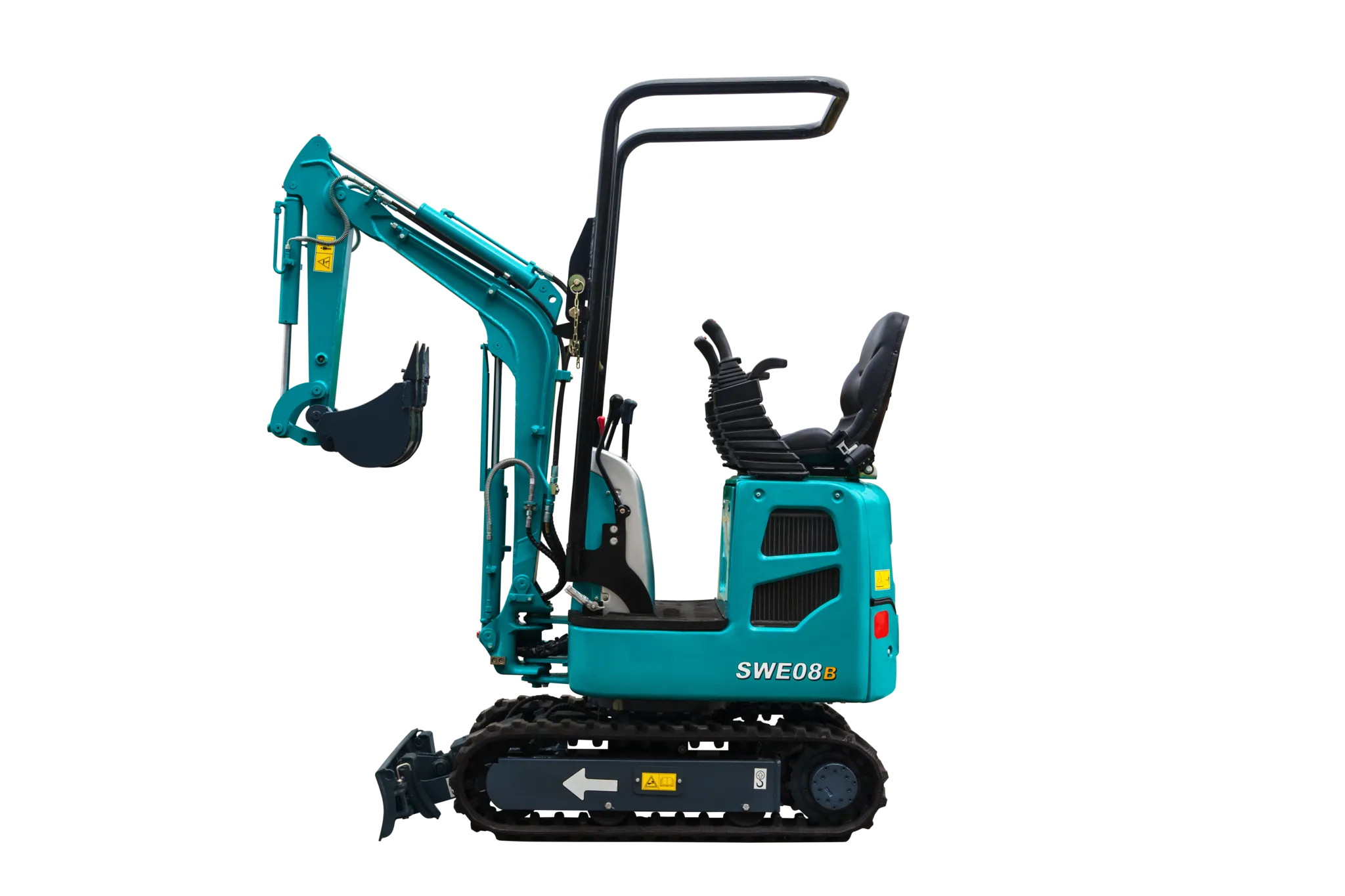
| 15–30cm | Small garden trees, leylandii hedge rows | Micro digger, or hand digging with patience | Sunward SWE 08B (0.8t) |
| 30–50cm | Mature garden trees, old apple trees | Mini digger to expose, cut and lift | Sunward SWE 18UF (1.8t) or SWE 20F (2.0t) |
| 50cm and over | Large oak, ash, beech or sycamore | Larger mini excavator, or grinding where access is tight | Sunward SWE 25UF or SWE 35UF; ask us about grinding |
| Rows of stumps | Hedge removal, clearing a plot | Digger plus dumper to clear as you go | Mini excavator with a tracked dumper |
These are guides, not hard limits. Species matters too. Conifers tend to have shallow, spreading roots that come out relatively easily. Oak and other broadleaf trees can have deep anchor roots that need more digging.
How to remove a tree stump by hand
For small stumps, hand digging is cheap and precise. It is also the right approach close to a wall or pipe where a machine would be too heavy-handed.
- Cut the trunk to a useful height. Leave around a metre of trunk if you can. It gives you leverage to rock the stump later. Only cut it flush if you plan to grind.
- Dig a trench round the stump. Work about 30–50cm out from the trunk, removing soil to expose the main lateral roots.
- Cut the roots. Use a root saw, axe or loppers. Cut each root on the outside of your trench so the stump is gradually freed.
- Find the tap root. Dig underneath and cut it with a saw or the edge of a sharp spade.
- Rock and lever. Push the trunk back and forth, cutting any root that holds. A long digging bar under the root plate helps lift it out.
- Clean up. Pull out remaining root pieces and backfill.
Wear gloves, safety boots and eye protection. Saws and axes in a muddy trench are a common cause of injury, so keep your footing firm and work steadily.
How to remove a tree stump with a mini or micro digger
For most stumps above about 15cm across, a digger turns a weekend of hard labour into an hour or two of controlled work. The method is the same whatever size of machine you use, but always match the machine to the stump and the access.
Step 1: Set up and plan the dig
Track the machine in on boards or ground protection mats if you are crossing a lawn. Position it so you can dig round at least two sides of the stump without moving. Decide where spoil and the stump itself will go before you start, ideally straight into a dumper.
Step 2: Expose the roots
Dig a trench round the stump, about the width of the bucket, roughly 50cm to a metre out from the trunk depending on size. Take it down until the main laterals are visible. Lift the soil out in thin layers so you see roots before you hit them.
Step 3: Cut the main roots
Get out of the cab and cut the larger roots with a chainsaw (only if you are trained to use one) or a root saw. Avoid running a chainsaw into soil, which blunts the chain instantly. Smaller roots can be cut with the bucket teeth by pushing down firmly against them.
Step 4: Rock and lift
Get the bucket teeth under the root plate on one side and lift gently. Then work from the opposite side. The stump will begin to move. Keep cutting any root that holds it rather than forcing it with the machine.
Once it is free, lift the stump with the bucket or curl it into the bucket and place it in the dumper or on a pile. Shake off as much soil as you can first, because a soil-laden stump is surprisingly heavy and that soil is what you need to backfill the hole.
Step 5: Check for stray roots
Dig over the base of the hole and pull out any thick root pieces. Large roots left in the ground rot and settle, which causes dips in lawns and cracks in paving later.
Working near foundations and walls
This is where most expensive mistakes happen. Never undercut a wall, fence post, garage base or house foundation to get at roots. A stump close to a building can be part of a delicate balance with the soil, particularly in shrinkable clay, and removing it can change how the ground moves.
If the stump is within a few metres of a building, take advice from a structural engineer or building control before you remove it. Cut roots on the building side by hand rather than ripping them with the bucket, and do not dig below the depth of nearby foundations.
Choosing the right digger for stump removal
Once you know how to remove a tree stump, the next question is which machine. Our Sunward range covers most domestic and smallholding stump work. Pick on access first, then on the size of the stump.
- Sunward SWE 08B (0.8 tonne). The micro digger for side gates, small back gardens and lines of hedge stumps. It works best on small to medium stumps where you can do some of the root cutting by hand. See our Sunward SWE 08B micro excavator guide for more on the machine.
- Sunward SWE 18UF (1.8 tonne, zero tail swing). A good all-rounder for mature garden trees. Zero tail swing helps between a fence and a house wall.
- Sunward SWE 20F and SWE 25UF. More weight and digging force for bigger root plates where access is reasonable.
- Sunward SWE 35UF (3.5 tonne). For large stumps, rows of field-boundary trees and plot clearance, where you have room to get it in.
All of our excavators are on the construction equipment hire page. Measure the narrowest point of your access route, including gate posts and any steps, and send it to us with photos. We will tell you which machine will fit and whether it will cope with the stump.
Stump grinding: when it makes more sense
A stump grinder uses a spinning cutting wheel to reduce the stump to chippings, usually to somewhere below ground level. It is a good choice when the stump is next to a building or wall where digging is risky, when the tree had very large roots, or when you just want a lawn and do not mind roots rotting in place.
The downside is that the root system stays put. That is fine for grass but less good if you plan footings, a drainage run or a patio. The chippings are also high in carbon, so they are best removed rather than mixed straight into topsoil.
Stump grinders are not part of our fleet. Ask us, and we’ll tell you what’s available or point you in the right direction. If the ground needs digging afterwards, we can still supply the digger and dumper for that stage.
Chemical and natural rotting
Leaving a stump to rot is the slowest method but needs no machinery. Drilling holes in the top speeds it up by letting water and fungi in. Some people also cover the stump with soil or mulch to keep it damp.
Expect a large stump to take years to break down. Stump killers can stop regrowth from species that sucker or resprout, such as some poplars and willow, but read and follow the label carefully, keep products away from ponds, ditches and drains, and think twice in vegetable gardens. Rotting suits a corner of a garden or field you are in no hurry to use.
Dealing with the brash, logs and spoil
Stump removal is often the last part of a bigger tree job, and the clear-up can take longer than the dig. Plan it in from the start.
Chipping branches and brash
If the tree has just come down, there will be a pile of branches. Our GL&D chippers turn it into chippings you can use as path mulch or take away in far fewer loads. The 5.5″ tracked chipper is self-propelled, so it climbs into back gardens and up slopes, and the 6.5″ towable chipper suits bigger volumes where you can get a vehicle close. Both are listed on our sports and landscaping equipment page.
Splitting logs
Trunk sections can be cut into rings and split for firewood. The Ifor Williams trailed log splitter takes the hard work out of that on estates and smallholdings.
Moving the stump and spoil
A stump with soil attached can weigh far more than you expect. A tracked dumper, such as our Hyundai 500kg tracked dumper or the Mechbadger tracked dumper, carries stumps and spoil across lawns and through narrow access. The HG 1000 electric wheeled dumper suits firm surfaces and yards, and the Tracspider electric tracked carrier is useful on soft or sloping ground.
Stumps are bulky and awkward in a skip. Ask your waste carrier whether they accept stumps and soil, and whether they want them kept separate. Green waste and soil often go to different places.
Filling the hole and finishing the ground
A well-filled hole is the difference between a tidy job and a dip that reappears every winter. Follow this sequence.
- Remove loose root pieces and wood chippings from the hole.
- Backfill with the soil you dug out, in layers of about 15–20cm.
- Firm each layer. Tread it in on lawns, or use a plate compactor under paving or a base.
- Top with good topsoil and leave it slightly proud, because it will settle.
- Seed or turf once the soil has settled, ideally after some rain.
Under hard landscaping, do not rely on soft topsoil. Fill with suitable compacted material and use a Weber MT plate compactor or rammer to consolidate it in layers. A deep hole under a patio filled with loose soil is one of the most common causes of sunken slabs.
Common mistakes to avoid
- Cutting the trunk flush when you plan to dig. You lose the leverage that helps rock the stump free.
- Forcing it with the machine. Excavators are strong, but tearing roots strains the machine and can pull up nearby paths or pipes. Cut roots, then lift.
- Skipping the services check. Roots and pipes often share the same ground.
- Undercutting nearby walls and foundations. Keep well clear and take advice for stumps near buildings.
- Leaving big roots behind. They rot, voids form and the ground sinks.
- Underestimating the clear-up. Book the dumper and chipper with the digger, not afterwards.
- Working in waterlogged ground. In a wet Devon or Cornwall winter, lawns churn up quickly. Use ground protection or wait for a drier spell if you can.
Planning the hire: a simple timeline
Knowing how to remove a tree stump is half the job; timing the hire is the other half. For most domestic and smallholding jobs, the hire itself is short. The planning is what makes it go smoothly.
- Two weeks before: confirm any tree protection, check underground services, agree access with neighbours if needed, and arrange waste disposal.
- One week before: measure your access, take photos and WhatsApp us with the stump sizes, site postcode and dates. We will suggest a machine and quote.
- Day before: clear the route, lay out ground protection and decide where spoil goes.
- Hire day: start with the hardest stump while you are fresh, clear as you go, and backfill before the machine leaves.
Many single-stump jobs fit in a day, but if you have several stumps, a hedge line or a whole plot, a weekly hire is usually better value and takes the pressure off. As an illustration, a back garden with five old leylandii stumps along a fence line and a narrow side gate might suit an SWE 08B and a tracked dumper for two or three days. A field boundary with a row of mature ash stumps is more likely to need a 3.5 tonne machine for a week.
Frequently asked questions
Do I need permission to remove a tree stump?
The protection rules mainly apply to the standing tree, so removing the stump of a tree that has already been lawfully felled is not usually controlled in the same way. If a replacement planting condition was attached to a felling consent, or the land is under a planning condition, check with the council before you dig.
Can I remove a tree stump myself with a hired digger?
Yes, many homeowners and smallholders do. Hire is self-drive, so you need to be confident operating the machine safely, and you should hold appropriate training. If you are new to diggers, start with a smaller machine and practise in open ground first.
What size digger do I need for stump removal?
For stumps up to about 30cm across, a 0.8 tonne micro digger usually copes with some hand root cutting. For mature trees, a 1.8–2.5 tonne machine is more comfortable, and large stumps suit a 3.5 tonne excavator. Access often decides it.
How deep do tree roots go?
Most tree roots are in the top metre or so of soil and spread widely rather than deeply. Some species, and trees in free-draining ground, send roots deeper. You do not need to chase every fine root, just the main ones and the root plate.
Will the stump grow back if I leave the roots?
Some species resprout from stumps and roots, including willow, poplar and some other broadleaves. Conifers such as leylandii generally do not regrow from a cut stump. Removing the root plate or grinding deep enough usually stops regrowth.
Is it better to grind or dig out a stump?
When deciding how to remove a tree stump, think about the end use. Dig it out if you plan to build, pave or lay drainage, because the roots come out with it. Grind it if the stump is close to a building, very large, or in a lawn where you simply need a level surface.
Can you deliver a digger to a back garden?
We deliver to the property. The machine then tracks in under its own power, so it needs a clear route at least as wide as its tracks. Send us your narrowest access measurement and photos so we can match the machine.
Book the kit to remove a tree stump
We deliver micro diggers, mini excavators, dumpers and chippers across Devon, Cornwall, Somerset and Dorset from our depot near Okehampton. WhatsApp or call 07841 036064 (Mon–Fri 7:30am–5:30pm) with the stump sizes, your site postcode, dates and access details, or use our contact page for a written quote. We will tell you the right machine for the job.


