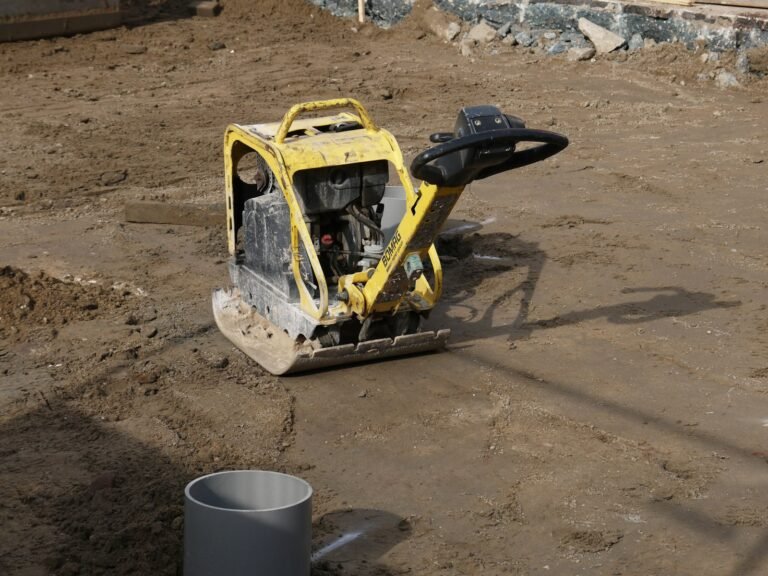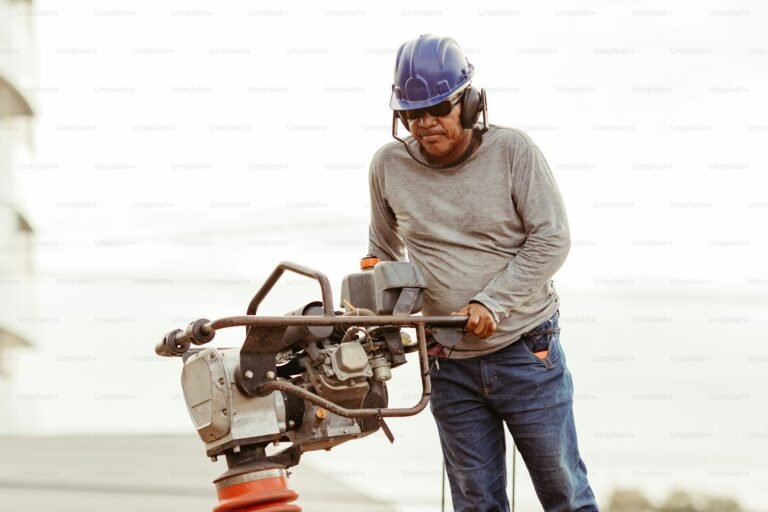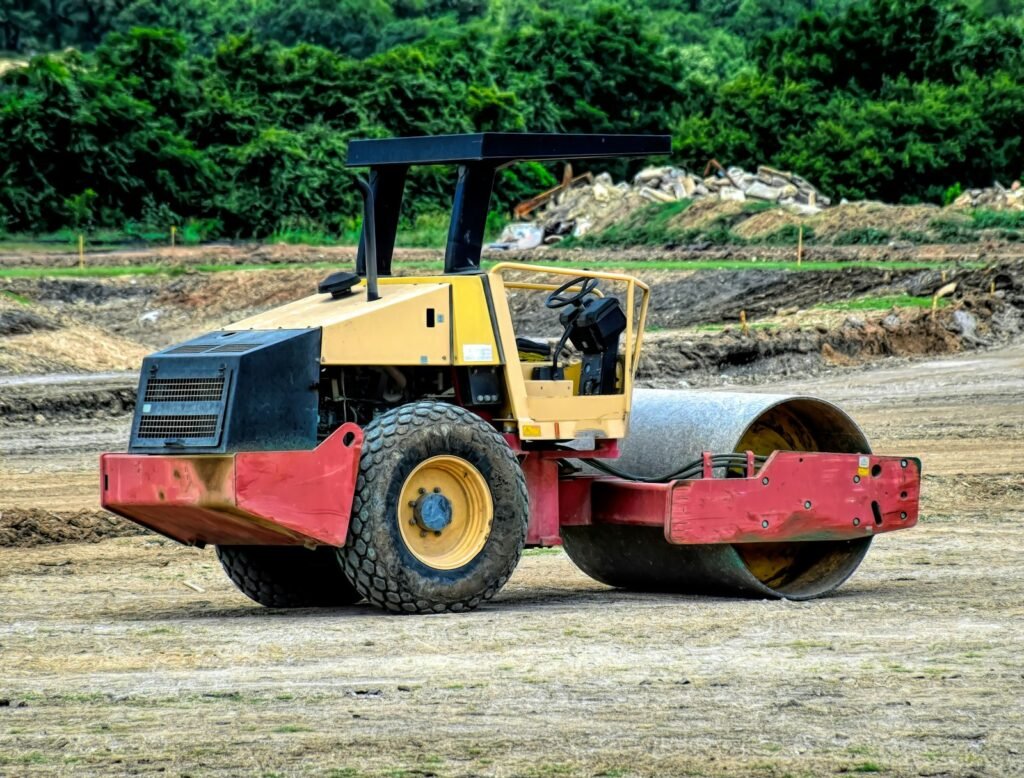
Roller hire makes sense when you need a firm, even surface over a longer run than a plate compactor can handle comfortably, or when you are bedding block paving and want to avoid chipping the blocks. From our depot near Okehampton we hire two Weber MT rollers: the VPR 450 paving stone roller for consolidating pavers and block paving, and the MC 85 trench roller for confined trench compaction.

In this guide
This guide explains what each one does, how a roller compares with plates and rammers, how soil type changes the method, and what to tell us when you book so the right machine turns up.
Roller hire at 4Counties: the two machines we stock
Both rollers sit within our Weber MT compaction range on the construction equipment hire page, alongside the forward and reversible plates, rammers and the SM 82-3 pavement saw. They are built for quite different jobs, so it is worth being clear which one you need before you ask for a quote.
Weber MT VPR 450 paving stone roller
The VPR 450 is a walk-behind vibratory roller designed for consolidating pavers and block paving. Instead of sliding a flat steel plate across the surface, it rolls over the blocks while vibrating, which settles them into the laying course and helps work jointing sand down between them. On a new drive, patio or courtyard that means a more even finish and less risk of scuffing or chipping the arrises of the blocks.
Weber MT MC 85 trench roller
The MC 85 is a compact trench roller for confined trench compaction. It is narrow enough to work along the trench itself on drainage, duct and service runs, and it covers long straight sections faster and more evenly than a rammer. We will run through its controls with you on handover, because the way you drive and steer a trench roller is different from a plate.
Roller, plate compactor or rammer: which do you need?
Most compaction questions we get on WhatsApp come down to this choice. Each machine type applies force in a different way, and each has a sweet spot. The table below is a practical starting point.
| Machine | How it compacts | Best for | Less suited to |
|---|---|---|---|
| Paving roller (Weber MT VPR 450) | Rolling drums with vibration, spreads the load over the blocks | Bedding block paving and pavers, settling jointing sand | Thick lifts of sub-base, trenches |
| Trench roller (Weber MT MC 85) | Compact roller with vibration, worked along the trench | Long trench runs, drainage and duct backfill | Very short trenches, tight work around fittings |
| Forward plate (CF 1-III Hd, CF 2-II Hd, CF 3-II Hd) | Vibrating flat plate, moves forward only | Sub-base for paths and patios, sand and granular fill | Sticky clay, deep lifts |
| Reversible plate (CR 2, CR 3-III, CR 7) | Heavier vibrating plate, forward and reverse | Thicker granular lifts, drives, wider reinstatement | Narrow trenches |
| Rammer (SRV 620-II, SRV 300-II SF) | Small foot hammering at high impact | Narrow trenches, clay, around pipes and chambers | Large open areas |
A useful rule of thumb: if the job is long and narrow, think trench roller. If it is a finished paved surface, think paving roller. If it is an open area of sub-base, a plate is usually quicker and cheaper. If it is tight, short or full of obstructions, a rammer. Plenty of jobs use two of these, and we are happy to talk you through the combination.
How rollers compact, and why it matters
Compaction is about pushing particles closer together so there are fewer air voids. A compacted layer carries load without settling, drains as designed and resists frost heave. Every compactor does this with some mix of weight, vibration and impact.
A plate concentrates vibration into a small flat area and relies on that energy travelling down into the material. A roller spreads weight along the contact line of the drum and, when vibration is switched on, adds dynamic force as it rolls. The result is usually a more uniform surface, because a roller does not dig in or bounce the way a plate can on uneven ground.
That uniformity is the main reason people choose roller hire over a plate. On a long trench, every metre gets the same treatment at walking pace. On block paving, the rolling action avoids the scraping that can mark the surface. The trade-off is that rollers are less forgiving in tight corners and around obstructions, where a rammer or small plate still has to finish the job.
Granular and cohesive soils: matching the method
The material you are compacting changes how you should work far more than most first-time hirers expect.
Granular materials
Sand, gravel and crushed stone sub-base such as Type 1 are granular. The particles are separate and lock together when vibrated. Vibration is the key ingredient here, which is why vibrating plates and rollers work so well on them. Granular fill compacts best with a little moisture, enough that it holds together when squeezed in your hand but does not leave water on your palm.
Cohesive soils
Clay and silty soils are cohesive. The fine particles stick together and hold water, so vibration alone does less. Impact and kneading action work better, which is why rammers are the traditional choice for clay trench backfill. A roller can still help on cohesive fill, but lifts need to be thinner and the material must be at a workable moisture content.
In much of Devon you will meet both. Mid Devon and the Culm Measures country north of Okehampton have plenty of heavy clay, while shillet (broken slate and shale) and granitic gravels are common nearer Dartmoor and into Cornwall. If you are reusing as-dug spoil, look at it honestly. Saturated, sticky clay will not compact properly with any machine. In that case importing a granular fill is often the cheaper option overall.
Quick moisture test
- Too dry: the material crumbles and will not form a ball. Damp it lightly with a hose and mix it in.
- About right: it forms a ball that holds its shape and breaks cleanly when pressed.
- Too wet: it smears, leaves water on your hand or pumps under the machine. Let it dry, spread it out, or swap it for granular fill.
Trench backfill with a trench roller, in layers
The single most important rule of trench backfill is to place it in thin layers, called lifts, and compact each one before the next goes in. Rolling the top of a trench filled to the brim gives a surface that feels firm but settles later, leaving a dip in the lawn, drive or road.
- Bed and surround the pipe or duct first with the specified material, usually pea shingle or sand, and compact the area beside the pipe by hand or with a rammer. Do not run any roller directly over a freshly laid pipe with little cover.
- Place the first lift of backfill once there is enough cover over the pipe to protect it. Keep each lift thin and even across the trench.
- Run the trench roller along the trench at a steady walking pace, overlapping each pass. Several passes per lift is normal.
- Check the result. If the roller is still sinking in noticeably, the lift is too thick or the material too wet.
- Finish the ends and corners with a rammer where the roller cannot reach.
- Repeat until you reach the level for your surface layers, then finish with the appropriate surfacing.
Work in the highway follows its own reinstatement specification, which sets layer thicknesses and passes for each type of compaction plant. If you are a utility contractor you will know it already. If you are a homeowner or small builder digging in or near the road, speak to the highway authority before you start rather than after.
Sub-base and block paving with the paving roller
A block paved drive is only as good as what lies underneath it. The VPR 450 is the finishing tool, not the whole job. Here is the general sequence for a typical domestic drive or patio.
- Excavate to formation level, removing topsoil, roots and soft spots. A mini excavator from our construction range saves days of hand digging on a drive.
- Compact the formation with a plate. Dig out and replace any area that stays soft.
- Lay a geotextile membrane if your design calls for it, particularly on clay.
- Place the sub-base in lifts, compacting each with a forward or reversible plate. For a drive, a heavier reversible plate such as the CR 3-III is usually the better choice.
- Screed the laying course of sharp sand to an even depth with the falls you need for drainage. Do not compact it before laying.
- Lay the blocks in your chosen pattern, cutting edges with a block splitter or saw. Wear suitable respiratory protection when cutting, because block dust contains silica.
- Brush dry jointing sand over the surface.
- Consolidate with the VPR 450, working in overlapping passes and in more than one direction. The vibration settles the blocks and works sand into the joints.
- Top up the jointing sand and roll again until the joints are full.
Make sure the surface is clean and dry before rolling. Grit or debris on the blocks can mark them, and wet sand will not flow into the joints. Edge restraints must be fully set and solid before you roll near them, or the blocks will creep outwards.
New hard surfaces in front gardens can need planning permission depending on the area and how the surface drains, so check the Planning Portal guidance on paving front gardens before you dig.
Tarmac and asphalt: what to know first
We get asked about tarmac often. Rolling hot-laid asphalt is a specialist job with a short working window, because the material must be compacted while it is still at temperature. Professional surfacing crews use rollers matched to the mix and thickness, keep the drums wet so material does not stick, and work to a planned rolling pattern.
For small patch repairs with bagged cold-lay material, many people use a plate compactor rather than a roller. For anything larger, ask us before you book. Tell us the area, the material and whether it is hot or cold lay, and we will tell you what we have available or point you in the right direction. We would rather do that than send out a machine that does not suit the job.
Three illustrative roller hire scenarios
These examples are illustrative, to show how the choice works in practice.
A new block paved drive near Exeter
A homeowner is laying around 60 square metres of block paving on a clay site. They would typically need a mini digger and dumper for the dig, a reversible plate for the sub-base, and the VPR 450 for the final consolidation. A weekly hire covering the whole sequence often works better than separate daily hires, because weather in the South West rarely lets you work to an exact plan.
A 40m drainage run across a smallholding
A contractor is laying a perforated land drain and a duct along a field edge. The MC 85 trench roller handles the main run, with a slim-foot SRV 300-II SF rammer for the ends and around the inspection chambers. The trench roller saves a lot of walking behind a rammer over that distance.
Re-laying a courtyard in Tavistock
The existing granite setts and pavers are lifted, the bed is re-screeded and the paving re-laid. The base is sound, so no sub-base work is needed. The job needs only the VPR 450 and hand tools, which makes it a good candidate for a short daily hire.
Operating a roller safely
Rollers are straightforward to operate, but they still carry real risks. Read the operator manual, take the handover seriously and make sure anyone using the machine has had suitable instruction.
Vibration exposure
Walk-behind compaction equipment exposes the operator to hand-arm vibration, and some ride-on plant exposes the operator to whole-body vibration. Under the Control of Vibration at Work Regulations 2005, employers must assess and control vibration risks. Practical steps include rotating operators, taking regular breaks, keeping hands warm and dry, and reporting tingling or numbness early. The HSE guidance on vibration at work explains the duties and exposure values. Ask us for the machine’s vibration data if you need it for your assessment.
Trenches and edges
Never stand in an unsupported trench that could collapse, and do not run a roller close to an unsupported trench edge. Spoil and machines near the edge add load to the trench sides. The HSE guidance on excavations covers support, edge protection and inspection.
Other everyday precautions
- Wear safety boots, hearing protection, gloves and eye protection.
- Keep bystanders, children and pets clear of the working area.
- Take extra care on slopes and near kerbs or drops, and work up and down gentle slopes rather than across them.
- Refuel with the engine off and cool, away from drains and watercourses.
- Lift and load the machine using the lifting points and mechanical aids, not by hand.
Getting your roller to site
We deliver across Devon, Cornwall, Somerset and Dorset, and same-day delivery is often possible across much of Devon and Cornwall. Delivery is the easiest option for most customers, because the driver can unload the machine where you need it.
If you prefer to collect, rollers travel on a plant trailer with ramps. We hire the Brian James 9ft plant trailer and the Indespension 10ft plant trailer, both listed on our trailer hire page. Check your towing vehicle’s limits and your licence entitlement on the GOV.UK towing rules, and secure the machine with proper straps at its tie-down points. Ask us and we will confirm the machine weight before you set off.
Common mistakes with roller hire
- Lifts too thick. The surface feels firm, but the material underneath stays loose and settles later.
- Rolling wet clay. It pumps and smears rather than compacting. Change the material or wait.
- Expecting the paving roller to fix a poor sub-base. It consolidates blocks, it cannot correct a soft or uneven base.
- Rolling block paving before edge restraints have set. The blocks spread and joints open.
- Running over a pipe with too little cover. Pipes and ducts crack, and you will only find out after the trench is filled.
- Skipping the corners. A roller cannot reach everywhere, so plan for a rammer or small plate to finish.
What to tell us when you book roller hire
A quick, clear WhatsApp message gets you an accurate quote fastest. Include:
- The job: block paving, trench backfill, sub-base or something else.
- The approximate area, or the trench length, width and depth.
- The material you are compacting, such as Type 1, clay spoil or sand.
- Your site postcode and access details, including gate widths, steps and slopes.
- Your dates and how long you expect the job to take.
- Whether you need delivery or will collect on a trailer.
- Any other machines you need, such as a mini digger, dumper or plate.
Hire periods and what affects the cost
We hire by the day, week or month, with long-term rental for longer contracts. The cost of roller hire depends on the machine, the hire period, delivery distance from our Okehampton depot, and whether you are combining it with other kit. WhatsApp us for a current quote. Insurance is not automatically included, and we refer customers to our partner insurance4plant for plant hire cover.
Contractors who need compaction on and off throughout the year may be better served by Flex Hire: one flat monthly fee, with the option to swap kit as the job changes. Tier 1 starts at £795 +VAT and delivery per month, Tier 2 at £895 adds crushers and excavators, Tier 3 at £995 adds large excavators and forklifts, and Tier 4 at £1,495 covers everything including 9 tonne excavators and tractors. Ask us which tier covers the compaction kit you need.
Frequently asked questions
Can I use a paving roller on Type 1 sub-base?
The VPR 450 is designed for consolidating pavers and block paving, not for compacting thick layers of sub-base. Use a forward or reversible plate for the sub-base, then bring in the paving roller once the blocks are laid.
Is a trench roller better than a rammer?
It depends on the trench. On long, straight runs a trench roller is faster and gives a more even result. In short trenches, clay, or anywhere crowded with pipes and chambers, a rammer is more versatile. Many jobs use both.
Do I need a ticket to operate a roller?
There is no single legal licence for walk-behind compaction equipment on private land, but employers must make sure operators are trained and competent, and many sites require a recognised card. Hire is self-drive, so whoever operates it needs suitable training or experience.
How many passes should I make?
There is no universal number. It depends on the material, lift thickness and machine. As a guide, keep going until the machine stops sinking in noticeably and the surface no longer changes between passes. Highway work follows the specified number of passes.
Can I roll block paving when it is wet?
It is better not to. Wet jointing sand will not flow into the joints, and grit stuck to wet blocks can mark them. Wait for a dry spell, which in a Devon winter may mean planning a little slack into your hire.
Can you deliver a roller with a mini digger and dumper?
Yes, we can usually combine machines on one delivery where it makes sense. Tell us everything you need in one message and we will plan the delivery and collection around it.
Book roller hire with 4Counties
For roller hire across Devon, Cornwall, Somerset and Dorset, WhatsApp or call 07841 036064 (Monday to Friday, 7:30am to 5:30pm) with the machine, site postcode, dates and access details. You can also send a written enquiry through our contact page and we will come back to you with a quote.